
Pulp Fiction, 1909 · page 141 of 227
The Argosy for May — page 141: what you’re looking at
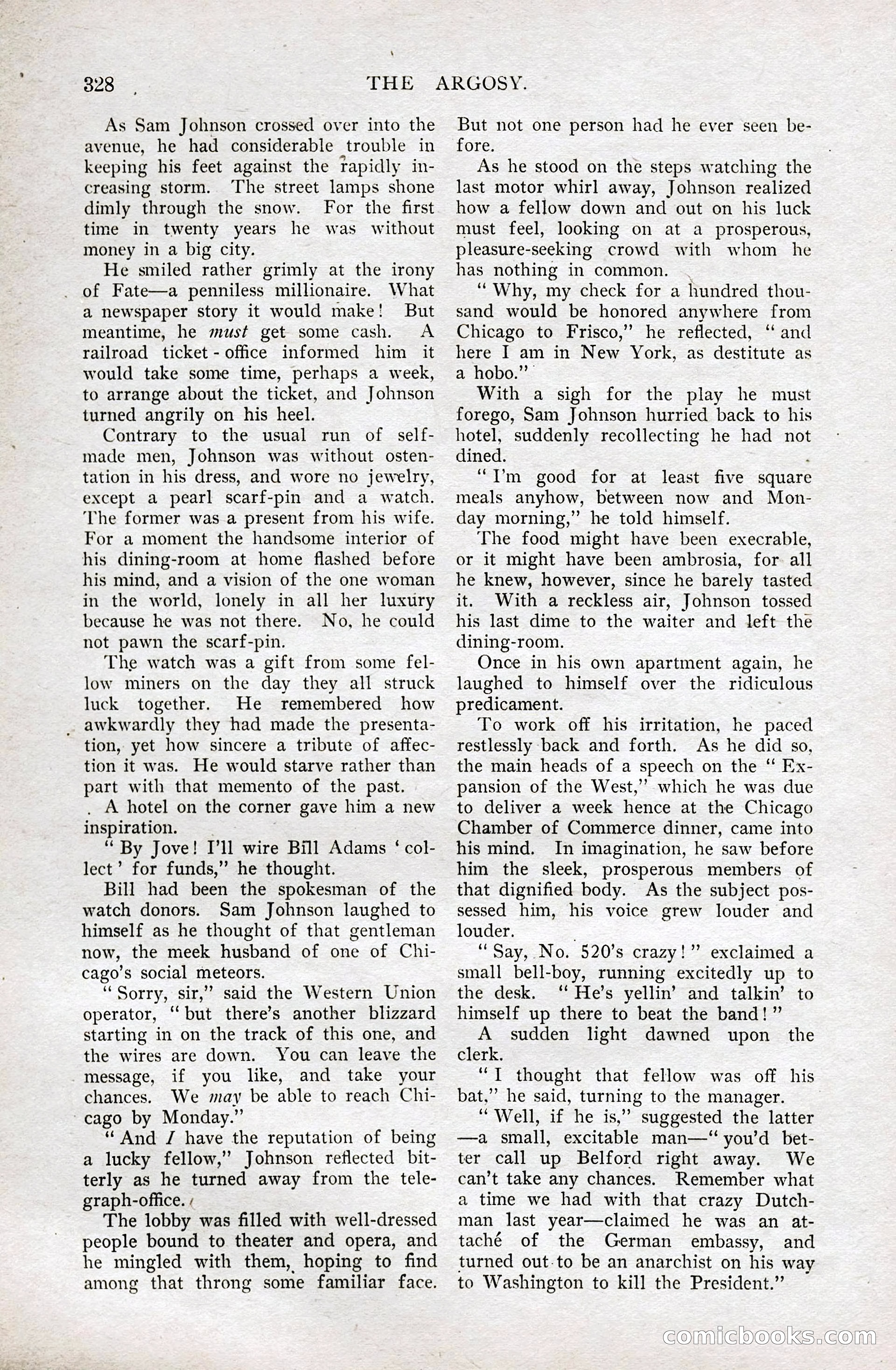
A restored page from Pulp Fiction, 1909. Page through the whole issue in the reader above.
📄 Transcribed text from this page (OCR, searchable)
Machine-transcribed from the original scan — historical spelling and the odd misread are preserved.
328 As Sam Johnson crossed over into the avenue, he had considerable trouble in keeping his feet against the rapidly in- creasing storm. The street lamps shone dimly through the snow. For the first time in twenty years he was without money in a big city. He smiled rather grimly at the irony of Fate—a penniless millionaire. What a newspaper story it would make! But meantime, he must get some cash. <A railroad ticket - office informed him it would take some time, perhaps a week, to arrange about the ticket, and Johnson turned angrily on his heel. Contrary to the usual run of self- made men, Johnson was without osten- tation in his dress, and wore no jewelry, except a pearl scarf-pin and a watch. The former was a present from his wife. For a moment the handsome interior of his dining-room at home flashed before his mind, and a vision of the one woman in the world, lonely in all her luxury because he was not there. No, he could not pawn the scarf-pin. The watch was a gift from some fel- low miners on the day they all struck luck together. He remembered how awkwardly they had made the presenta- tion, yet how sincere a tribute of affec- tion it was. He would starve rather than part with that memento of the past. . A hotel on the corner gave him a new inspiration. ‘By Jove! I'll wire Bill Adams ‘ col- lect’ for funds,” he thought. Bill had been the spokesman of the watch donors. Sam Johnson laughed to himself as he thought of that gentleman now, the meek husband of one of Chi- cago’s social meteors. ‘Sorry, sir,” said the Western Union operator, “but there’s another blizzard starting in on the track of this one, and the wires are down. You can leave the message, if you like, and take your chances. We may be able to reach Chi- cago by Monday.” “ And J have the reputation of being a lucky fellow,’ Johnson reflected bit- terly as he turned away from the tele- graph-office. ; The lobby was filled with well-dressed people bound to theater and opera, and he mingled with them, hoping to find among that throng some familiar face. THE ARGOSY. But not one person had he ever seen be- fore. As he stood on the steps watching the last motor whirl away, Johnson realized how a fellow down and out on his luck must feel, looking on at a prosperous, pleasure-seeking crowd with whom he has nothing in common. . ‘Why, my check for a hundred thou- sand would be honored anywhere from Chicago to Frisco,” he reflected, ‘‘ and here I am in New York, as destitute as a hobo.” With a sigh for the play he must forego, Sam Johnson hurried back to his hotel, suddenly recollecting he had not dined. “I’m good for at least five square meals anyhow, between now and Mon- day morning,” he told himself. The food might have been execrable, or it might have been ambrosia, for. all he knew, however, since he barely tasted it. With a reckless air, Johnson tossed his last dime to the waiter and left the dining-room. Once in his own apartment again, he laughed to himself over the ridiculous predicament. To work off his irritation, he paced restlessly back and forth. As he did so, the main heads of a speech on the ‘ Ex- pansion of the West,’’ which he was due to deliver a week hence at the Chicago Chamber of Commerce dinner, came into his mind. In imagination, he saw before him the sleek, prosperous members of that dignified body. As the subject pos- sessed him, his voice grew louder and louder. “Say, No. 520’s crazy!” exclaimed a small bell-boy, running excitedly up to the desk. ‘“ He’s yellin’ and talkin’ to himself up there to beat the band!” A sudden light dawned upon the clerk. “IT thought that fellow was off his bat,” he said, turning to the manager. “ Well, if he is,” suggested the latter —a small, excitable man—“ you'd bet- ter call up Belford right away. We can’t take any chances. Remember what a time we had with that crazy Dutch- man last year—claimed he was an at- taché of the German embassy, and turned out-to be an anarchist on his way to Washington to kill the President.” NOOK ANG (CO)