
Pulp Fiction, 1909 · page 150 of 227
The Argosy for May — page 150: what you’re looking at
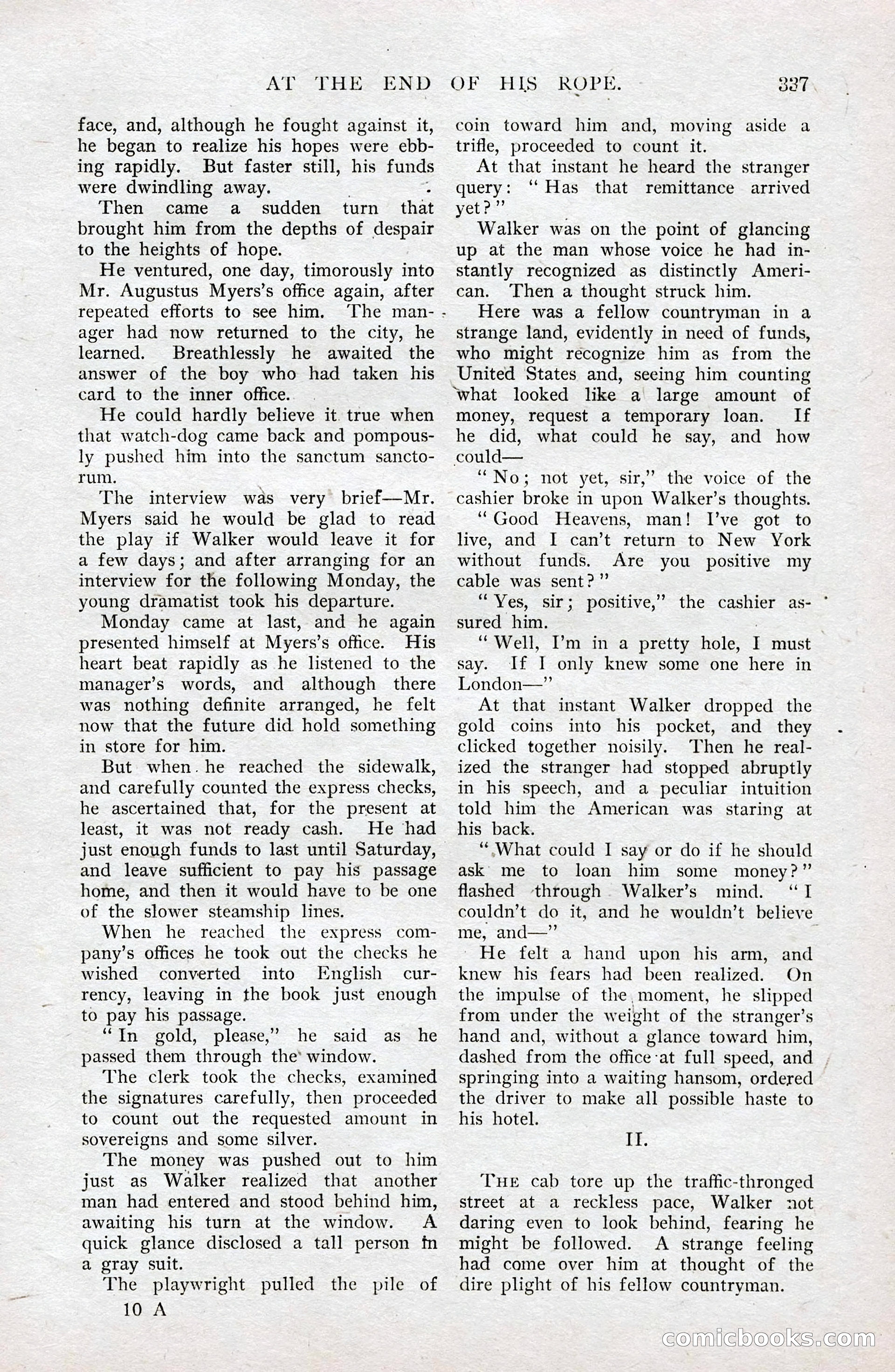
A restored page from Pulp Fiction, 1909. Page through the whole issue in the reader above.
📄 Transcribed text from this page (OCR, searchable)
Machine-transcribed from the original scan — historical spelling and the odd misread are preserved.
AT THE END face, and, although he fought against it, he began to realize his hopes were ebb- ing rapidly. But faster still, his funds were dwindling away. Then came a_ sudden turn that brought him from the depths of despair to the heights of hope. He ventured, one day, timorously into Mr. Augustus Myers’s office again, after repeated efforts to see him. ‘The man- - ager had now returned to the city, he learned. Breathlessly he awaited the answer of the boy who had taken his card to the inner office. | He could hardly believe it. true when that watch-dog came back and pompous- ly pushed him into the sanctum sancto- rum. . The interview was very brief—Mr. Myers said he would be glad to read the play if Walker would leave it for a few days; and after arranging for an interview for the following Monday, the young dramatist took his departure. Monday came at last, and he again presented himself at Myers’s office. His heart beat rapidly as he listened to the manager’s words, and although there was nothing definite arranged, he felt now that the future did hold something in store for him. But when.he reached the sidewalk, and carefully counted the express checks, he ascertained that, for the present at least, it was not ready cash. He had just enough funds to last until Saturday, and leave sufficient to pay his passage home, and then it would have to be one of the slower steamship lines. When he reached the express com- pany’s offices he took out the checks he wished converted into [English cur- rency, leaving in the book just enough to pay his passage. ‘In gold, please,’ he said as he passed them through the’ window. The clerk took the checks, examined the signatures carefully, then proceeded to count out the requested amount in sovereigns and some silver. The money was pushed out to him just as Walker realized that another man had entered and stood behind him, awaiting his turn at the window. A quick glance disclosed a tall person fn a gray suit. The playwright pulled the pile of 10 A OF HIS ROPE. el coin toward him and, moving aside a trifle, proceeded to count it. At that instant he heard the stranger query: ‘Has that remittance arrived Vers: Walker was on the point of glancing up at the man whose voice he had in- stantly recognized as distinctly Ameri- can. Then a thought struck him. Here was a fellow countryman in a strange land, evidently in need of funds, who might recognize him as from the United States and, seeing him counting ‘what looked like a large amount of money, request a temporary loan. If he did, what could he say, and how could— “No; not yet, sir,” the voice of the cashier broke in upon Walker’s thoughts. ‘“Good Heavens, man! I’ve got to live, and I can’t return to New York without funds. Are you positive my cable was sent?” “Yes, sir; positive,” sured him. | “Well, I’m in a pretty hole, I must say. If I only knew some one here in London—”’ At that instant Walker dropped the gold coins into his pocket, and they clicked together noisily. Then he real- ized the stranger had stopped abruptly in his speech, and a peculiar intuition told him the American was staring at his back. “What could I say or do if he should ask me to loan him some money?” flashed through. Walker’s mind. “I couldn’t do it, and he wouldn’t believe me, and—”’ He felt a hand upon his arm, and knew his fears had been realized. On the impulse of the, moment, he slipped from under the w eight of the stranger’s hand and, without a glance toward him, dashed from the office-at full speed, and springing into a waiting hansom, ordered the driver to make all possible haste to his hotel. 7 IT. THE cab tore up the traffic-thronged street at a reckless pace, Walker not daring even to look behind, fearing he might be followed. A strange feeling had come over him at thought of the dire plight of his fellow countryman. (eO) NOOK ANG the cashier as- ° (C@ S|