
Pulp Fiction, 1909 · page 39 of 227
The Argosy for May — page 39: what you’re looking at
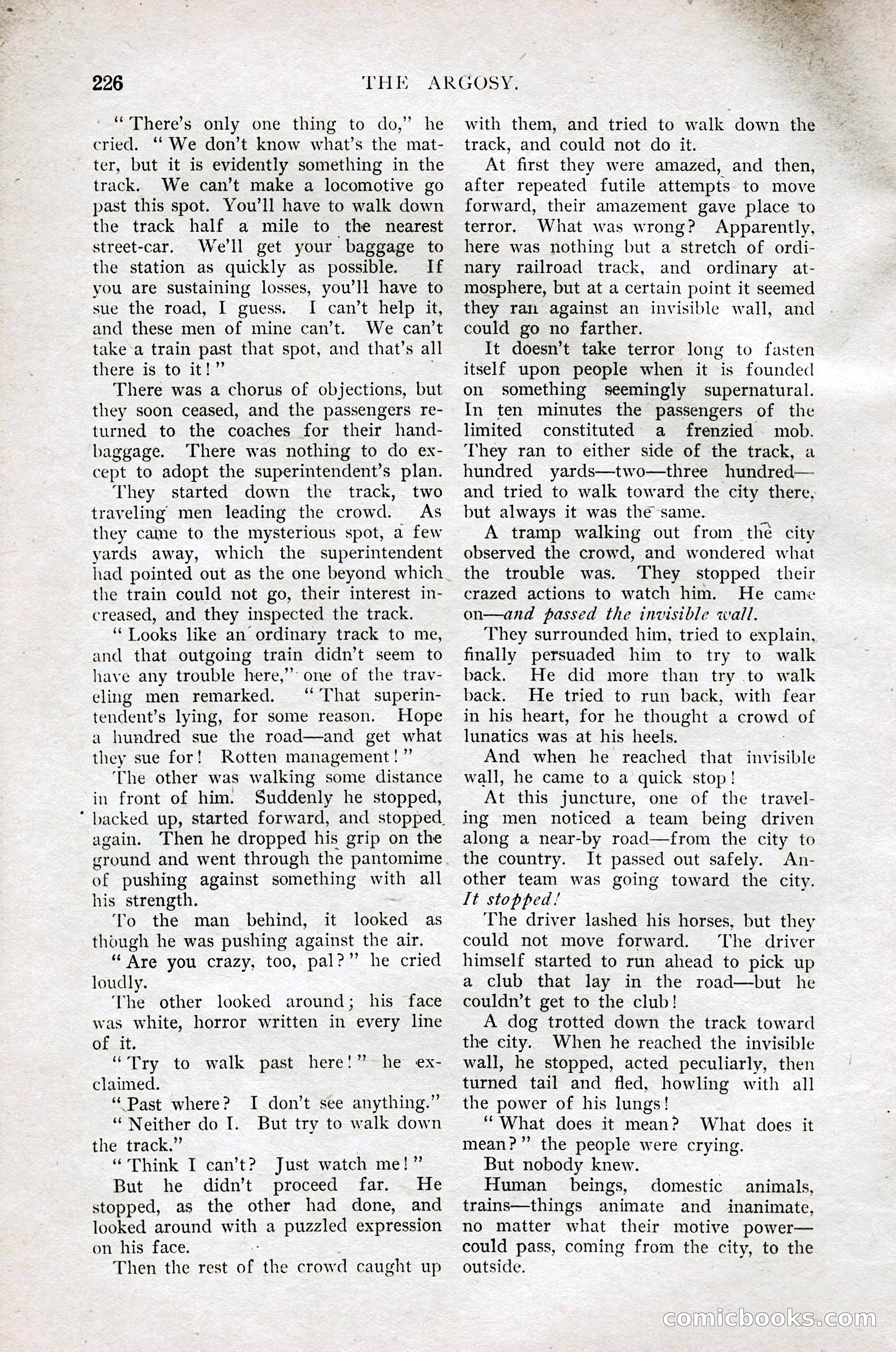
A restored page from Pulp Fiction, 1909. Page through the whole issue in the reader above.
📄 Transcribed text from this page (OCR, searchable)
Machine-transcribed from the original scan — historical spelling and the odd misread are preserved.
226 THE ‘There’s only one thing to do,” he cried. “‘ We don’t know what’s the mat- ter, but it is evidently something in the track. We can’t make a locomotive go past this spot. You'll have to walk down the track half a mile to the nearest street-car. We'll get your baggage to the station as quickly as possible. If you are sustaining losses, you’ll have to sue the road, I guess. I can’t help it, and these men of mine can’t. We can’t take a train past that spot, and that’s all there is to it!” There was a chorus of objections, but they soon ceased, and the passengers re- turned to the coaches for their hand- baggage. There was nothing to do ex- cept to adopt the superintendent’s plan. They started down the track, two traveling men leading the crowd. As they came to the mysterious spot, a few yards away, which the superintendent had pointed out as the one beyond which. the train could not go, their interest in- creased, and they inspected the track. ‘Looks like an ordinary track to me, and that outgoing train didn’t seem to have any trouble here,” one of the trav- eling men remarked. “ That superin- tendent’s lying, for some reason. Hope a hundred sue the road—and get what they sue for! Rotten management!” The other was walking some distance in front of him. Suddenly he stopped, ‘ backed up, started forward, and stopped again. Then he dropped his grip on the ground and went through the pantomime of pushing against something with all his strength. To the man behind, it looked as though he was pushing against the air. “Are you crazy, too, pal?” he cried loudly. The other looked around; his face was white, horror written in every line of it. “Try to walk past here!” claimed. ‘Past where? “Neither do I. the track.” | “Think I can’t? Just watch me!” But he didn’t proceed far. He stopped, as the other had done, and looked around with a puzzled expression on his face. Then the rest of the crowd caught up he ex- I don’t see anything.” But try to walk down ARGOSY. with them, and tried to walk down the track, and could not do it. At first they were amazed, and then, after repeated futile attempts to move forward, their amazement gave place to terror. What was wrong? Apparently, here was nothing but a stretch of ordi- nary railroad track, and ordinary at- mosphere, but at a certain point it seemed they rati against an invisible wall, and could go no farther. It doesn’t take terror long to fasten itself upon people when it is founded on something seemingly supernatural. In ten minutes the passengers of the limited constituted a frenzied mob. They ran to either side of the track, a hundred yards—two—three hundred— and tried to walk toward the city there, but always it was the same. A tramp walking out from the city observed the crowd, and wondered what the trouble was. They stopped their crazed actions to watch him. He came on—and passed the invisible wall. They surrounded him, tried to explain, finally persuaded him to try to walk back. He did more than try to walk back. He tried to run back, with fear in his heart, for he thought a oous of lunatics was at his heels. And when he reached that invisible wall, he came to a quick stop! At this juncture, one of the travel- ing men noticed a team being driven along a near-by road—from the city to the country. It passed out safely. An- other team was going toward the city. It stopped! The driver lashed his horses, but they could not move forward. ‘The driver himself started to run ahead to pick up a club that lay in the road—but he couldn’t get to the club! A dog trotted down the track toward the city. When he reached the invisible wall, he stopped, acted peculiarly, then turned tail and fled, howling with all the power of his lungs! ‘What does it mean? What does it mean?’’ the people were crying. But nobody knew. Human beings, domestic animals, trains—things animate and inanimate, no matter what their motive power— could pass, coming from the city, to the outside. WOOK (C@)