
Pulp Fiction, 1909 · page 41 of 227
The Argosy for May — page 41: what you’re looking at
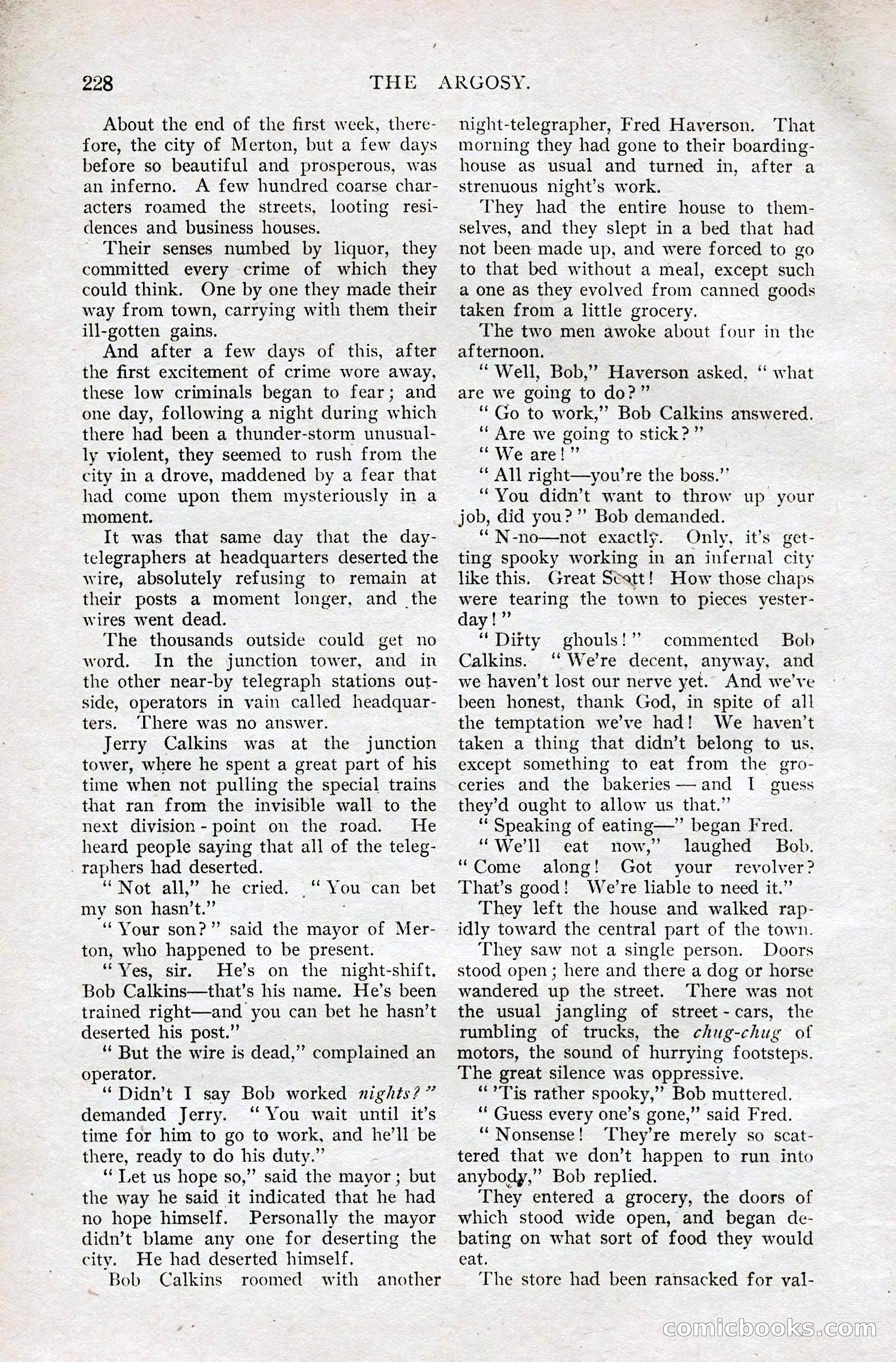
A restored page from Pulp Fiction, 1909. Page through the whole issue in the reader above.
📄 Transcribed text from this page (OCR, searchable)
Machine-transcribed from the original scan — historical spelling and the odd misread are preserved.
228 THE About the end of the first week, there- fore, the city of Merton, but a few days before so beautiful and prosperous, was an inferno. A few hundred coarse char- acters roamed the streets, looting resi- dences and business houses. Their senses numbed by liquor, they committed every crime of which they could think. One by one they made their way from town, carrying with them their ill-gotten gains. And after a few days of this, after the first excitement of crime wore away, these low criminals began to fear; and one day, following a night during which there had been a thunder-storm unusual- ly violent, they seemed to rush from the city in a drove, maddened by a fear that had come upon them mysteriously in a moment, It was that same day that the day- telegraphers at headquarters deserted the wire, absolutely refusing to remain at their posts a moment longer, and the wires went dead. The thousands outside could get no word. In the junction tower, and in the other near-by telegraph stations out- side, operators in vain called headquar- ters. ‘There was no answer. Jerry Calkins was at the junction tower, where he spent a great part of his time when not pulling the special trains that ran from the invisible wall to the next division- point on the road. He heard people saying that all of the teleg- _ raphers had deserted. “Not all,” he cried. my son hasn’t.”’ “Your son?” said the mayor of Mer- ton, who happened to be present. “Yes, sir. He’s on the night-shift. Bob Calkins—that’s his name. He’s been trained right—and you can bet he hasn’t deserted his post.” ‘** But the wire is dead,”’ complained an operator. “Didn't I say Bob worked nights?” demanded Jerry. ‘“ You wait until it’s time for him to go to work, and he’ll be there, ready to do his duty.” ‘Let us hope so,” said the mayor ; but the way he said it indicated that he had no hope himself. Personally the mayor didn’t blame any one for deserting the city. He had deserted himself. Bob Calkins roomed with “You can bet another ARGOSY. night-telegrapher, Fred Haverson. That morning they had gone to their boarding- house as usual and turned in, after a strenuous night’s work. They had the entire house to them- selves, and they slept in a bed that had not been made up, and were forced to go to that bed without a meal, except such a one as they evolved from canned goods taken from a little grocery. The two men awoke about four in the afternoon. “ Well, Bob,” Haverson asked, ‘‘ what are we going to do?” ‘Go to work,” Bob Calkins answered. ‘‘ Are we going to stick?” ‘We are!” ‘ All right—you’re the boss.”’ “You didn’t want to throw up your job, did you?” Bob demanded. “ N-no—not exactly. Only, it’s get- ting spooky working in an infernal city like this. Great Seatt! How those chaps were tearing the town to pieces yester- day!” “Dirty ghouls!” commented Bob Calkins. “ We’re decent, anyway, and we haven’t lost our nerve yet. And we've been honest, thank God, in spite of all the temptation we’ve had! We haven't taken a thing that didn’t belong to us, except something to eat from the gro- ceries and the bakeries—and I guess they’d ought to allow us that.” ‘‘ Speaking of eating—” began Fred. “We'll eat now,’ laughed Bob. ‘Come along! Got your revolver? That’s good! We're liable to need it.” They left the house and walked rap- idly toward the central part of the town. They saw not a single person. Doors stood open ; here and there a dog or horse wandered up the street. There was not the usual jangling of street-cars, the rumbling of trucks, the chug-chug of motors, the sound of hurrying footsteps. The great silence was oppressive. “*’Tis rather spooky,” Bob muttered. ‘“ Guess every one’s gone,” said Fred. “Nonsense! ‘They’re merely so scat- tered that we don’t happen to run into anybody,” Bob replied. They entered a grocery, the doors of which stood wide open, and began de- bating on what sort of food they would eat. The store had been ransacked for val- GomiGcbdooks G (C@