
Pulp Fiction, 1909 · page 56 of 227
The Argosy for May — page 56: what you’re looking at
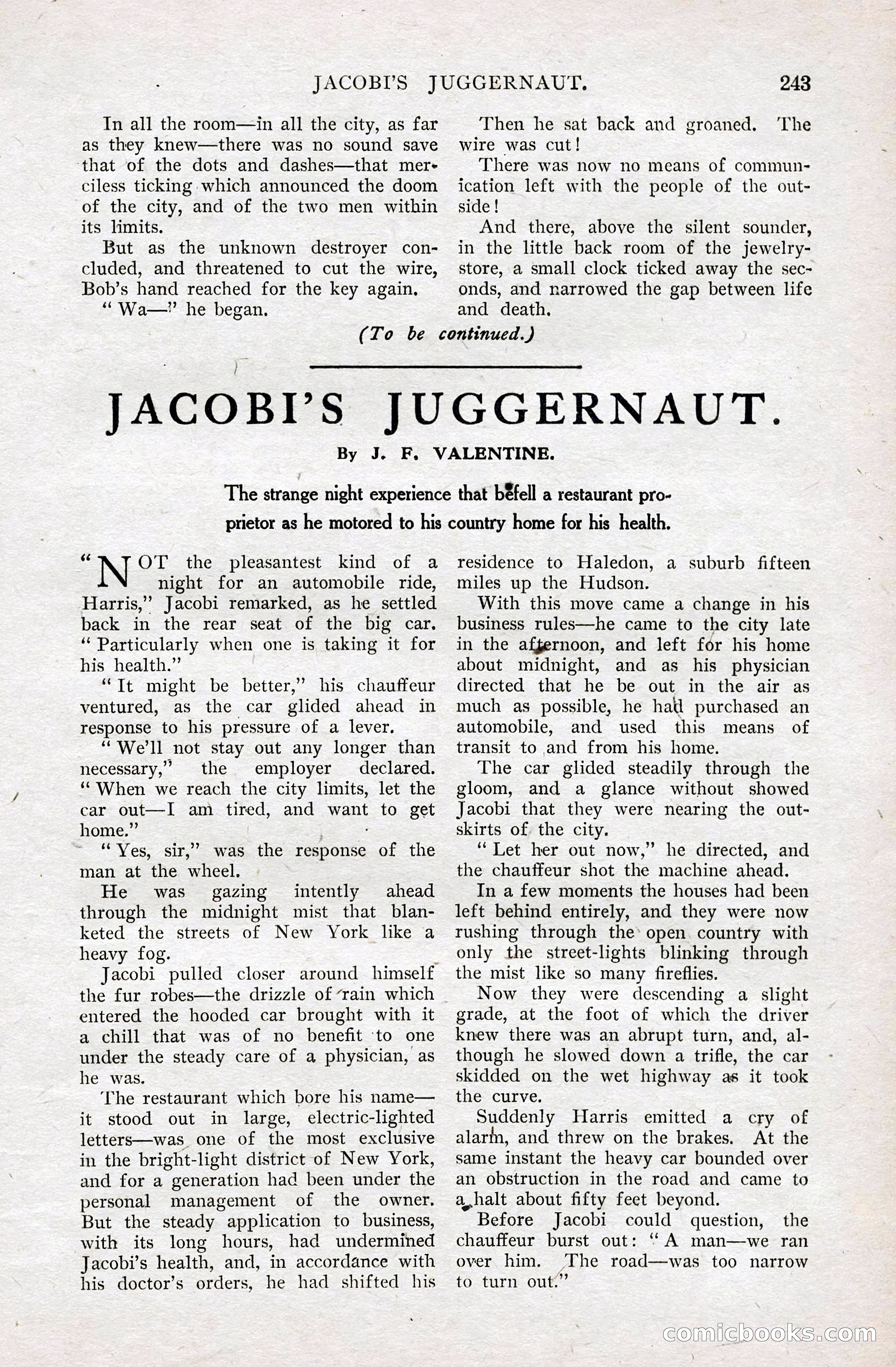
A restored page from Pulp Fiction, 1909. Page through the whole issue in the reader above.
📄 Transcribed text from this page (OCR, searchable)
Machine-transcribed from the original scan — historical spelling and the odd misread are preserved.
JACOBY’S JUGGERNAUT. In all the room—in all the city, as far as they knew—there was no sound save that of the dots and dashes—that mer- ciless ticking which announced the doom of the city, and of the two men within its limits. But as the unknown destroyer con- cluded, and threatened to cut the wire, Bob’s hand reached for the key again. “Wa—” he began. 243 Then he sat back and groaned. The Wire was cut! There was now no means of commun- ication left with the people of the out- side ! And there, above the silent sounder, in the little back room of the jewelry- store, a small clock ticked away the sec- onds, and narrowed the gap between life and death, : (To be continued.) JACOBI’S JUGGERNAUT. By J. F. VALENTINE. The strange night experience that befell a restaurant pro- prietor as he motored to his country home for his health. = NE SE the pleasantest kind of a night for an automobile ride, Harris,” Jacobi remarked, as he settled back in the rear seat of the big car. “Particularly when one is taking it for his health.” “Tt might be better,” his chauffeur ventured, as the car glided ahead in response to his pressure of a lever. “We'll not stay out any longer than necessary,” the employer declared. ‘When we reach the city limits, let the car out—I am tired, and want to get home.” : ‘““'Yes, sir,” was the response of the man at the wheel. He was’ gazing intently ahead through the midnight mist that blan- keted the streets of New York like a heavy fog. ? Jacobi pulled closer around himself the fur robes—the drizzle of ‘rain which entered the hooded car brought with it a chill that was of no benefit to one under the steady care of a physician, as he was. The restaurant which bore his name— it stood out in large, electric-lighted letters—was one of the most exclusive in the bright-light district of New York, and for a generation had been under the personal management of the owner. But the steady application to business, with its long hours, had undermined Jacobi’s health, and, in accordance with his doctor’s orders, he had shifted his residence to Haledon, a suburb fifteen miles up the Hudson. With this move came a change in his business rules—he came to the city late in the afgernoon, and left for his home about midnight, and as his physician directed that he be out in the air as much as possible, he had purchased an automobile, and used this means of transit to and from his home. The car glided steadily through the gloom, and a glance without showed Jacobi that they were nearing the out- skirts of. the city. ‘Let her out now,” he directed, and the chauffeur shot the machine ahead. In a few moments the houses had been left behind entirely, and they were now rushing through the’ open country with only the street-lights blinking through the mist like so many fireflies. Now they were descending a slight grade, at the foot of which the driver knew there was an abrupt turn, and, al- though he slowed down a trifle, the car skidded on the wet highway as it took the curve. Suddenly Harris emitted a cry of alarm, and threw on the brakes. At the same instant the heavy car bounded over an obstruction in the road and came to a.halt about fifty feet beyond. Before Jacobi could question, the chauffeur burst out: “ A man—we ran over him. ‘The road—was too narrow to turn out.” 1 DOOLK (C@