
Pulp Fiction, 1909 · page 67 of 227
The Argosy for May — page 67: what you’re looking at
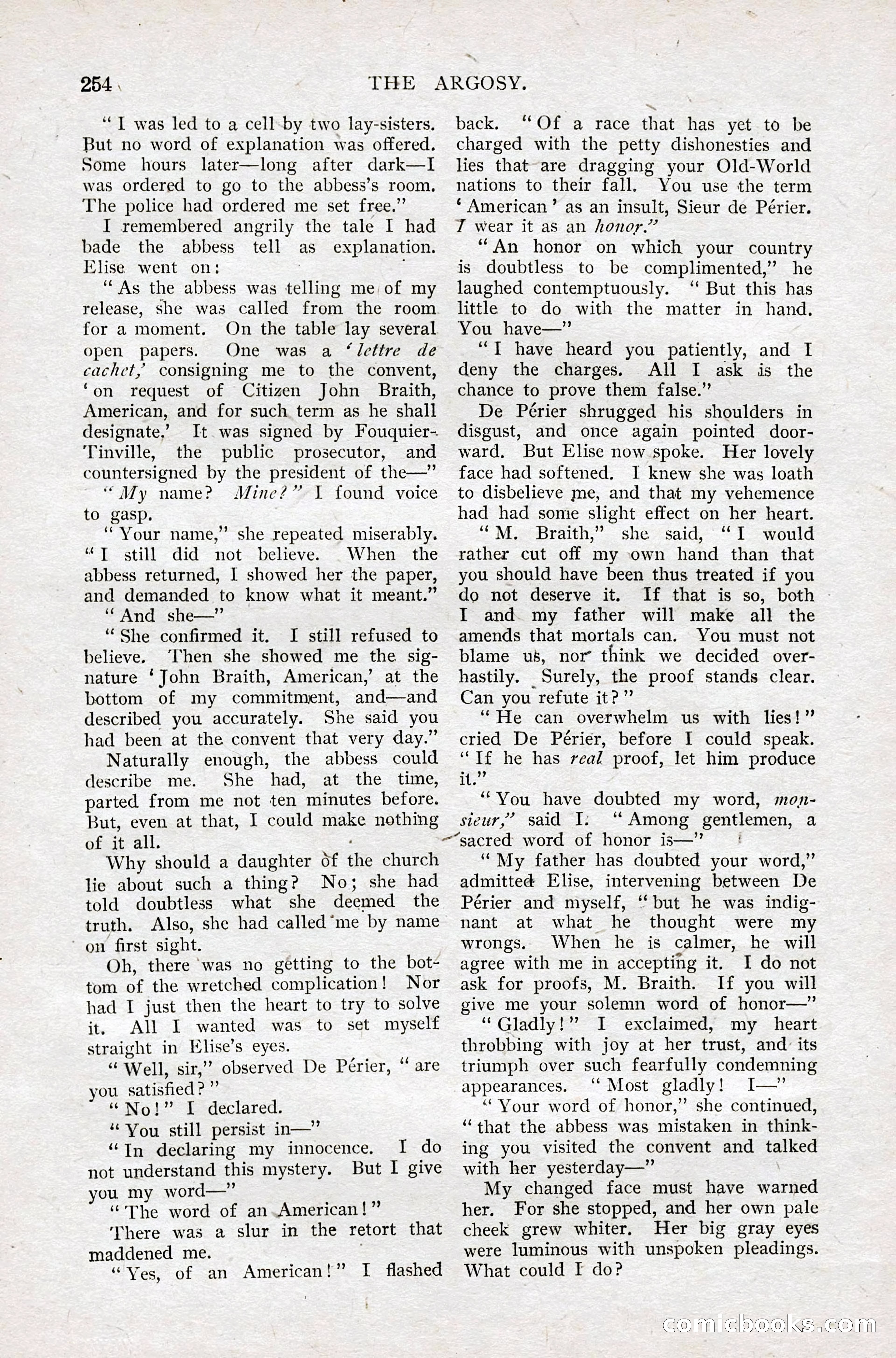
A restored page from Pulp Fiction, 1909. Page through the whole issue in the reader above.
📄 Transcribed text from this page (OCR, searchable)
Machine-transcribed from the original scan — historical spelling and the odd misread are preserved.
254 | ‘“T was led to a cell by two lay-sisters. But no word of explanation was offered. Some hours later—long after dark—I was ordered to go to the abbess’s room. The police had ordered me set free.” I remembered angrily the tale I had bade the abbess tell as explanation. Elise went on: , “As the abbess was telling me of my release, she was called from the room for a moment. On the table lay several open papers. One was a ‘lettre de cachet, consigning me to the convent, ‘on request of Citizen John Braith, American, and for such term as he shall designate,’ It was signed by Fouquier- Tinville, the public prosecutor, and countersigned by the president of the—” “My name? Mine?” 1 found voice to gasp. “Your name,” she repeated miserably. “YT still did not believe. When the abbess returned, I showed her the paper, and demanded to know what it meant.” “And she—” ‘She confirmed it. I still refused to believe. ‘Then she showed me the sig- nature ‘John Braith, American,’ at the bottom of my commitment, and—and described you accurately. She said you had been at the convent that very day.” Naturally enough, the abbess could describe me. She had, at the time, parted from me not ten minutes before. But, even at that, I could make nothing of it all. Why should a daughter of the church lie about such a thing? No; she had told doubtless what she deemed the truth. Also, she had called°me by name on first sight. Oh, there was no gétting to the bot- tom of the wretched complication! Nor had I just then the heart to try to solve it, All I wanted was to set myself straight in Elise’s eyes. “Well, sir,” observed De Périer, “ ou satisfied?” “No!” I declared. “Vou still persist in—” “Tn declaring my innocence. I do not understand this mystery. But I give ou my word—” “The word of an.American There was a slur in the retort that maddened me. “Ves of an American!” I flashed ? are {?? ask for proofs, M. Braith. THE ARGOSY. back. ‘Of a race that has yet to be charged with the petty dishonesties and lies that-are dragging your Old-World nations to their fall. You use the term ‘American’ as an insult, Sieur de Périer. 7 wear it as an honor.” “An honor on which your country is doubtless to be complimented,” he laughed contemptuously. “ But this has little to do with the matter in hand. You have—” ‘IT have heard you patiently, and I deny the charges. All I ask is the chance to prove them false.” De Périer shrugged his shoulders in disgust, and once again pointed door- ward. But Elise now spoke. Her lovely face had softened. I knew she was loath to disbelieve me, and that my vehemence had had some slight effect on her heart. ‘““M. Braith,”’ she said, ‘I would rather cut off my own hand than that you should have been thus treated if you do not deserve it. I and. my father will make all the amends that mortals can. You must not blame us, nor’ think we decided over- hastily. Surely, the proof stands clear. Can you refute it?” ‘““He can overwhelm us with lies!” cried De Périéer, before I could speak. “Tf he has real proof, let him produce Its ‘You have doubted my word, mon- sieur,’ said I: “ Among gentlemen, a ~“sacred word of honor is—’’ “My father has doubted your word,” admitted Elise, intervening between De Périer and myself, ‘‘ but he was indig- nant at what he thought were my wrongs. When he is calmer, he will agree with me in accepting it. I do not If you will give me your solemn word of honor—” “Gladly!”” I exclaimed, my heart throbbing with joy at her trust, and its triumph over such fearfully condemning appearances. ‘‘ Most gladly! I—’” ‘““VYour word of honor,” she continued, “that the abbess was mistaken in think- ing you visited the convent and talked with her yesterday—” My changed face must have warned her. For she stopped, and her own pale cheek grew whiter. Her big gray eyes were luminous with unspoken pleadings. What could I do? COnniclo@ol< If that is so, both - CO)