
Pulp Fiction, 1909 · page 73 of 227
The Argosy for May — page 73: what you’re looking at
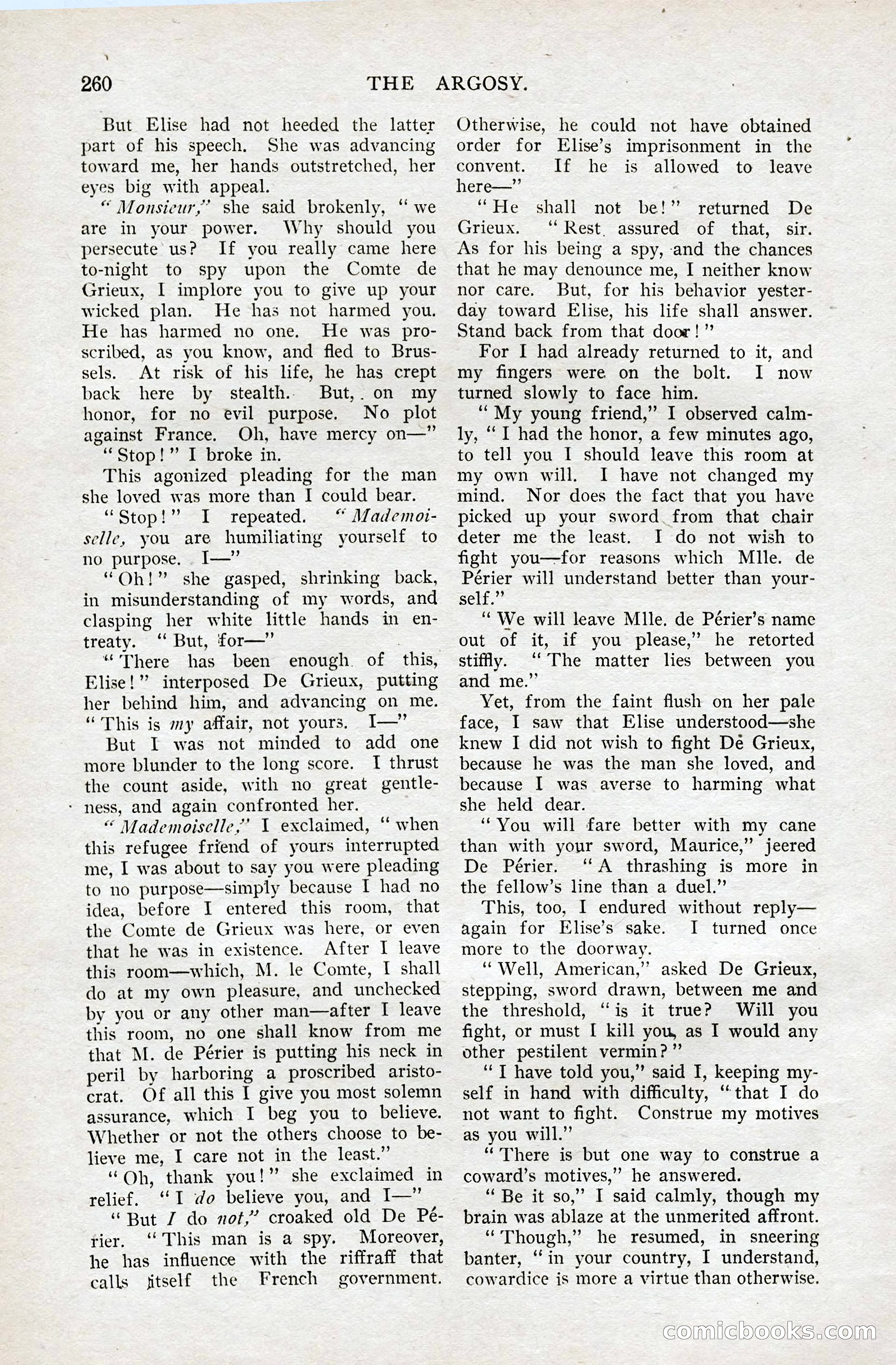
A restored page from Pulp Fiction, 1909. Page through the whole issue in the reader above.
📄 Transcribed text from this page (OCR, searchable)
Machine-transcribed from the original scan — historical spelling and the odd misread are preserved.
\ 260 But Elise had not heeded the latter part of his speech. She was advancing toward me, her hands outstretched, her eyes big with appeal. “ Monsieur,’ she said brokenly, “ are in your power. Why should you persecute us? If you really came here to-night to spy upon the Comte de Grieux, [ implore you to give up your wicked plan. He has not harmed you. He has harmed no one. He was pro- scribed, as you know, and fled to Brus- we sels. At risk of his life, he has crept back here by stealth. But,. on my honor, for no evil purpose. No plot against France. Oh, have mercy on—” “Stop!” I broke in. This agonized pleading for the man she loved was more than I could bear. “Stop!” I repeated. “ AZademot- selle, you are humiliating yourself to no purpose. I—”’ “Oh!” she gasped, shrinking back, in misunderstanding of my words, and clasping her white little hands in en- treaty. ‘‘ But, for—” “There has been Elise!” interposed De Grieux, putting her behind him, and advancing on me. “This is my affair, not yours, I—’ But I was not minded to add one more blunder to the long score. I thrust the count aside, with no great gentle- - ness, and again confronted her. “ Mademoiselle,’ 1 exclaimed, ‘ when this refugee friend of yours interrupted me, I was about to say you were pleading to no purpose—simply because I had no idea, before I entered this room, that the Comte de Grieux was here, or even that he was in existence. After I leave this room—which, M. le Comte, I shall do at my own pleasure, and unchecked by you or any other man—after I leave this room, no one shall know from me that M. de Périer is putting his neck in peril by harboring a proscribed aristo- crat. Of all this I give you most solemn assurance, which I beg you to believe. Whether or not the others choose to be- lieve me, I care not in the least.” “Oh, thank you!’’ she exclaimed in relief. ‘I do believe you, and I—” “But J do not,” croaked old De Pe- Moreover, rier. ‘“‘ This man is a spy. he has influence with the riffraff that calls jitself the French government. enough. of this, THE ARGOSY. Otherwise, he could not have obtained order for Elise’s imprisonment in the convent. If he is allowed to leave here—”’ “He shall not be!” returned De Grieux. ‘Rest. assured of that, sir. As for his being a spy, -and the chances that he may denounce me, I neither know nor care. But, for his behavior yester- day toward Elise, his life shall answer. Stand back from that door!” For I had already returned to it, and my fingers were on the bolt. I now turned slowly to face him. “My young friend,” I observed calm- ly, “ I had the honor, a few minutes ago, to tell you I should leave this room at my own will. I have not changed my mind. Nor does the fact that you have picked up your sword. from that chair deter me the least. I do not wish to fight you—for reasons which Mlle. de Périer will understand better than your- self.” ‘We will leave Mlle. de Périer’s name out of it, if you please,” he retorted stiffly. “The matter lies between you and me.” Yet, from the faint flush on her pale face, I saw that Elise understood—she knew I did not wish to fight De Grieux, because he was the man she loved, and because I was averse to harming what she held dear. “You will fare better with my cane than with your sword, Maurice,” jeered De Périer. ‘A thrashing is more in the fellow’s line than a duel.” This, too, I endured without reply— again for Elise’s sake. I turned once more to the doorway. ‘Well, American,” asked De Grieux, stepping, sword drawn, between me and the threshold, “is it true? Will you fight, or must [ kill you, as I would any other pestilent vermin? ”’ ‘‘T have told you,” said I, keeping my- self in hand with difficulty, “that I do not want to fight. Construe my motives as you will.” “There is but one way to construe a coward’s motives,” he answered. ‘Be it so,” I said calmly, though my brain was ablaze at the unmerited affront. “Though,” he resumed, in sneering banter, “in your country, I understand, cowardice is more a virtue than otherwise. 9)(0)(6) ANG SS co