
Pulp Fiction, 1912 · page 110 of 276
The Argosy, Christmas 1912 — page 110: what you’re looking at
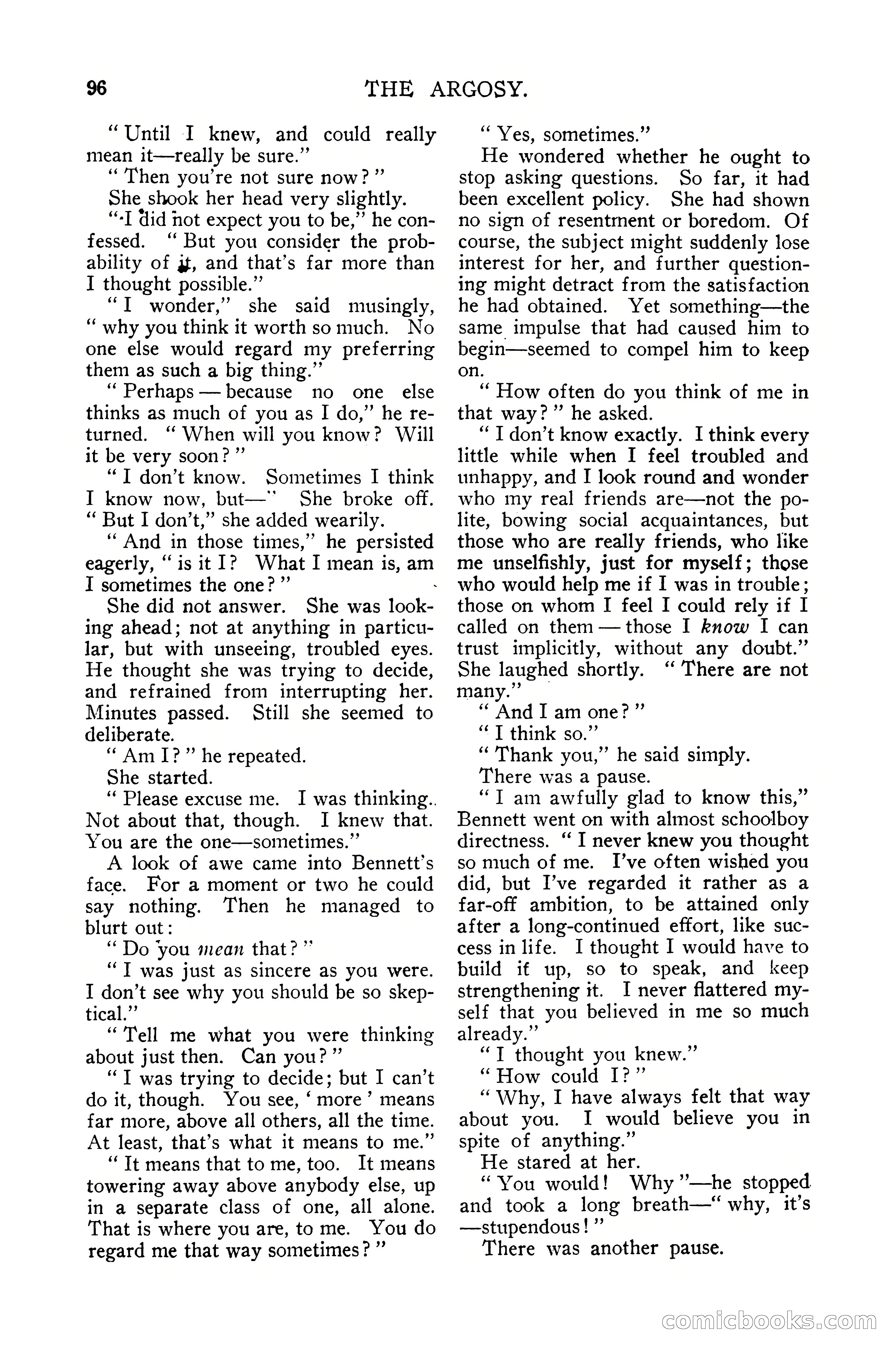
A restored page from Pulp Fiction, 1912. Page through the whole issue in the reader above.
📄 Transcribed text from this page (OCR, searchable)
Machine-transcribed from the original scan — historical spelling and the odd misread are preserved.
96 “Until I knew, and could really mean it—really be sure.” “Then you’re not sure now? ” She shook her head very slightly. “.T did not expect you to be,” he con- fessed. ‘“‘ But you consider the prob- ability of gy, and that’s far more than I thought possible.” “IT wonder,’ she said musingly, “why you think it worth somuch. No one else would regard my preferring them as such a big thing.” “ Perhaps — because no one else thinks as much of you as I do,” he re- turned. “ When will you know? Will it be very soon? ” “I don’t know. Sometimes I think I know now, but—" She broke off. “ But I don’t,” she added wearily. ‘And in those times,” he persisted eagerly, “is it]? What I mean is, am I sometimes the one? ”’ She did not answer. She was look- ing ahead; not at anything in particu- lar, but with unseeing, troubled eyes. He thought she was trying to decide, and refrained from interrupting her. Minutes passed. Still she seemed to deliberate. “Am I?” he repeated. She started. ‘““ Please excuse me. I was thinking.. Not about that, though. I knew that. You are the one—sometimes.”’ A look of awe came into Bennett's face. For a moment or two he could say nothing. Then he managed to blurt out: “ Do ‘you mean that ?”’ “T was just as sincere as you were. I don’t see why you should be so skep- tical.” “Tell me what you were thinking about just then. Can you?” ‘“T was trying to decide; but I can’t do it, though. You see, ‘ more’ means far more, above all others, all the time. At least, that’s what it means to me.” “Tt means that to me, too. It means towering away above anybody else, up in a separate class of one, all alone. That is where you are, to me. You do regard me that way sometimes?” THE ARGOSY. ‘Yes, sometimes.” He wondered whether he ought to stop asking questions. So far, it had been excellent policy. She had shown no sign of resentrnent or boredom. Of course, the subject might suddenly lose interest for her, and further question- ing might detract from the satisfaction he had obtained. Yet something—the same impulse that had caused him to begin—seemed to compel him to keep on. “How often do you think of me in that way?” he asked. “J don’t know exactly. I think every little while when I feel troubled and unhappy, and I look round and wonder who my real friends are—not the po- lite, bowing social acquaintances, but those who are really friends, who like me unselfishly, just for myself; those who would help me if I was in trouble; those on whom [ feel I could rely if I called on them — those I know I can trust implicitly, without any doubt.” She laughed shortly. “ There are not many.” “And Iam one?” “T think so.” “ Thank you,” he said simply. There was a pause. “JT am awfully glad to know this,” Bennett went on with almost schoolboy directness. “ I never knew you thought so much of me. I’ve often wished you did, but I’ve regarded it rather as a far-off ambition, to be attained only after a long-continued effort, like suc- cess in life. I thought I would have to build if up, so to speak, and keep strengthening it. I never flattered my- self that you believed in me so much already.” “T thought you knew.” “How could [?” “Why, I have always felt that way about you. I would believe you in spite of anything.” He stared at her. “Vou would! Why ”—he stopped and took a long breath—“ why, it’s —stupendous!”’ There was another pause. CoOMmicbook CO