
Pulp Fiction, 1912 · page 117 of 276
The Argosy, Christmas 1912 — page 117: what you’re looking at
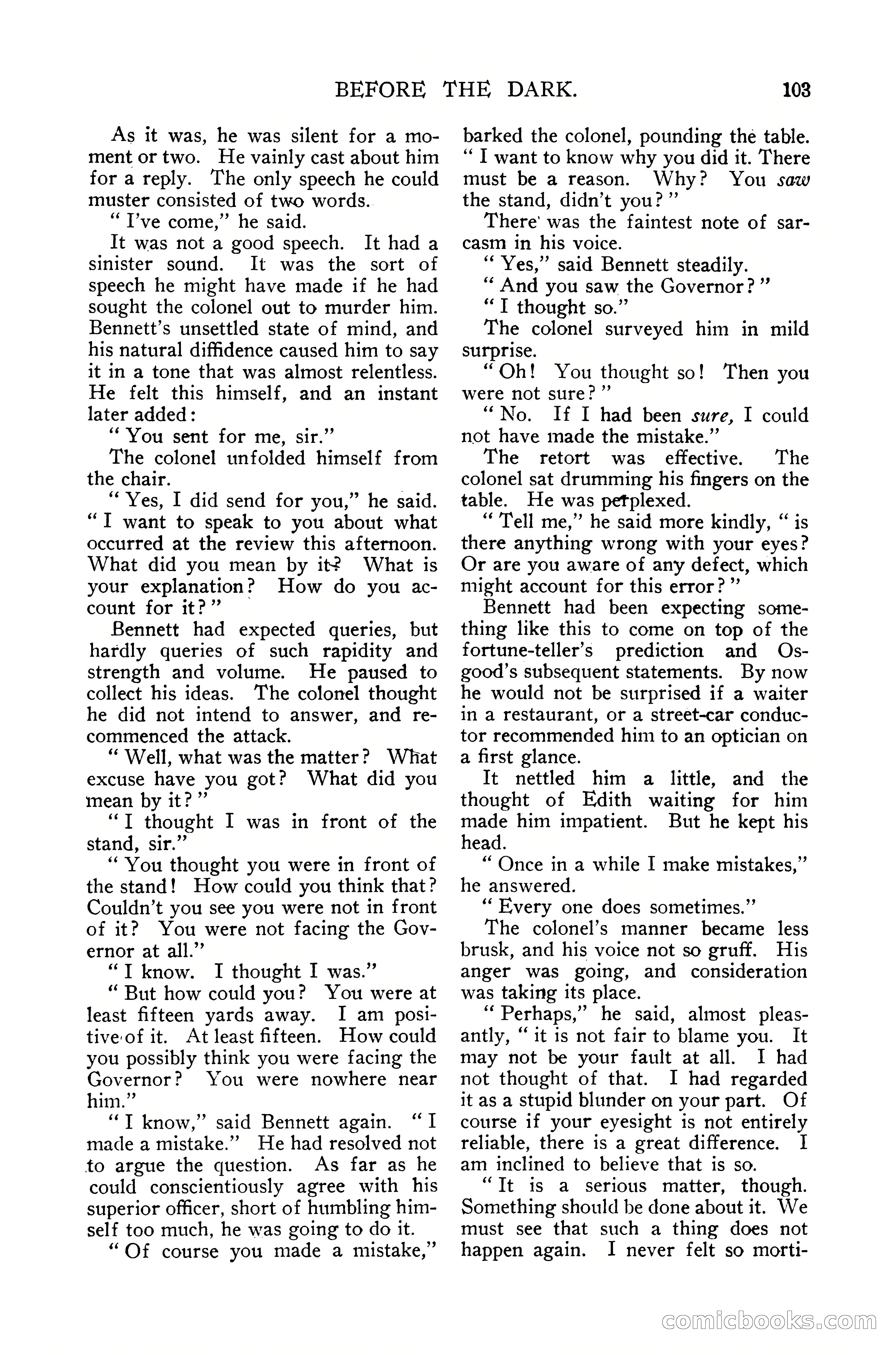
A restored page from Pulp Fiction, 1912. Page through the whole issue in the reader above.
📄 Transcribed text from this page (OCR, searchable)
Machine-transcribed from the original scan — historical spelling and the odd misread are preserved.
BEFORE THE DARK. As it was, he was silent for a mo- ment or two. He vainly cast about him for a reply. The only speech he could muster consisted of two words. “ T’ve come,” he said. It was not a good speech. It had a sinister sound. It was the sort of speech he might have made if he had sought the colonel out to murder him. Bennett’s unsettled state of mind, and his natural diffidence caused him to say it in a tone that was almost relentless. He felt this himself, and an instant later added: “You sent for me, sir.” The colonel unfolded himself from the chair. “Yes, I did send for you,” he said. “TI want to speak to you about what occurred at the review this afternoon. What did you mean by it? What is your explanation? How do you ac- count for it?” Bennett had expected queries, but hardly queries of such rapidity and strength and volume. He paused to collect his ideas. The colonel thought he did not intend to answer, and re- commenced the attack. *“ Well, what was the matter? What excuse have you got? What did you mean by it?” “T thought I was in front of the stand, sir.” “You thought you were in front of the stand! How could you think that? Couldn’t you see you were not in front of it? You were not facing the Gov- ernor at all.” “T know. I thought I was.” “But how could you? You were at least fifteen yards away. I am posi- tive of it. At least fifteen. How could you possibly think you were facing the Governor? You were nowhere near him.” ‘““‘T know,” said Bennett again. “TI made a mistake.” He had resolved not to argue the question. As far as he could conscientiously agree with his superior officer, short of humbling him- self too much, he was going to do it. “Of course you made a mistake,” 103 barked the colonel, pounding the table. “IT want to know why you did it. There must be a reason. Why? You saw the stand, didn’t you? ”’ There’ was the faintest note of sar- casm in his voice. “Yes,” said Bennett steadily. ““ And you saw the Governor? ” “T thought so.” The colonel surveyed him in mild surprise. “Oh! You thought so! Then you were not sure? ’”’ “No. If I had been sure, I could not have made the mistake.”’ The retort was effective. The colonel sat drumming his fingers on the table. He was petplexed. ‘Tell me,” he said more kindly, “ is there anything wrong with your eyes? Or are you aware of any defect, which might account for this error? ”’ Bennett had been expecting some- thing like this to come on top of the fortune-teller’s prediction and Os- good’s subsequent statements. By now he would not be surprised if a waiter in a restaurant, or a street-car conduc- tor recommended him to an optician on a first glance. It nettled him a little, and the thought of Edith waiting for him made him impatient. But he kept his head. “Once in a while I make mistakes,” he answered. “Every one does sometimes.” The colonel’s manner became less brusk, and his voice not so gruff. His anger was going, and consideration was taking its place. ‘““ Perhaps,’ he said, almost pleas- antly, “it is not fair to blame you. It may not be your fault at all. I had not thought of that. I had regarded it as a stupid blunder on your part. Of course if your eyesight is not entirely reliable, there is a great difference. | am inclined to believe that is so. “Tt is a serious matter, though. Something should be done about it. We must see that such a thing does not happen again. I never felt so morti- CoOMmicbook CO