
Pulp Fiction, 1912 · page 184 of 276
The Argosy, Christmas 1912 — page 184: what you’re looking at
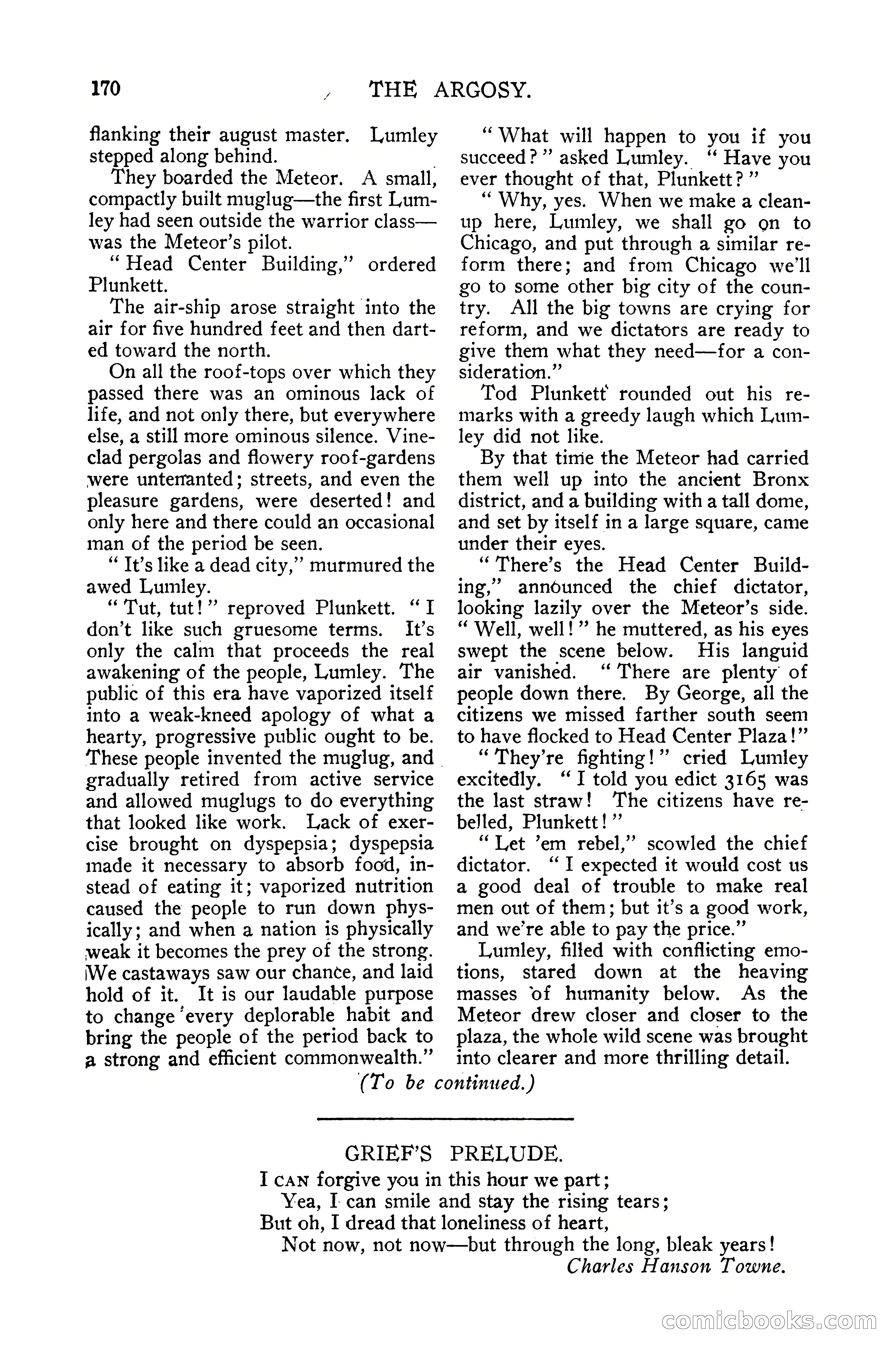
A restored page from Pulp Fiction, 1912. Page through the whole issue in the reader above.
📄 Transcribed text from this page (OCR, searchable)
Machine-transcribed from the original scan — historical spelling and the odd misread are preserved.
170 / flanking their august master. stepped along behind. . They boarded the Meteor. A small, compactly built muglug—the first Lum- ley had seen outside the warrior class— was the Meteor’s pilot. “Head Center Building,’ ordered Plunkett. The air-ship arose straight into the air for five hundred feet and then dart- ed toward the north. On all the roof-tops over which they passed there was an ominous lack of life, and not only there, but everywhere else, a still more ominous silence. Vine- clad pergolas and flowery roof-gardens were unterranted; streets, and even the pleasure gardens, were deserted! and only here and there could an occasional man of the period be seen. “It’s like a dead city,” murmured the awed Lumley. “Tut, tut!” reproved Plunkett. “I don’t like such gruesome terms. It’s only the calm that proceeds the real awakening of the people, Lumley. The public of this era have vaporized itself into a weak-kneed apology of what a hearty, progressive public ought to be. Lumley These people invented the muglug, and _ gradually retired from active service and allowed muglugs to do everything that looked like work. Lack of exer- cise brought on dyspepsia; dyspepsia made it necessary to absorb food, in- stead of eating it; vaporized nutrition caused the people to run down phys- ically; and when a nation is physically weak it becomes the prey of the strong. We castaways saw our chance, and laid hold of it. It is our laudable purpose to change ‘every deplorable habit and bring the people of the period back to a strong and efficient commonwealth.” THE ARGOSY. “What will happen to you if you succeed?” asked Lumley. ‘‘ Have you ever thought of that, Plunkett?” “Why, yes. When we make a clean- up here, Lumley, we shall go on to Chicago, and put through a similar re- form there; and from Chicago we'll go to some other big city of the coun- try. All the big towns are crying for reform, and we dictators are ready to give them what they need—for a con- sideration.” Tod Plunkett’ rounded out his re- marks with a greedy laugh which Lum- ley did not like. By that tinie the Meteor had carried them well up into the ancient Bronx district, and a building with a tall dome, and set by itself in a large square, came under their eyes. ‘“There’s the Head Center Build- ing,’ announced the chief dictator, looking lazily over the Meteor’s side. “ Well, well! ’ he muttered, as his eyes swept the scene below. His languid air vanished. ‘“ There are plenty of people down there. By George, all the citizens we missed farther south seem to have flocked to Head Center Plaza!”’ ‘“They’re fighting!” cried Lumley excitedly. “I told you edict 3165 was the last straw! The citizens have re- belled, Plunkett! ”’ “Let ’em rebel,’ scowled the chief dictator. “I expected it would cost us a good deal of trouble to make real men out of them; but it’s a good work, and we're able to pay the price.” Lumley, filled with conflicting emo- tions, stared down at the heaving masses of humanity below. As the Meteor drew closer and closer to the plaza, the whole wild scene was brought into clearer and more thrilling detail. (To be continued.) GRIEF’S PRELUDE. I can forgive you in this hour we part; Yea, I can smile and stay the rising tears; But oh, I dread that loneliness of heart, Not now, not now—but through the long, bleak years! Charles Hanson Towne. oO CoOMmicbook CO