
Pulp Fiction, 1912 · page 20 of 276
The Argosy, Christmas 1912 — page 20: what you’re looking at
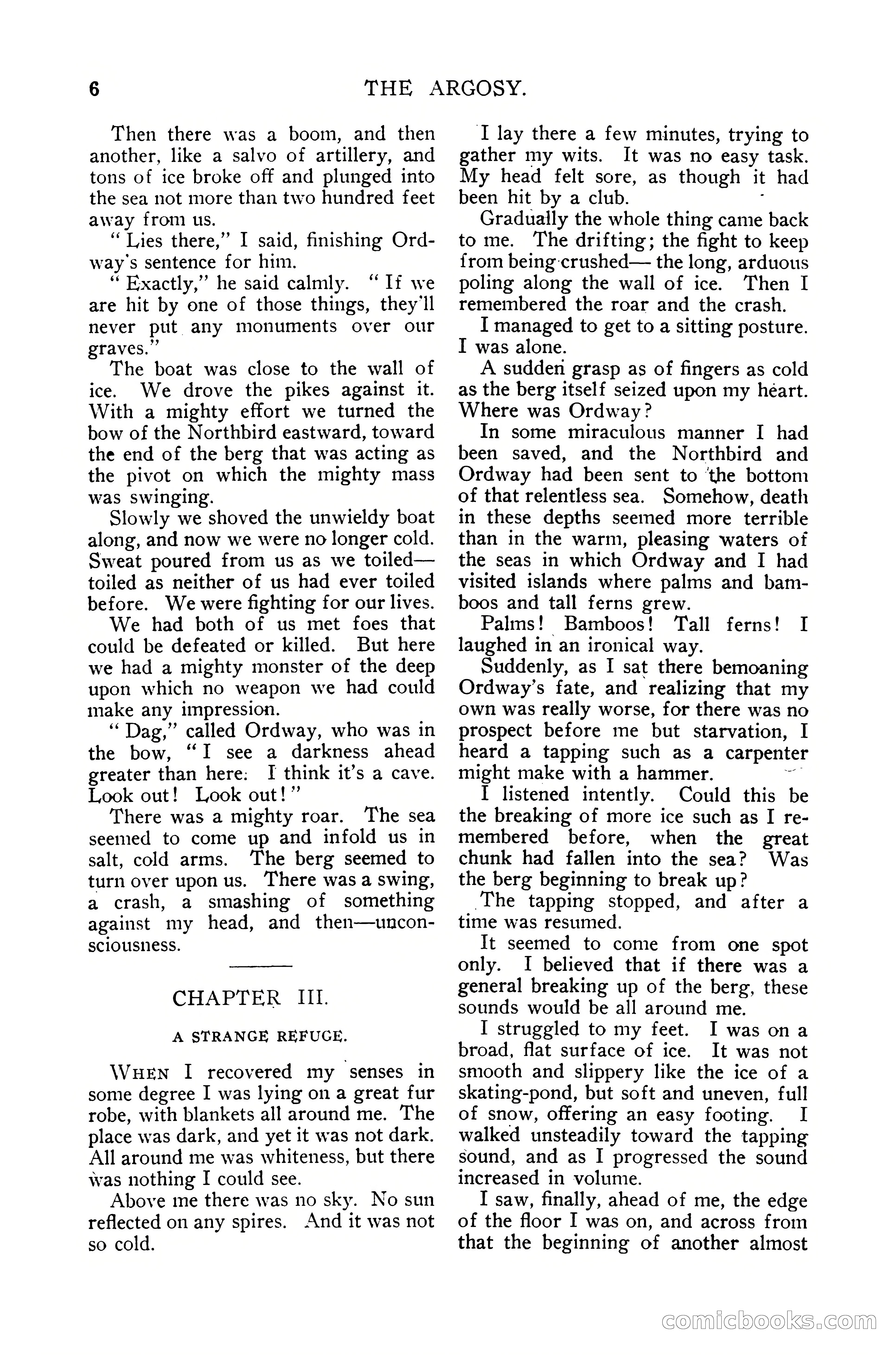
A restored page from Pulp Fiction, 1912. Page through the whole issue in the reader above.
📄 Transcribed text from this page (OCR, searchable)
Machine-transcribed from the original scan — historical spelling and the odd misread are preserved.
6 THE ARGOSY. Then there was a boom, and then another, like a salvo of artillery, and tons of ice broke off and plunged into the sea not more than two hundred feet away from us. “Lies there,” I said, finishing Ord- way's sentence for him. “ Exactly,” he said calmly. “If we are hit by one of those things, they'll never put any monuments over our graves.” The boat was close to the wall of ice. We drove the pikes against it. With a mighty effort we turned the bow of the Northbird eastward, toward the end of the berg that was acting as the pivot on which the mighty mass was swinging. Slowly we shoved the unwieldy boat along, and now we were no longer cold. Sweat poured from us as we toiled— toiled as neither of us had ever toiled before. We were fighting for our lives. We had both of us met foes that could be defeated or killed. But here we had a mighty monster of the deep upon which no weapon we had could make any impression. ‘“ Dag,” called Ordway, who was in the bow, “I see a darkness ahead greater than here: I think it’s a cave. Look out! Look out!” There was a mighty roar. The sea seemed to come up and infold us in salt, cold arms. The berg seemed to turn over upon us. There was a swing, a crash, a smashing of something against my head, and then—uncon- sciousness. CHAPTER IIL. A STRANGE REFUGE. Wuen I recovered my senses in some degree I was lying on a great fur robe, with blankets all around me. The place was dark, and yet it was not dark. All around me was whiteness, but there was nothing I could see. Above me there was no sky. No sun reflected on any spires. And it was not so cold. I lay there a few minutes, trying to gather my wits. It was no easy task. My head felt sore, as though it had been hit by a club. Gradually the whole thing came back tome. The drifting; the fight to keep from being -crushed— the long, arduous poling along the wall of ice. Then I remembered the roar and the crash. I managed to get to a sitting posture. I was alone. A sudden grasp as of fingers as cold as the berg itself seized upon my heart. Where was Ordway? In some miraculous manner I had been saved, and the Northbird and Ordway had been sent to ‘the bottom of that relentless sea. Somehow, death in these depths seemed more terrible than in the warm, pleasing waters of the seas in which Ordway and I had visited islands where palms and bam- boos and tall ferns grew. Palms! Bamboos! Tall ferns! I laughed in an ironical way. Suddenly, as I sat there bemoaning Ordway’s fate, and realizing that my own was really worse, for there was no prospect before me but starvation, I heard a tapping such as a carpenter might make with a hammer. I listened intently. Could this be the breaking of more ice such as I re- membered before, when the great chunk had fallen into the sea? Was the berg beginning to break up? The tapping stopped, and after a time was resumed. It seemed to come from one spot only. I believed that if there was a general breaking up of the berg, these sounds would be all around me. I struggled to my feet. I was ona broad, flat surface of ice. It was not smooth and slippery like the ice of a skating-pond, but soft and uneven, full of snow, offering an easy footing. I walked unsteadily toward the tapping sound, and as I progressed the sound increased in volume. I saw, finally, ahead of me, the edge of the floor I was on, and across from that the beginning of another almost CoOMmicbook CO