
Pulp Fiction, 1912 · page 202 of 276
The Argosy, Christmas 1912 — page 202: what you’re looking at
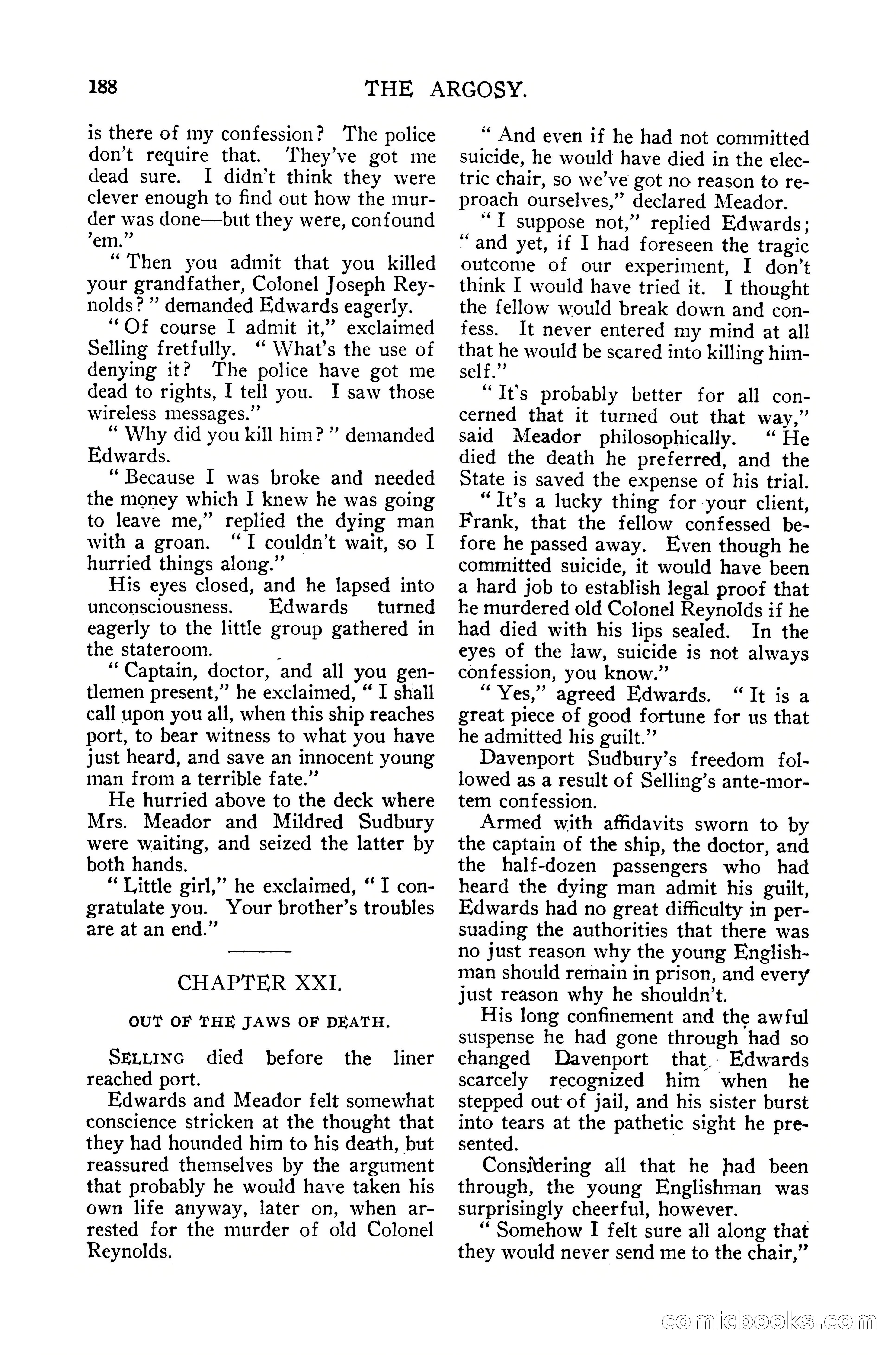
A restored page from Pulp Fiction, 1912. Page through the whole issue in the reader above.
📄 Transcribed text from this page (OCR, searchable)
Machine-transcribed from the original scan — historical spelling and the odd misread are preserved.
188 is there of my confession? The police don’t require that. They’ve got me dead sure. I didn’t think they were clever enough to find out how the mur- der was done—but they were, confound ’em.” “Then you admit that you killed your grandfather, Colonel Joseph Rey- nolds? ” demanded Edwards eagerly. “Of course I admit it,” exclaimed Selling fretfully. ‘ What’s the use of denying it? The police have got me dead to rights, I tell you. I saw those wireless messages.”’ “Why did you kill him? ” demanded Edwards. “ Because I was broke and needed the money which I knew he was going to leave me,” replied the dying man with a groan. “TI couldn’t wait, so I hurried things along.” His eyes closed, and he lapsed into unconsciousness. Edwards turned eagerly to the little group gathered in the stateroom. ; “Captain, doctor, and all you gen- tlemen present,” he exclaimed, “ I shall call upon you all, when this ship reaches port, to bear witness to what you have just heard, and save an innocent young man from a terrible fate.” He hurried above to the deck where Mrs. Meador and Mildred Sudbury were waiting, and seized the latter by both hands. “Little girl,” he exclaimed, “ I con- gratulate you. Your brother’s troubles are at an end.” CHAPTER XXI. OUT OF THE JAWS OF DEATH. SELLING died before the liner reached port. Edwards and Meador felt somewhat conscience stricken at the thought that they had hounded him to his death, but reassured themselves by the argument that probably he would have taken his own life anyway, later on, when ar- rested for the murder of old Colonel Reynolds. THE ARGOSY. ‘“ And even if he had not committed suicide, he would have died in the elec- tric chair, so we’ve got no reason to re- proach ourselves,” declared Meador. ““T suppose not,” replied Edwards; “and yet, if I had foreseen the tragic outcome of our experiment, I don’t think I would have tried it. I thought the fellow would break down and con- fess. It never entered my mind at all that he would be scared into killing him- self.”’ “It’s probably better for all con- cerned that it turned out that way,” said Meador philosophically. ‘“ He died the death he preferred, and the State is saved the expense of his trial. “It’s a lucky thing for your client, Frank, that the fellow confessed be- fore he passed away. Even though he committed suicide, it would have been a hard job to establish legal proof that he murdered old Colonel Reynolds if he had died with his lips sealed. In the eyes of the law, suicide is not always confession, you know.” “Yes,” agreed Edwards. “It is a great piece of good fortune for us that he admitted his guilt.” Davenport Sudbury’s freedom fol- lowed as a result of Selling’s ante-mor- tem confession. Armed with affidavits sworn to by the captain of the ship, the doctor, and the half-dozen passengers who had heard the dying man admit his guilt, Edwards had no great difficulty in per- suading the authorities that there was no just reason why the young English- man should remain in prison, and every just reason why he shouldn’t. His long confinement and the awful suspense he had gone through had so changed Davenport that. Edwards scarcely recognized him when he stepped out of jail, and his sister burst into tears at the pathetic sight he pre- sented. Considering all that he had been through, the young Englishman was surprisingly cheerful, however. | “ Somehow I felt sure all along that they would never send me to the chair,” oO cComicbooks CO