
Pulp Fiction, 1912 · page 206 of 276
The Argosy, Christmas 1912 — page 206: what you’re looking at
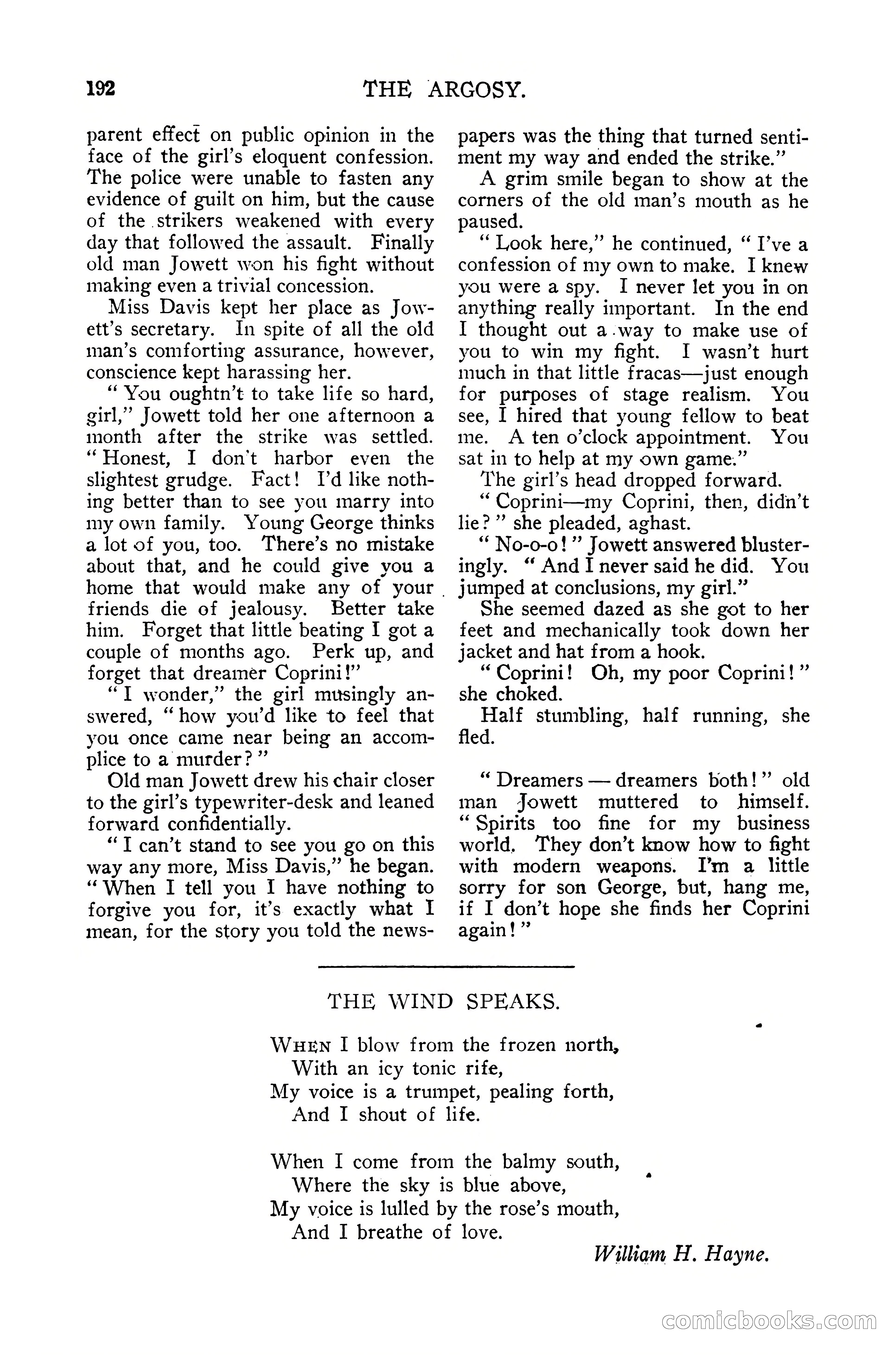
A restored page from Pulp Fiction, 1912. Page through the whole issue in the reader above.
📄 Transcribed text from this page (OCR, searchable)
Machine-transcribed from the original scan — historical spelling and the odd misread are preserved.
192 parent effect on public opinion in the face of the girl’s eloquent confession. The police were unable to fasten any evidence of guilt on him, but the cause of the strikers weakened with every day that followed the assault. Finally old man Jowett won his fight without making even a trivial concession. Miss Davis kept her place as Jow- ett’s secretary. In spite of all the old man’s comforting assurance, however, conscience kept harassing her. “You oughtn’t to take life so hard, girl,” Jowett told her one afternoon a month after the strike was settled. “Honest, I don't harbor even the slightest grudge. Fact! Id like noth- ing better than to see you marry into my own family. Young George thinks a lot of you, too. ‘There’s no mistake about that, and he could give vou a home that would make any of your | friends die of jealousy. Better take him. Forget that little beating I got a couple of months ago. Perk up, and forget that dreamer Coprini!” “TI wonder,” the girl musingly an- swered, “how youd like to feel that you once came near being an accom- plice to a murder? ”’ Old man Jowett drew his chair closer to the girl’s typewriter-desk and leaned forward confidentially. “T can’t stand to see you go on this way any more, Miss Davis,” he began. “When I tell you I have nothing to forgive you for, it’s exactly what I mean, for the story you told the news- THE ARGOSY. papers was the thing that turned senti- ment my way and ended the strike.” A grim smile began to show at the corners of the old man’s mouth as he paused. ‘““ Look here,” he continued, “ I’ve a confession of my own to make. I knew you were a spy. I never let you in on anything really important. In the end I thought out a-way to make use of you to win my fight. I wasn’t hurt much in that little fracas—just enough for purposes of stage realism. You see, I hired that young fellow to beat me. A ten o’clock appointment. You sat in to help at my own game.” The girl’s head dropped forward. “ Coprini—my Coprini, then, didn’t lie?’ she pleaded, aghast. * No-o-o! ” Jowett answered bluster- ingly. “ And I never said he did. You jumped at conclusions, my girl.” She seemed dazed as she got to her feet and mechanically took down her jacket and hat from a hook. “Coprini! Oh, my poor Coprini!” she choked. Half stumbling, half running, she fled. ““ Dreamers — dreamers both!” old man Jowett muttered to himself. “Spirits too fine for my business world. They don’t know how to fight with modern weapons. I’m a little sorry for son George, but, hang me, if I don’t hope she finds her Coprini again!” THE WIND SPEAKS. WueEN I blow from the frozen north, With an icy tonic rife, My voice is a trumpet, pealing forth, And [ shout of life. When I come from the balmy south, Where the sky is blue above, My voice is lulled by the rose’s mouth, And I breathe of love. Wilham H. Hayne. oO MICLOOOK CO CO