
Pulp Fiction, 1912 · page 22 of 276
The Argosy, Christmas 1912 — page 22: what you’re looking at
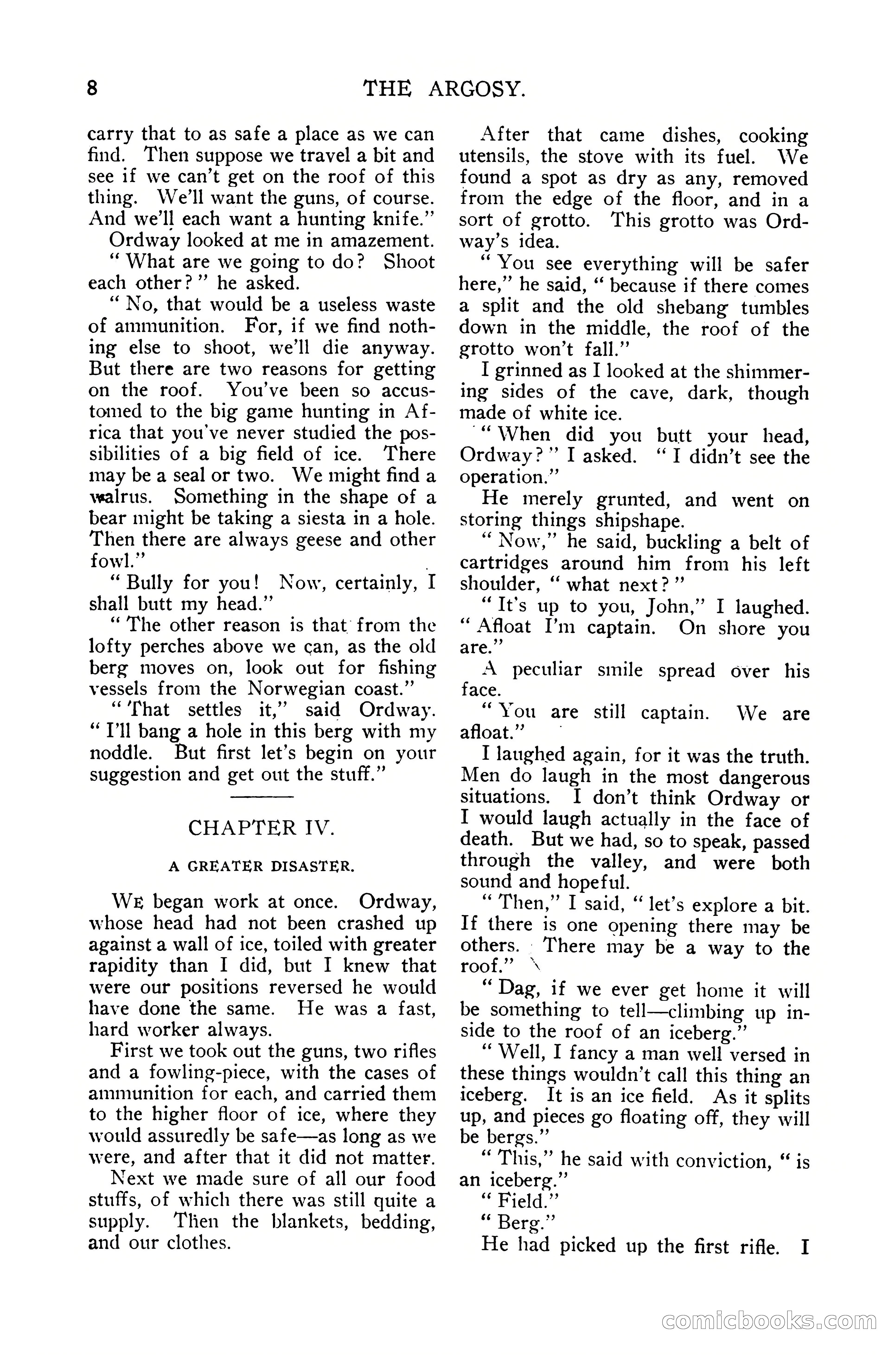
A restored page from Pulp Fiction, 1912. Page through the whole issue in the reader above.
📄 Transcribed text from this page (OCR, searchable)
Machine-transcribed from the original scan — historical spelling and the odd misread are preserved.
8 THE ARGOSY. carry that to as safe a place as we can find. Then suppose we travel a bit and see 1f we can’t get on the roof of this thing. We’ll want the guns, of course. And we'll each want a hunting knife.” Ordway looked at me in amazement. ‘What are we going to do? Shoot each other?” he asked. “No, that would be a useless waste of ammunition. For, if we find noth- ing else to shoot, we'll die anyway. But there are two reasons for getting on the roof. You've been so accus- tomed to the big game hunting in Af- rica that you've never studied the pos- sibilities of a big field of ice. There may be a seal or two. We might find a walrus. Something in the shape of a bear might be taking a siesta in a hole. Then there are always geese and other fowl.” | “ Bully for you! Now, certainly, I shall butt my head.” “The other reason is that from the lofty perches above we can, as the old berg moves on, look out for fishing vessels from the Norwegian coast.” “That settles it,” said Ordway. “Tl bang a hole in this berg with my noddle. But first let’s begin on your suggestion and get out the stuff.” CHAPTER IV. A GREATER DISASTER. WE began work at once. Ordway, whose head had not been crashed up against a wall of ice, toiled with greater rapidity than I did, but I knew that were our positions reversed he would have done the same. He was a fast, hard worker always. First we took out the guns, two rifles and a fowling-piece, with the cases of ammunition for each, and carried them to the higher floor of ice, where they would assuredly be safe—as long as we were, and after that it did not matter. Next we made sure of all our food stuffs, of which there was still quite a supply. Then the blankets, bedding, and our clothes. After that came dishes, cooking utensils, the stove with its fuel. We found a spot as dry as any, removed from the edge of the floor, and in a sort of grotto. This grotto was Ord- way’s idea. “You see everything will be safer here,” he said, ‘‘ because if there comes a split and the old shebang tumbles down in the middle, the roof of the grotto won’t fall.” I grinned as I looked at the shimmer- ing sides of the cave, dark, though made of white ice. “When did you butt your head, Ordway?” I asked. ‘I didn’t see the operation.” He merely grunted, and went on storing things shipshape. ‘ Now,” he said, buckling a belt of cartridges around him from his left shoulder, ‘‘ what next?” “It's up to you, John,” I laughed. “ Afloat I’m captain. On shore you are.” A peculiar smile spread over his face. “You are still captain. afloat.” I laughed again, for it was the truth. Men do laugh in the most dangerous situations. I don’t think Ordway or I would laugh actually in the face of death. But we had, so to speak, passed through the valley, and were both sound and hopeful. “ Then,” I said, “ let’s explore a bit. If there is one opening there may be others. There may be a way to the roof.” \ “Dag, if we ever get home it will be something to tell—climbing up in- side to the roof of an iceberg.” “Well, I fancy a man well versed in these things wouldn’t call this thing an iceberg. It is an ice field. As it splits up, and pieces go floating off, they will be bergs.”’ “ This,” he said with conviction, “ is an iceberg.” “ Field.” 66 Berg.” He had picked up the first rifle. I We are CoOMmicbook CO