
Pulp Fiction, 1912 · page 33 of 276
The Argosy, Christmas 1912 — page 33: what you’re looking at
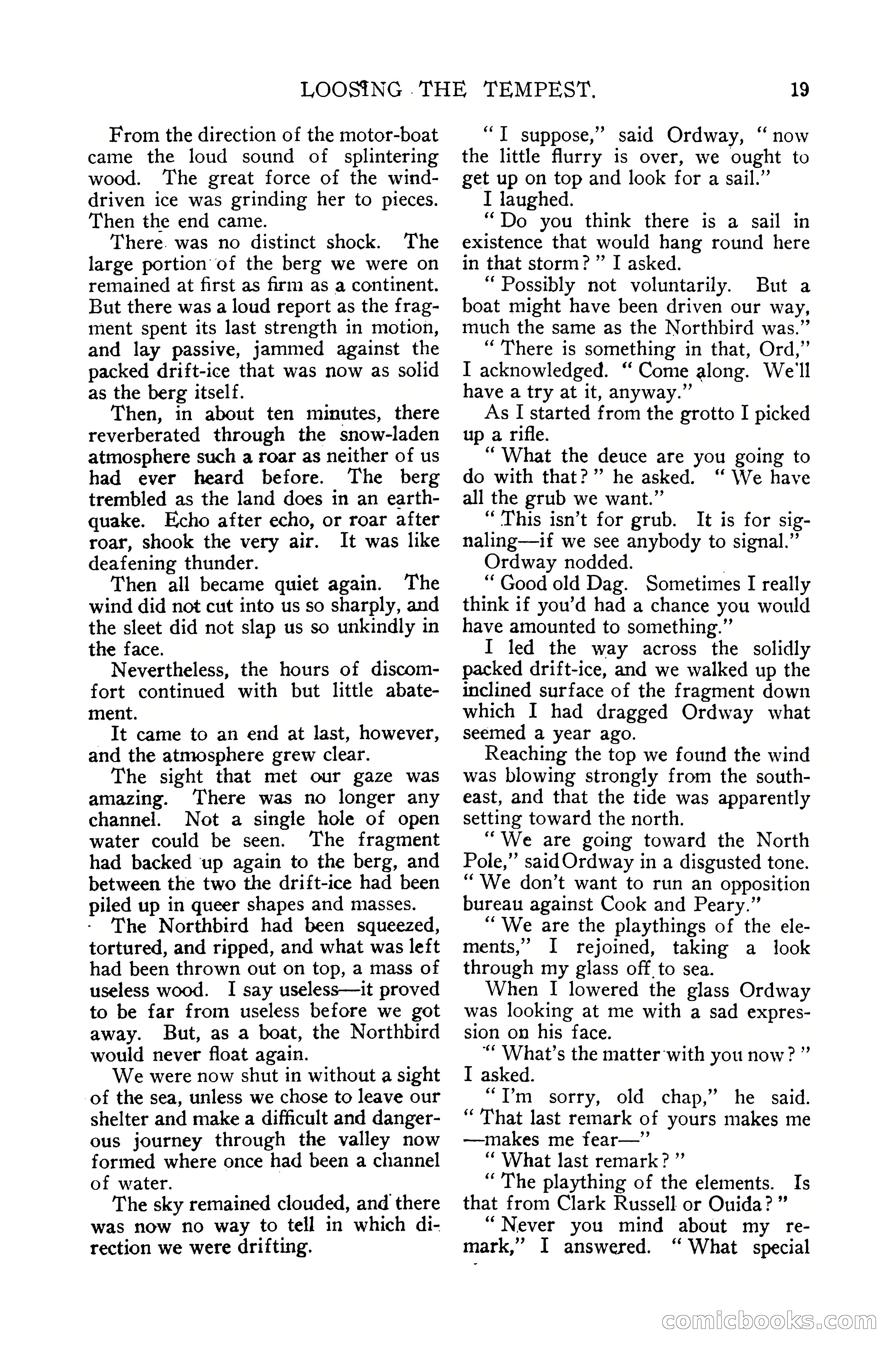
A restored page from Pulp Fiction, 1912. Page through the whole issue in the reader above.
📄 Transcribed text from this page (OCR, searchable)
Machine-transcribed from the original scan — historical spelling and the odd misread are preserved.
LOOSING .THE TEMPEST. From the direction of the motor-boat came the loud sound of splintering wood. The great force of the wind- driven ice was grinding her to pieces. Then the end came. There. was no distinct shock. The large portion of the berg we were on remained at first as firm as a continent. But there was a loud report as the frag- ment spent its last strength in motion, and lay passive, jammed against the packed drift-ice that was now as solid as the berg itself. Then, in about ten minutes, there reverberated through the snow-laden atmosphere such a roar as neither of us had ever heard before. The berg trembled as the land does in an earth- quake. Echo after echo, or roar after roar, shook the very air. It was like deafening thunder. Then all became quiet again. The wind did not cut into us so sharply, and the sleet did not slap us so unkindly in the face. Nevertheless, the hours of discom- fort continued with but little abate- ment. It came to an end at last, however, and the atmosphere grew clear. The sight that met our gaze was amazing. There was no longer any channel. Not a single hole of open water could be seen. The fragment had backed up again to the berg, and between the two the drift-ice had been piled up in queer shapes and masses. The Northbird had been squeezed, tortured, and ripped, and what was left had been thrown out on top, a mass of useless wood. I say useless—it proved to be far from useless before we got away. But, as a boat, the Northbird would never float again. We were now shut in without a sight of the sea, unless we chose to leave our shelter and make a difficult and danger- ous journey through the valley now formed where once had been a channel of water. The sky remained clouded, and there was now no way to tell in which di- rection we were drifting. 19 “I suppose,” said Ordway, “ now the little flurry is over, we ought to get up on top and look for a sail.” I laughed. “Do you think there is a sail in existence that would hang round here in that storm? ” I asked. “Possibly not voluntarily. But a boat might have been driven our way, much the same as the Northbird was.” “There is something in that, Ord,” I acknowledged. “ Come along. We'll have a try at it, anyway.” As I started from the grotto I picked up a rifle. “What the deuce are you going to do with that?” he asked. ‘“‘ We have all the grub we want.” “This isn’t for grub. It is for sig- naling—if we see anybody to signal.” Ordway nodded. | “Good old Dag. Sometimes I really think if you’d had a chance you would have amounted to something.” I led the way across the solidly packed drift-ice, and we walked up the inclined surface of the fragment down which I had dragged Ordway what seemed a year ago. Reaching the top we found the wind was blowing strongly from the south- east, and that the tide was apparently setting toward the north. “We are going toward the North Pole,” saidOrdway in a disgusted tone. “We don’t want to run an opposition bureau against Cook and Peary.” “We are the playthings of the ele- ments,’ I rejoined, taking a look through my glass off to sea. When I lowered the glass Ordway was looking at me with a sad expres- sion on his face. “ What’s the matter'with you now? ” I asked. “Tm sorry, old chap,” he said. “That last remark of yours makes me —makes me fear—”’ “ What last remark? ” “The plaything of the elements. Is that from Clark Russell or Ouida? ” “Never you mind about my re- mark,” I answered. “ What special oO COMmMiclhoo S CO