
Pulp Fiction, 1912 · page 59 of 276
The Argosy, Christmas 1912 — page 59: what you’re looking at
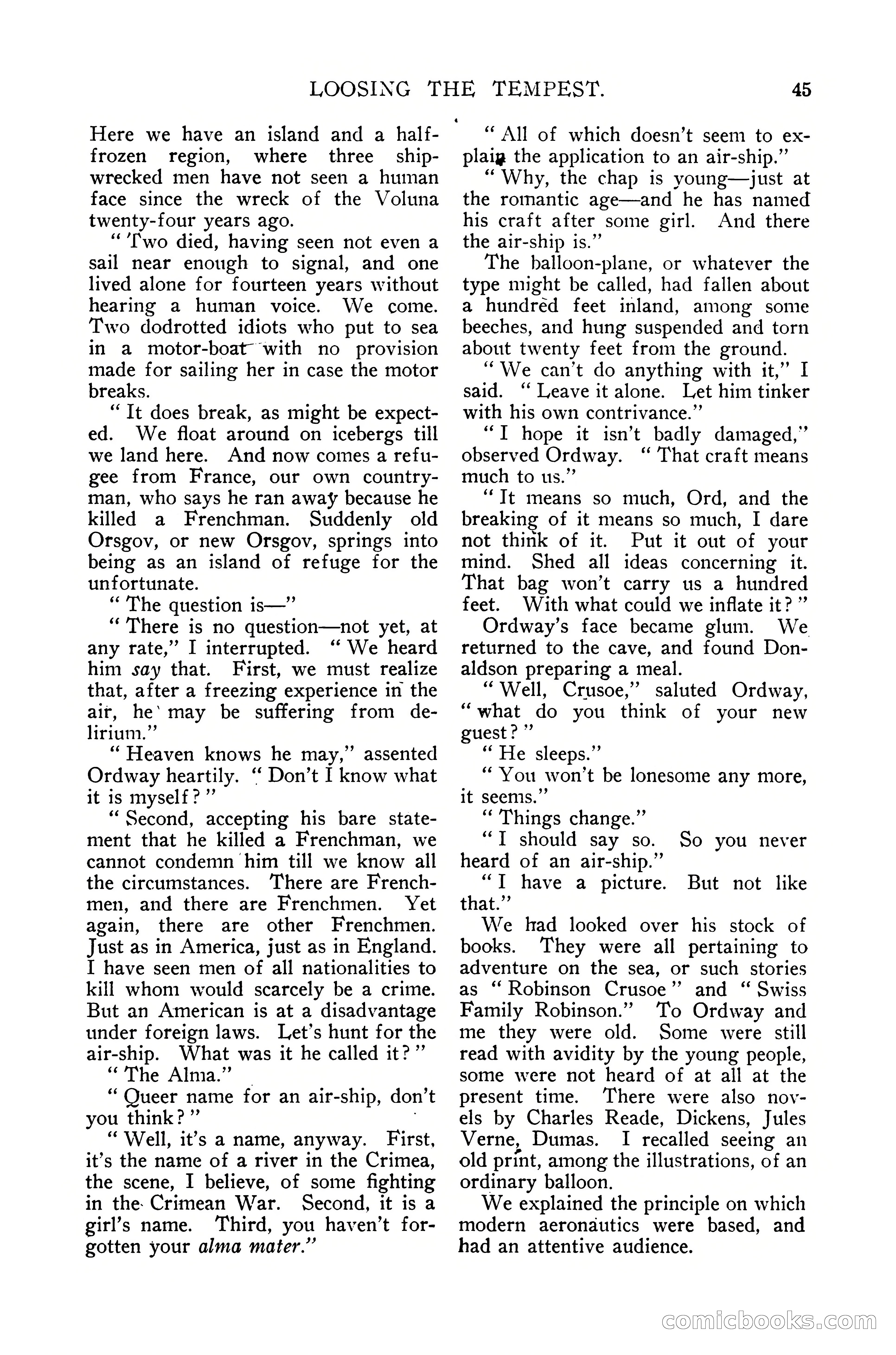
A restored page from Pulp Fiction, 1912. Page through the whole issue in the reader above.
📄 Transcribed text from this page (OCR, searchable)
Machine-transcribed from the original scan — historical spelling and the odd misread are preserved.
LOOSING THE TEMPEST. Here we have an island and a half- frozen region, where three ship- wrecked men have not seen a human face since the wreck of the Voluna twenty-four years ago. “Two died, having seen not even a sail near enough to signal, and one lived alone for fourteen years without hearing a human voice. We come. Two dodrotted idiots who put to sea in a motor-boat with no provision made for sailing her in case the motor breaks. “Tt does break, as might be expect- ed. We float around on icebergs till we land here. And now comes a refu- gee from France, our own country- man, who says he ran away because he killed a Frenchman. Suddenly old Orsgov, or new Orsgov, springs into being as an island of refuge for the unfortunate. “The question is—” “There is no question—not yet, at any rate,” I interrupted. ‘ We heard him say that. First, we must realize that, after a freezing experience in the air, he’ may be suffering from de- lirium.”’ “Heaven knows he may,” assented Ordway heartily. ‘‘ Don’t I know what it 1s myself?” “Second, accepting his bare state- ment that he killed a Frenchman, we cannot condemn him till we know all the circumstances. There are French- men, and there are Frenchmen. Yet again, there are other Frenchmen. Just as in America, just as in England. I have seen men of all nationalities to kill whom would scarcely be a crime. But an American is at a disadvantage under foreign laws. Let’s hunt for the air-ship. What was it he called it?” “The Alma.” — “Queer name for an air-ship, don’t you think?” “ Well, it’s a name, anyway. First, it’s the name of a river in the Crimea, the scene, I believe, of some fighting in the Crimean War. Second, it is a girl’s name. ‘Third, you haven’t for- gotten your alma mater.” 45 “All of which doesn’t seem to ex- plaig the application to an air-ship.” “Why, the chap is young—just at the romantic age—and he has named his craft after some girl. And there the air-ship is.” The balloon-plane, or whatever the type might be called, had fallen about a hundred feet inland, among some beeches, and hung suspended and torn about twenty feet from the ground. “We can’t do anything with it,” I said. “ Leave it alone. Let him tinker with his own contrivance.” “IT hope it isn’t badly damaged,” observed Ordway. ‘ That craft means much to us.” “‘Tt means so much, Ord, and the breaking of it means so much, I dare not think of it. Put it out of your mind. Shed all ideas concerning it. That bag won’t carry us a hundred feet. With what could we inflate it? ” Ordway’s face became glum. We returned to the cave, and found Don- aldson preparing a meal. “Well, Crusoe,” saluted Ordway, “what do you think of your new guest?” “He sleeps.” “You won't be lonesome any more, it seems.” “ Things change.” ““T should say so. heard of an air-ship.” “TY have a picture. that.” We had looked over his stock of books. They were all pertaining to adventure on the sea, or such stories as “Robinson Crusoe” and “ Swiss Family Robinson.” To Ordway and me they were old. Some were still read with avidity by the young people, some were not heard of at all at the present time. There were also nov- els by Charles Reade, Dickens, Jules Verne, Dumas. I recalled seeing an old print, among the illustrations, of an ordinary balloon. We explained the principle on which modern aeronautics were based, and had an attentive audience. So you never But not like CoOMmicbook CO