
Pulp Fiction, 1912 · page 63 of 276
The Argosy, Christmas 1912 — page 63: what you’re looking at
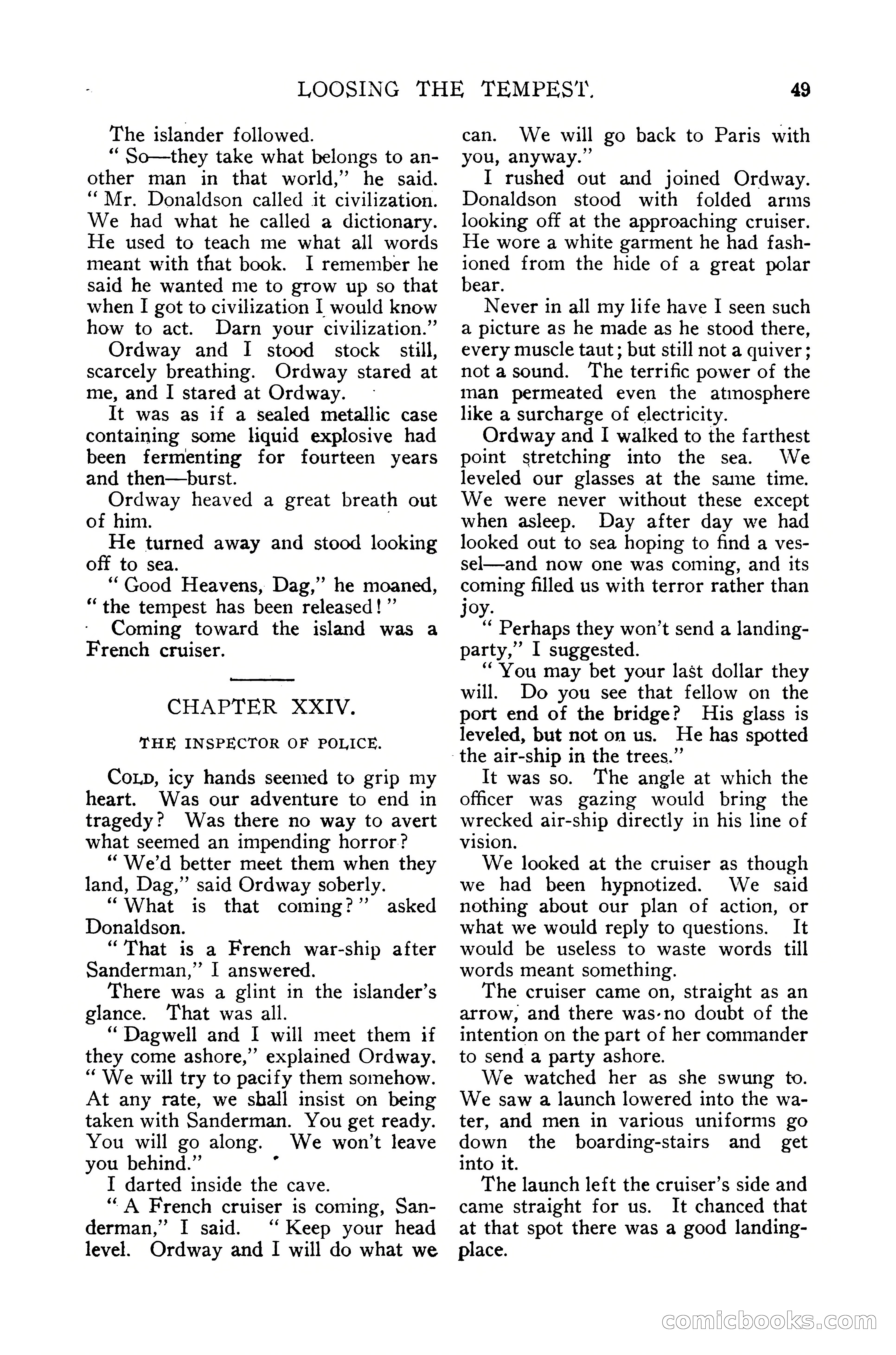
A restored page from Pulp Fiction, 1912. Page through the whole issue in the reader above.
📄 Transcribed text from this page (OCR, searchable)
Machine-transcribed from the original scan — historical spelling and the odd misread are preserved.
LOOSING THE TEMPEST. The islander followed. ““ So—they take what belongs to an- other man in that world,” he said. “Mr. Donaldson called it civilization. We had what he called a dictionary. He used to teach me what all words meant with that book. I remember he said he wanted me to grow up so that when I got to civilization I would know how to act. Darn your civilization.” Ordway and I stood stock still, scarcely breathing. Ordway stared at me, and I stared at Ordway. It was as if a sealed metallic case containing some liquid explosive had been fermenting for fourteen years and then—burst. Ordway heaved a great breath out of him. | He turned away and stood looking off to sea. “Good Heavens, Dag,” he moaned, “the tempest has been released! ” Coming toward the island was a French cruiser. CHAPTER XXIV. THE INSPECTOR OF POLICE. Coup, icy hands seemed to grip my heart. Was our adventure to end in tragedy: Was there no way to avert what seemed an impending horror? “We'd better meet them when they land, Dag,” said Ordway soberly. “What is that coming?” asked Donaldson. “That is a French war-ship after Sanderman,” I answered. There was a glint in the islander’s glance. That was all. “ Dagwell and I will meet them if they come ashore,” explained Ordway. “We will try to pacify them somehow. At any rate, we shall insist on being taken with Sanderman. You get ready. You will go along. We won't leave you behind.” . I darted inside the cave. “A French cruiser is coming, San- derman,” I said. “ Keep your head level. Ordway and I will do what we 49 can. We will go back to Paris with you, anyway.” I rushed out and joined Ordway. Donaldson stood with folded arms looking off at the approaching cruiser. He wore a white garment he had fash- ioned from the hide of a great polar bear. Never in all my life have I seen such a picture as he made as he stood there, every muscle taut; but still not a quiver; nota sound. The terrific power of the man permeated even the atmosphere like a surcharge of electricity. Ordway and I walked to the farthest point stretching into the sea. We leveled our glasses at the same time. We were never without these except when asleep. Day after day we had looked out to sea hoping to find a ves- sel—and now one was coming, and its coming filled us with terror rather than joy. “Perhaps they won’t send a landing- party,” I suggested. “You may bet your last dollar they will. Do you see that fellow on the port end of the bridge? His glass is leveled, but not on us. He has spotted ‘the air-ship in the trees.” It was so. The angle at which the officer was gazing would bring the wrecked air-ship directly in his line of vision. We looked at the cruiser as though we had been hypnotized. We said nothing about our plan of action, or what we would reply to questions. It would be useless to waste words till words meant something. The cruiser came on, straight as an arrow, and there was-no doubt of the intention on the part of her commander to send a party ashore. We watched her as she swung to. We saw a launch lowered into the wa- ter, and men in various uniforms go down the boarding-stairs and _ get into it. The launch left the cruiser’s side and came straight for us. It chanced that at that spot there was a good landing- place. CoOMmicbook CO