
Pulp Fiction, 1914 · page 100 of 266
The Argosy, Vol. 76, No. 3 — page 100: what you’re looking at
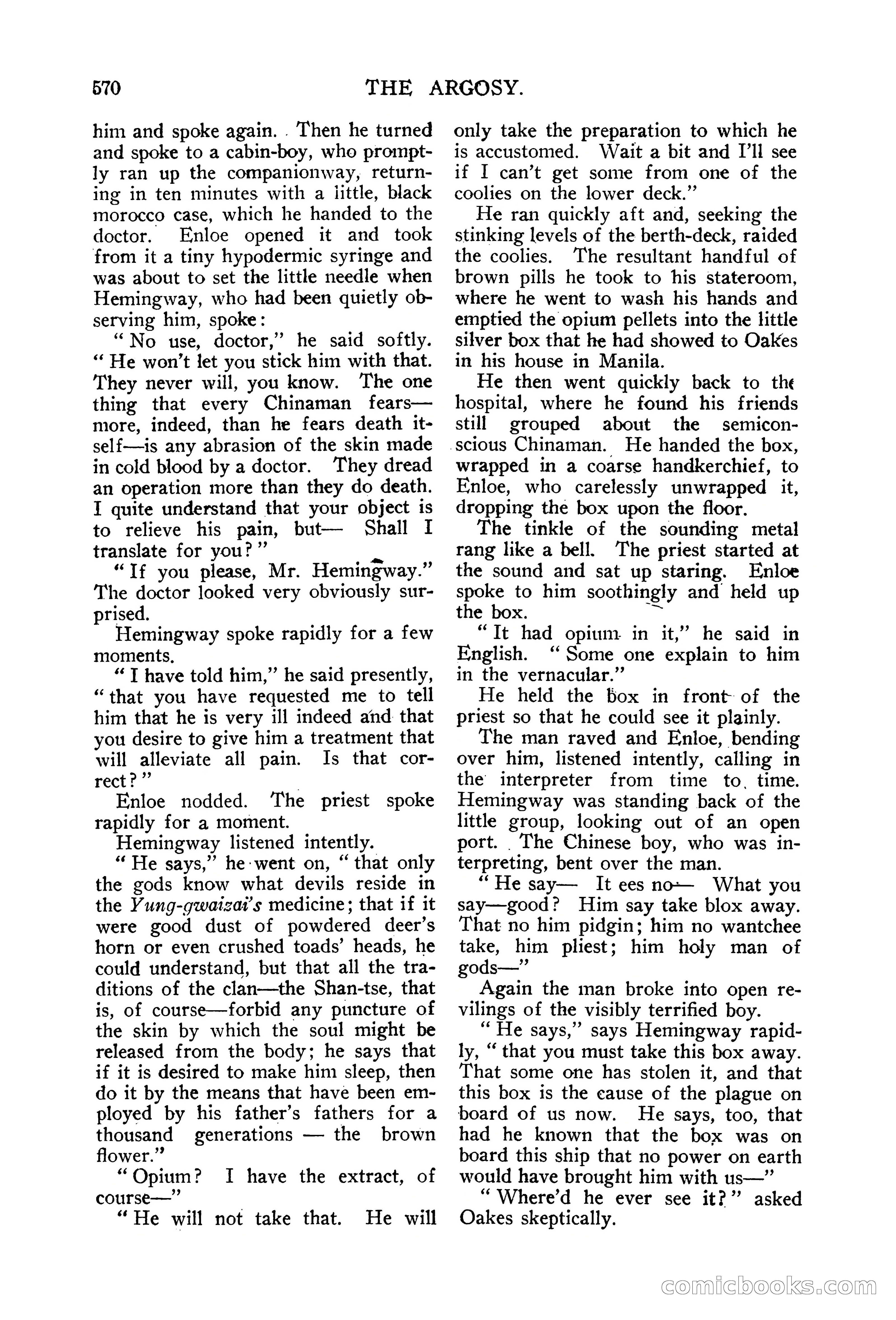
A restored page from Pulp Fiction, 1914. Page through the whole issue in the reader above.
📄 Transcribed text from this page (OCR, searchable)
Machine-transcribed from the original scan — historical spelling and the odd misread are preserved.
570 him and spoke again. . Then he turned and spoke to a cabin-boy, who prompt- ly ran up the companionway, return- ing in ten minutes with a little, black morocco case, which he handed to the doctor. Enloe opened it and took from it a tiny hypodermic syringe and was about to set the little needle when Hemingway, who had been quietly ob- serving him, spoke: “No use, doctor,’ he said softly. “He won’t let you stick him with that. They never will, you know. The one thing that every Chinaman fears— more, indeed, than he fears death it- self—is any abrasion of the skin made in cold blood by a doctor. They dread an operation more than they do death. I quite understand that your object is to relieve his pain, but— Shall I translate for you?” . “If you please, Mr. Hemingway.” The doctor looked very obviously sur- prised. Hemingway spoke rapidly for a few moments, ““T have told him,” he said presently, “that you have requested me to tell him that he is very ill indeed and that you desire to give him a treatment that will alleviate all pain. Is that cor- rect?” | Enloe nodded. The priest spoke rapidly for a moment. Hemingway listened intently. “He says,” he-went on, “ that only the gods know what devils reside in the Yung-qwaizat’s medicine; that if it were good dust of powdered deer’s horn or even crushed toads’ heads, he could understand, but that all the tra- ditions of the clan—the Shan-tse, that is, of course—forbid any puncture of the skin by which the soul might be released from the body; he says that if it is desired to make him sleep, then do it by the means that have been em- ployed by his father’s fathers for a thousand generations — the brown flower.” “Opium? I have the extract, of course—”’ “He will not take that. He will THE ARGOSY. only take the preparation to which he is accustomed. Wait a bit and I’ll see if I can’t get some from one of the coolies on the lower deck.” He ran quickly aft and, seeking the stinking levels of the berth-deck, raided the coolies. The resultant handful of brown pills he took to his stateroom, where he went to wash his hands and emptied the opium pellets into the little silver box that he had showed to Oakes in his house in Manila. He then went quickly back to the hospital, where he found his friends still grouped about the semicon- scious Chinaman. He handed the box, wrapped in a coarse handkerchief, to Enloe, who carelessly unwrapped it, dropping the box upon the floor. The tinkle of the sounding metal rang like a bell. The priest started at the sound and sat up staring. Enloe spoke to him soothingly and held up the box. i “It had opium. in it,” he said in English. ‘“ Some one explain to him in the vernacular.” He held the box in front of the priest so that he could see it plainly. The man raved and Enloe, bending over him, listened intently, calling in the interpreter from time to, time. Hemingway was standing back of the little group, looking out of an open port. The Chinese boy, who was in- terpreting, bent over the man. “He say— It ees no— What you say—good? Him say take blox away. That no him pidgin; him no wantchee take, him pliest; him holy man of gods—” Again the man broke into open re- vilings of the visibly terrified boy. “ He says,” says Hemingway rapid- ly, “ that you must take this box away. That some one has stolen it, and that this box is the cause of the plague on board of us now. He says, too, that had he known that the box was on board this ship that no power on earth would have brought him with us—” “Where'd he ever see it?” asked Oakes skeptically. COMicdoo S CO@