
Pulp Fiction, 1914 · page 113 of 266
The Argosy, Vol. 76, No. 3 — page 113: what you’re looking at
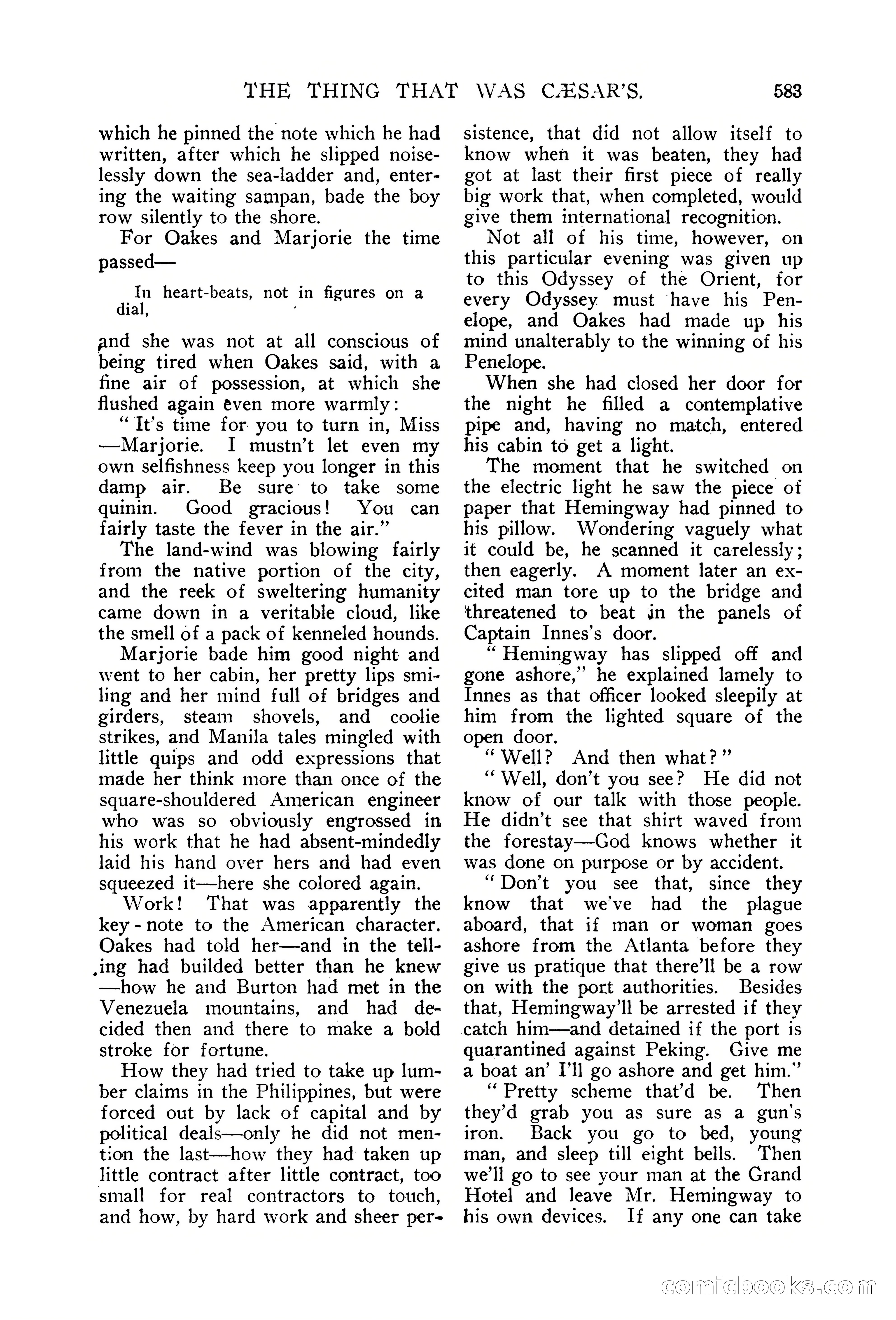
A restored page from Pulp Fiction, 1914. Page through the whole issue in the reader above.
📄 Transcribed text from this page (OCR, searchable)
Machine-transcribed from the original scan — historical spelling and the odd misread are preserved.
THE THING THAT WAS C/ESAR'S. which he pinned the note which he had written, after which he slipped noise- lessly down the sea-ladder and, enter- ing the waiting sampan, bade the boy row silently to the shore. For Oakes and Marjorie the time passed— In heart-beats, not in figures on a dial, and she was not at all conscious of being tired when Oakes said, with a fine air of possession, at which she flushed again éven more warmly: “It’s time for you to turn in, Miss —Marjorie. I mustn’t let even my own selfishness keep you longer in this damp air. Be sure’ to take some quinin. Good gracious! You can fairly taste the fever in the air.” The land-wind was blowing fairly from the native portion of the city, and the reek of sweltering humanity came down in a veritable cloud, like the smell of a pack of kenneled hounds. Marjorie bade him good night and went to her cabin, her pretty lips smi- ling and her mind full of bridges and girders, steam shovels, and _ coolie strikes, and Manila tales mingled with little quips and odd expressions that made her think more than once of the square-shouldered American engineer who was so obviously engrossed in his work that he had absent-mindedly laid his hand over hers and had even squeezed it—here she colored again. Work! That was apparently the key - note to the American character. Oakes had told her—and in the tell- .ing had builded better than he knew —how he and Burton had met in the Venezuela mountains, and had de- cided then and there to make a bold stroke for fortune. How they had tried to take up lum- ber claims in the Philippines, but were forced out by lack of capital and by political deals—only he did not men- tion the last—how they had taken up little contract after little contract, too small for real contractors to touch, and how, by hard work and sheer per- 583 sistence, that did not allow itself to know when it was beaten, they had got at last their first piece of really big work that, when completed, would give them international recognition. Not all of his time, however, on this particular evening was given up to this Odyssey of the Orient, for every Odyssey. must have his Pen- elope, and Oakes had made up his mind unalterably to the winning of his Penelope. When she had closed her door for the night he filled a contemplative pipe and, having no match, entered his cabin to get a light. The moment that he switched on the electric light he saw the piece of paper that Hemingway had pinned to his pillow. Wondering vaguely what it could be, he scanned it carelessly ; then eagerly. A moment later an ex- cited man tore up to the bridge and threatened to beat in the panels of Captain Innes’s door. “Hemingway has slipped off and gone ashore,’ he explained lamely to Innes as that officer looked sleepily at him from the lighted square of the open door. “Well? And then what?” “Well, don’t you see? He did not know of our talk with those people. He didn’t see that shirt waved from the forestay—God knows whether it was done on purpose or by accident. “Don’t you see that, since they know that we've had the plague aboard, that if man or woman goes ashore from the Atlanta before they give us pratique that there’ll be a row on with the port authorities. Besides that, Hemingway’ll be arrested if they catch him—and detained if the port is quarantined against Peking. Give me a boat an’ I’ll go ashore and get him.” “Pretty scheme that'd be. Then they'd grab you as sure as a gun's iron. Back you go to bed, young man, and sleep till eight bells. Then we'll go to see your man at the Grand Hotel and leave Mr. Hemingway to his own devices. If any one can take COMicdoo S CO@