
Pulp Fiction, 1914 · page 120 of 266
The Argosy, Vol. 76, No. 3 — page 120: what you’re looking at
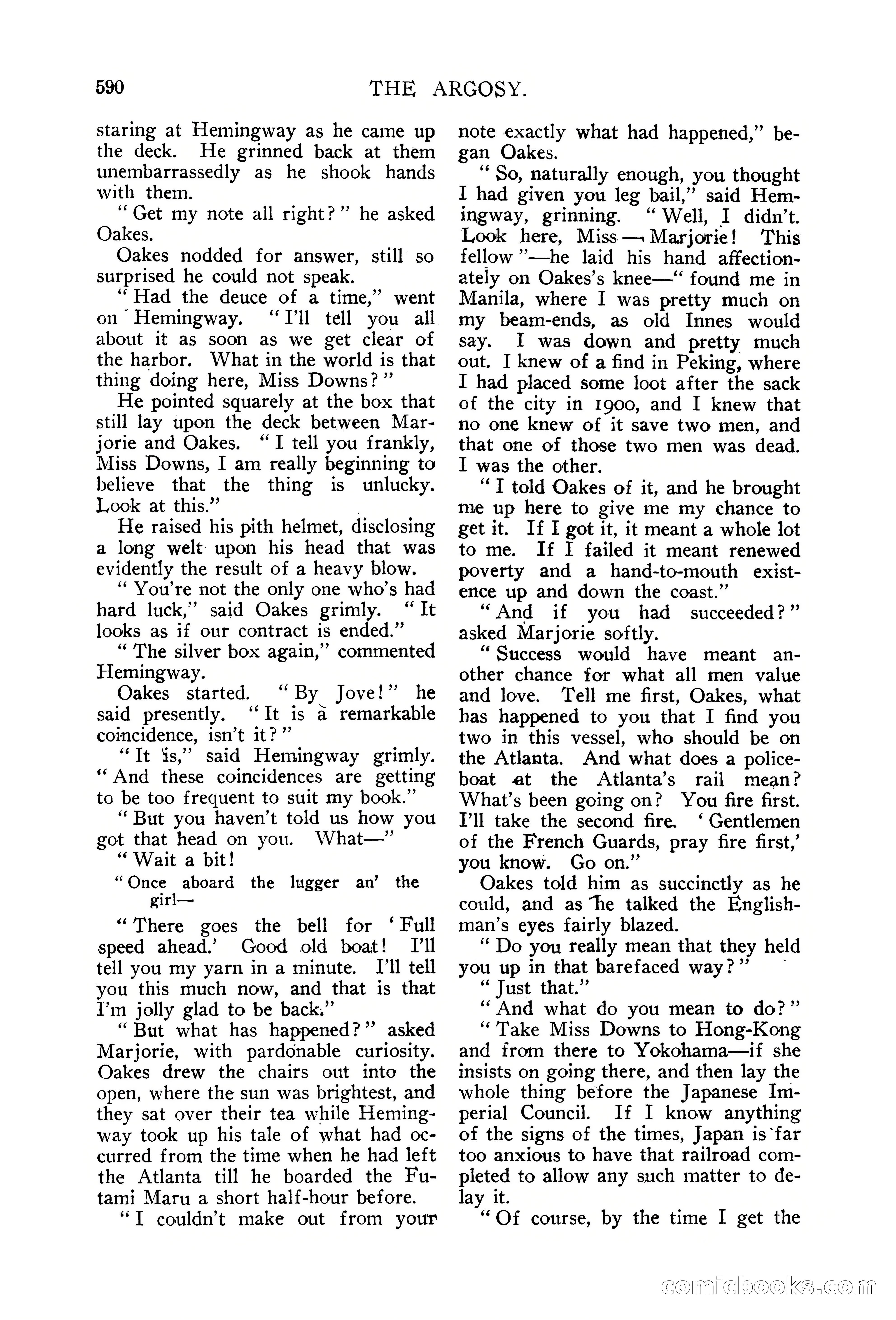
A restored page from Pulp Fiction, 1914. Page through the whole issue in the reader above.
📄 Transcribed text from this page (OCR, searchable)
Machine-transcribed from the original scan — historical spelling and the odd misread are preserved.
590 staring at Hemingway as he came up the deck. He grinned back at them unembarrassedly as he shook hands with them. “Get my note all right?” he asked Oakes. Oakes nodded for answer, still so surprised he could not speak. ‘““ Had the deuce of a time,” went on Hemingway. about it as soon as we get clear of the harbor. What in the world is that thing doing here, Miss Downs? ” He pointed squarely at the box that still lay upon the deck between Mar- jorie and Oakes. “I tell you frankly, Miss Downs, I am really beginning to believe that the thing is unlucky. Look at this.” | He raised his pith helmet, disclosing a long welt upon his head that was evidently the result of a heavy blow. ‘“You’re not the only one who’s had hard luck,” said Oakes grimly. “ It looks as if our contract is ended.” ‘“ The silver box again,’ commented Hemingway. Oakes started. “By Jove he said presently. “It is a remarkable coincidence, isn’t it?” “Tt is,” said Hemingway grimly. ** And these coincidences are getting to be too frequent to suit my book.” ‘But you haven’t told us how you got that head on you. What—” “Wait a bit! “Once aboard the lugger an’ the girl— “There goes the bell for ‘ Full speed ahead.’ Good old boat! Til tell you my yarn in a minute. I'll tell you this much now, and that is that I’m jolly glad to be back.” “ But what has happened?” asked Marjorie, with pardonable curiosity. Oakes drew the chairs out into the open, where the sun was brightest, and they sat over their tea while Heming- way took up his tale of what had oc- curred from the time when he had left the Atlanta till he boarded the Fu- tami Maru a short half-hour before. “T couldn't make out from your 99 ! “Tl tell you all THE ARGOSY. note exactly what had happened,” be- gan Oakes. ‘So, naturally enough, you thought I had given you leg bail,” said Hem- ingway, grinning. ‘ Well, I didn’t. Look here, Miss— Marjorie! This fellow ’—he laid his hand affection- ately on Oakes’s knee—“‘ found me in Manila, where I was pretty much on my beam-ends, as old Innes would say. I was down and pretty much out. I knew of a find in Peking, where I had placed some loot after the sack of the city in 1900, and I knew that no one knew of it save two men, and that one of those two men was dead. I was the other. ‘TI told Oakes of it, and he brought me up here to give me my chance to get it. If I got it, it meant a whole lot to me. If I failed it meant renewed poverty and a hand-to-mouth exist- ence up and down the coast.” “And if you had _ succeeded? ” asked Marjorie softly. “Success would have meant an- other chance for what all men value and love. Tell me first, Oakes, what has happened to you that I find you two in this vessel, who should be on the Atlanta. And what does a police- boat at the Atlanta’s rail mean? What’s been going on? You fire first. Ill take the second fire. ‘ Gentlemen of the French Guards, pray fire first,’ you know. Go on.” Oakes told him as succinctly as he could, and as ‘he talked the English- man’s eyes fairly blazed. “Do you really mean that they held you up in that barefaced way?” — “Just that.” “And what do you mean to do?” “Take Miss Downs to Hong-Kong and trom there to Yokohama—1if she insists on going there, and then lay the whole thing before the Japanese Im- perial Council. If I know anything of the signs of the times, Japan 1s far too anxious to have that railroad com- pleted to allow any such matter to de- lay it. “Of course, by the time I get the COMicdoo S CO@