
Pulp Fiction, 1914 · page 137 of 266
The Argosy, Vol. 76, No. 3 — page 137: what you’re looking at
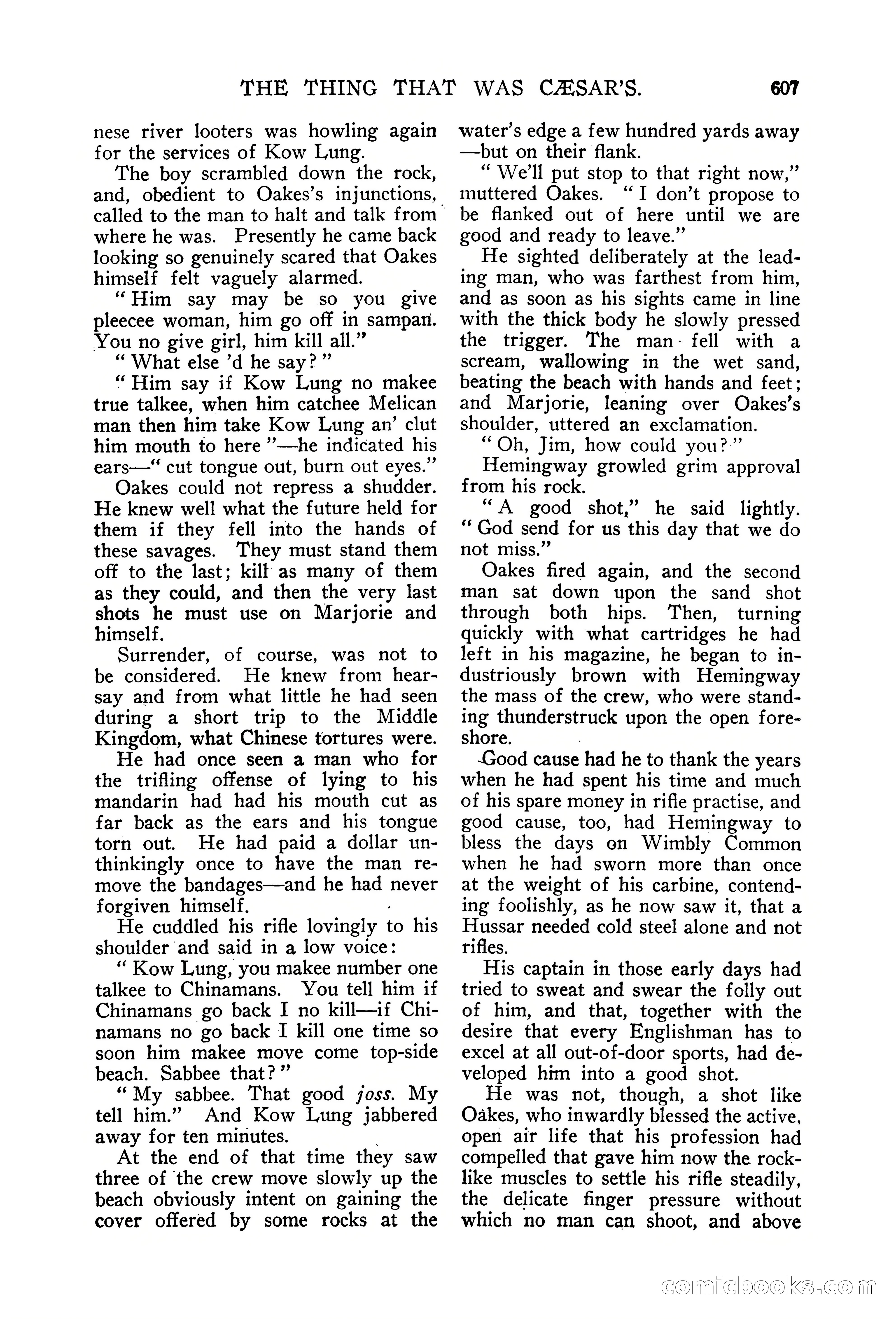
A restored page from Pulp Fiction, 1914. Page through the whole issue in the reader above.
📄 Transcribed text from this page (OCR, searchable)
Machine-transcribed from the original scan — historical spelling and the odd misread are preserved.
THE THING THAT WAS CASAR’S. nese river looters was howling again for the services of Kow Lung. The boy scrambled down the rock, and, obedient to Oakes’s injunctions, called to the man to halt and talk from > where he was. Presently he came back looking so genuinely scared that Oakes himself felt vaguely alarmed. “Him say may be so you give pleecee woman, him go off in sampan. You no give girl, him kill all.” “What else ’d he say? ” “Him say if Kow Lung no makee true talkee, when him catchee Melican man then him take Kow Lung an’ clut him mouth to here ’’—he indicated his ears— cut tongue out, burn out eyes.” Oakes could not repress a shudder. He knew well what the future held for them if they fell into the hands of these savages. They must stand them off to the last; kilt as many of them as they could, and then the very last shots he must use on Marjorie and himself. Surrender, of course, was not to be considered. He knew from hear- say and from what little he had seen during a short trip to the Middle Kingdom, what Chinese tortures were. He had once seen a man who for the trifling offense of lying to his mandarin had had his mouth cut as far back as the ears and his tongue torn out. He had paid a dollar un- thinkingly once to have the man re- move the bandages—and he had never forgiven himself, He cuddled his rifle lovingly to his shoulder and said in a low voice: “ Kow Lung, you makee number one talkee to Chinamans. You tell him if Chinamans go back I no kill—if Chi- namans no go back I kill one time so soon him makee move come top-side beach. Sabbee that?” “My sabbee. That good joss. My tell him.” And Kow Lung jabbered away for ten minutes. At the end of that time they saw three of the crew move slowly up the beach obviously intent on gaining the cover offered by some rocks at the 607 water's edge a few hundred yards away —but on their flank. “We'll put stop to that right now,” muttered Oakes. “I don’t propose to be flanked out of here until we are good and ready to leave.” He sighted deliberately at the lead- ing man, who was farthest from him, and as soon as his sights came in line with the thick body he slowly pressed the trigger. The man- fell with a scream, wallowing in the wet sand, beating the beach with hands and feet; and Marjorie, leaning over Oakes’s shoulder, uttered an exclamation. “Oh, Jim, how could you?” Hemingway growled grim approval from his rock. ““A good shot,” he said lightly. ** God send for us this day that we do not miss.’ Oakes fired again, and the second man sat down upon the sand shot through both hips. Then, turning quickly with what cartridges he had left in his magazine, he began to in- dustriously brown with Hemingway the mass of the crew, who were stand- ing thunderstruck upon the open fore- shore. Good cause had he to thank the years when he had spent his time and much of his spare money in rifle practise, and good cause, too, had Hemingway to bless the days on Wimbly Common when he had sworn more than once at the weight of his carbine, contend- ing foolishly, as he now saw it, that a Hussar needed cold steel alone and not rifles. His captain in those early days had tried to sweat and swear the folly out of him, and that, together with the desire that every Englishman has to excel at all out-of-door sports, had de- veloped htm into a good shot. He was not, though, a shot like Oakes, who inwardly blessed the active, open air life that his profession had compelled that gave him now the rock- like muscles to settle his rifle steadily, the delicate finger pressure without which no man can shoot, and above COMicdoo S CO@