
Pulp Fiction, 1914 · page 156 of 266
The Argosy, Vol. 76, No. 3 — page 156: what you’re looking at
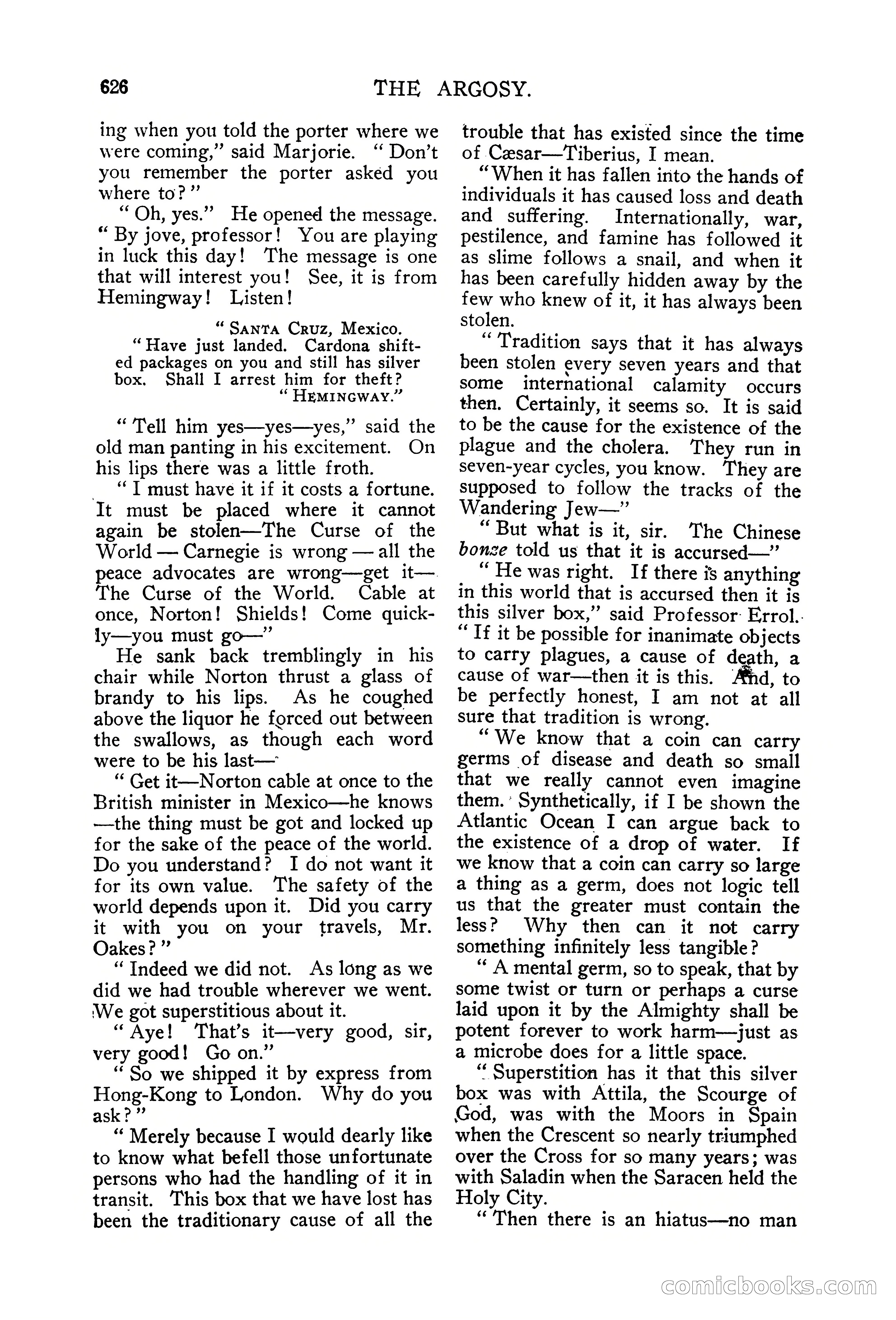
A restored page from Pulp Fiction, 1914. Page through the whole issue in the reader above.
📄 Transcribed text from this page (OCR, searchable)
Machine-transcribed from the original scan — historical spelling and the odd misread are preserved.
626 ing when you told the porter where we were coming,” said Marjorie. “‘ Don’t you remember the porter asked you where to?”’ “Oh, yes.” He opened the message. “ By jove, professor! You are playing in luck this day! The message is one that will interest you! See, it is from Hemingway! Listen! “Santa Cruz, Mexico. “Have just landed. Cardona shift- ed packages on you and still has silver box. Shall I arrest him for theft? “ HEMINGWAY.” “Tell him yes—yes—yes,” said the old man panting in his excitement. On his lips there was a little froth. “T must have it if it costs a fortune. It must be placed where it cannot again be stolen—The Curse of the World — Carnegie is wrong — all the peace advocates are wrong—get it—. The Curse of the World. Cable at once, Norton! Shields! Come quick- ly—you must go—” He sank back tremblingly in his chair while Norton thrust a glass of brandy to his lips. As he coughed above the liquor he forced out between the swallows, as though each word were to be his last— “Get it—Norton cable at once to the British minister in Mexico—he knows —the thing must be got and locked up for the sake of the peace of the world. Do you understand? I do not want it for its own value. The safety of the world depends upon it. Did you carry it with you on your travels, Mr. Oakes? ”’ “Indeed we did not. As long as we did we had trouble wherever we went. ‘We got superstitious about it. “Aye! That’s it—very good, sir, very good! Go on.” ‘So we shipped it by express from Hong-Kong to London. Why do you ask?” “Merely because I would dearly like to know what befell those unfortunate persons who had the handling of it in transit. This box that we have lost has been the traditionary cause of all the THE ARGOSY. trouble that has existed since the time of Czsar—Tiberius, I mean. “When it has fallen into the hands of individuals it has caused loss and death and suffering. Internationally, war, pestilence, and famine has followed it as slime follows a snail, and when it has been carefully hidden away by the few who knew of it, it has always been stolen. “ Tradition says that it has always been stolen every seven years and that some international calamity occurs then. Certainly, it seems so. It is said to be the cause for the existence of the plague and the cholera. They run in seven-year cycles, you know. They are supposed to follow the tracks of the Wandering Jew—” “But what is it, sir. The Chinese bonze told us that it is accursed—” “ He was right. If there is anything in this world that is accursed then it is this silver box,” said Professor: Errol.. “ If it be possible for inanimate objects to carry plagues, a cause of death, a cause of war—then it is this. And, to be perfectly honest, I am not at all sure that tradition is wrong. “We know that a coin can carry germs of disease and death so small that we really cannot even imagine them. ' Synthetically, if I be shown the Atlantic Ocean I can argue back to the existence of a drop of water. If we know that a coin can carry so large a thing as a germ, does not logic tell us that the greater must contain the less? Why then can it not carry something infinitely less tangible? ‘‘ A mental germ, so to speak, that by some twist or turn or perhaps a curse laid upon it by the Almighty shall be potent forever to work harm—yjust as a microbe does for a little space. “ Superstition has it that this silver box was with Attila, the Scourge of God, was with the Moors in Spain when the Crescent so nearly triumphed over the Cross for so many years; was with Saladin when the Saracen held the Holy City. “Then there is an hiatus—no man COMicdoo S CO@