
Pulp Fiction, 1914 · page 186 of 266
The Argosy, Vol. 76, No. 3 — page 186: what you’re looking at
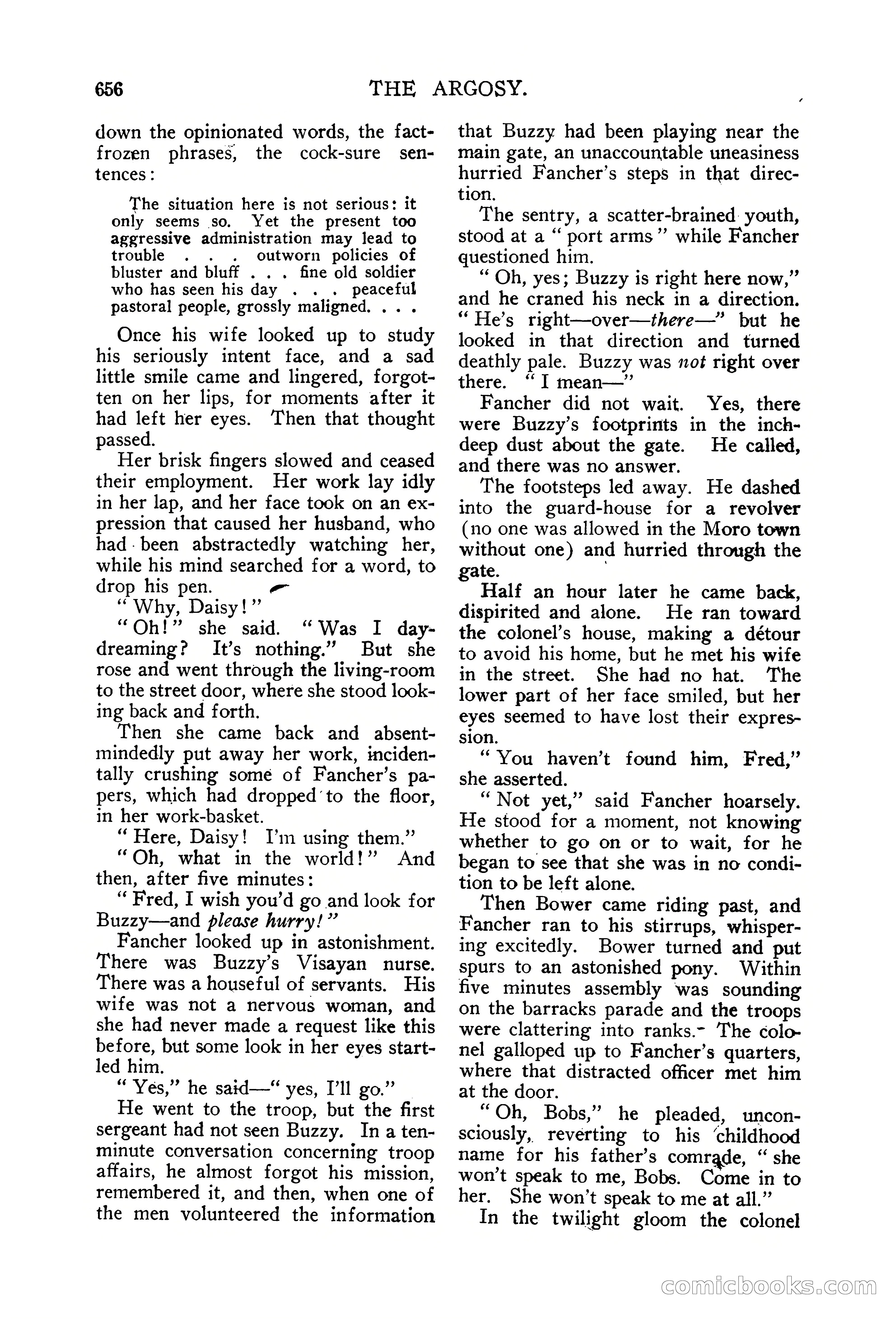
A restored page from Pulp Fiction, 1914. Page through the whole issue in the reader above.
📄 Transcribed text from this page (OCR, searchable)
Machine-transcribed from the original scan — historical spelling and the odd misread are preserved.
656 down the opinionated words, the fact- frozen phrases, the cock-sure_ sen- tences : The situation here is not serious: it only seems so. Yet the present too aggressive administration may lead to trouble . . . outworn policies of bluster and bluff . .. fine old soldier who has seen his day . peaceful pastoral people, grossly maligned. .. . Once his wife looked up to study his seriously intent face, and a sad little smile came and lingered, forgot- ten on her lips, for moments after it had left her eyes. Then that thought passed. Her brisk fingers slowed and ceased their employment. Her work lay idly in her lap, and her face took on an ex- pression that caused her husband, who had- been abstractedly watching her, while his mind searched for a word, to drop his pen. o- “Why, Daisy!” “Oh!” she said. “Was I day- dreaming? It’s nothing.” But she rose and went through the living-room to the street door, where she stood look- ing back and forth. Then she came back and absent- mindedly put away her work, inciden- tally crushing some of Fancher’s pa- pers, which had dropped ‘to the floor, in her work-basket. “Here, Daisy! [’m using them.” “Oh, what in the world!” And then, after five minutes: “Fred, I wish you’d go and look for Buzzy—and please hurry!” Fancher looked up in astonishment. There was Buzzy’s Visayan nurse. There was a houseful of servants. His wife was not a nervous woman, and she had never made a request like this before, but some look in her eyes start- led him. “Yes,” he satd—“ yes, I’ll go.” | He went to the troop, but the first sergeant had not seen Buzzy. Ina ten- minute conversation concerning troop affairs, he almost forgot his mission, remembered it, and then, when one of the men volunteered the information THE ARGOSY. that Buzzy had been playing near the main gate, an unaccountable uneasiness hurried Fancher’s steps in that direc- tion. The sentry, a scatter-brained: youth, stood at a “ port arms” while Fancher questioned him. “ Oh, yes; Buzzy is right here now,” and he craned his neck in a direction. “ He’s right—over—there—” but he looked in that direction and turned deathly pale. Buzzy was not right over there. ‘“ I mean—” Fancher did not wait. Yes, there were Buzzy’s footprints in the inch- deep dust about the gate. He called, and there was no answer. The footsteps led away. He dashed into the guard-house for a revolver (no one was allowed in the Moro town without one) and hurried through the gate. Half an hour later he came back, dispirited and alone. He ran toward the colonel’s house, making a détour to avoid his home, but he met his wife in the street. She had no hat. The lower part of her face smiled, but her eyes seemed to have lost their expres- sion. “You haven’t found him, Fred,” she asserted. “Not yet,” said Fancher hoarsely. He stood for a moment, not knowing whether to go on or to wait, for he began to see that she was in no condi- tion to be left alone. Then Bower came riding past, and Fancher ran to his stirrups, whisper- ing excitedly. Bower turned and put spurs to an astonished pony. Within five minutes assembly was sounding on the barracks parade and the troops were clattering into ranks.- The colo- nel galloped up to Fancher’s quarters, where that distracted officer met him at the door. “Oh, Bobs,” he pleaded, uncon- sciously, reverting to his ‘childhood name for his father’s comrade, “ she won't speak to me, Bobs. Come in to her. She won’t speak to me at all.” In the twilight gloom the colonel COMicdoo S CO@