
Pulp Fiction, 1914 · page 23 of 266
The Argosy, Vol. 76, No. 3 — page 23: what you’re looking at
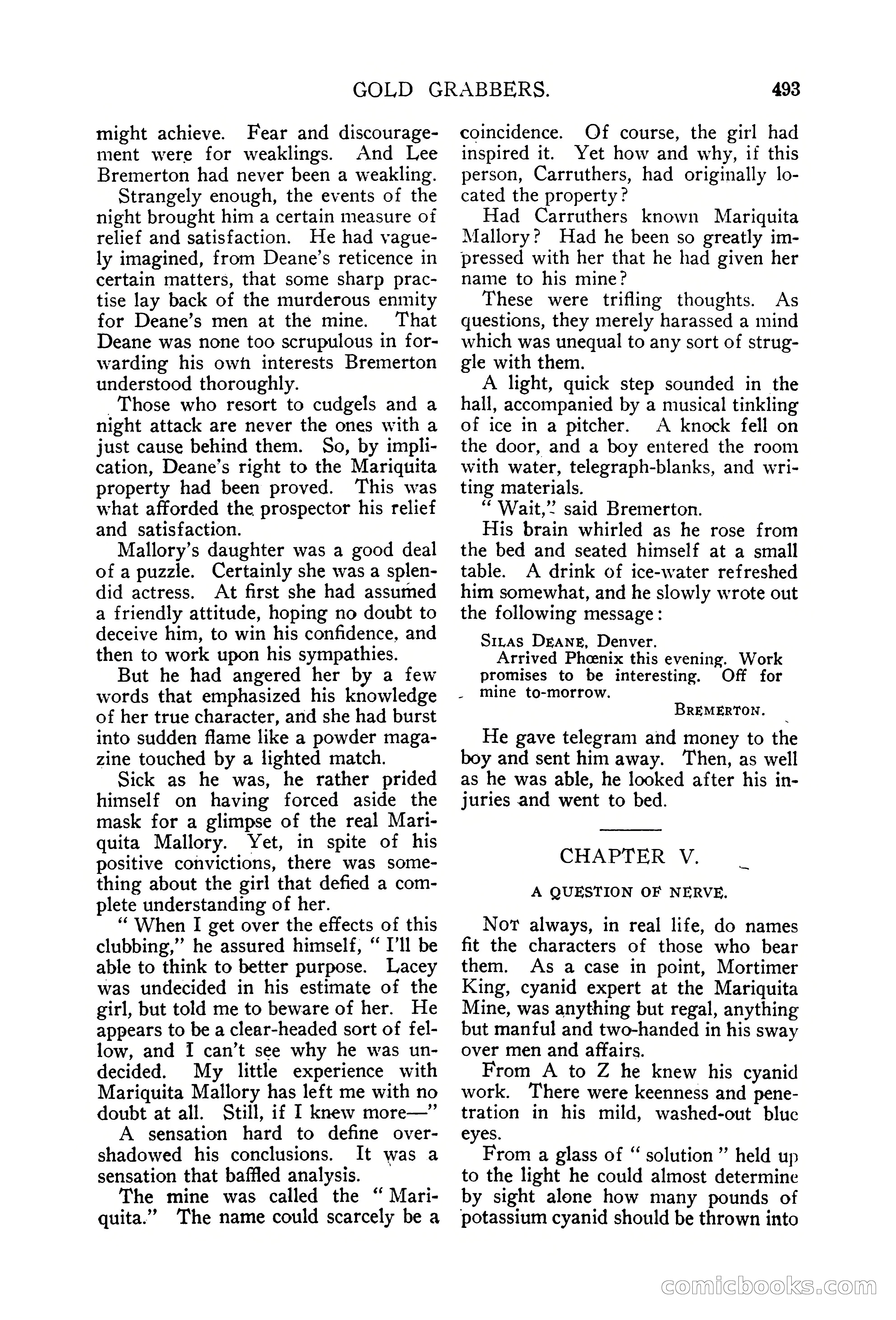
A restored page from Pulp Fiction, 1914. Page through the whole issue in the reader above.
📄 Transcribed text from this page (OCR, searchable)
Machine-transcribed from the original scan — historical spelling and the odd misread are preserved.
GOLD GRABBERS. might achieve. Fear and discourage- ment were for weaklings. And Lee Bremerton had never been a weakling. Strangely enough, the events of the night brought him a certain measure of relief and satisfaction. He had vague- ly imagined, from Deane’s reticence in certain matters, that some sharp prac- tise lay back of the murderous enmity for Deane’s men at the mine. That Deane was none too scrupulous in for- warding his owh interests Bremerton understood thoroughly. Those who resort to cudgels and a night attack are never the ones with a just cause behind them. So, by impli- cation, Deane’s right to the Mariquita property had been proved. This was what afforded the prospector his relief and satisfaction. Mallory’s daughter was a good deal of a puzzle. Certainly she was a splen- did actress. At first she had assumed a friendly attitude, hoping no doubt to deceive him, to win his confidence, and then to work upon his sympathies. But he had angered her by a few words that emphasized his knowledge of her true character, and she had burst into sudden flame like a powder maga- zine touched by a lighted match. Sick as he was, he rather prided himself on having forced aside the mask for a glimpse of the real Mari- quita Mallory. Yet, in spite of his positive convictions, there was some- thing about the girl that defied a com- plete understanding of her. “When I get over the effects of this clubbing,” he assured himself, “ I'll be able to think to better purpose. Lacey was undecided in his estimate of the girl, but told me to beware of her. He appears to be a clear-headed sort of fel- low, and I can’t see why he was un- decided. My little experience with Mariquita Mallory has left me with no doubt at all. Still, if I knew more—” A sensation hard to define over- shadowed his conclusions. It was a sensation that baffled analysis. The mine was called the “ Mari- 493 coincidence. Of course, the girl had inspired it. Yet how and why, if this person, Carruthers, had originally lo- cated the property? Had Carruthers known Mariquita Mallory? Had he been so greatly im- pressed with her that he had given her name to his mine? These were trifling thoughts. As questions, they merely harassed a mind which was unequal to any sort of strug- gle with them. A light, quick step sounded in the hall, accompanied by a musical tinkling of ice in a pitcher. A knock fell on the door, and a boy entered the room with water, telegraph-blanks, and wri- ting materials. “ Wait,” said Bremerton. His brain whirled as he rose from the bed and seated himself at a small table. A drink of ice-water refreshed him somewhat, and he slowly wrote out the following message: SILAS Deane, Denver. Arrived Phoenix this evening. Work promises to be interesting. Off for _ mine to-morrow. BREMERTON. He gave telegram and money to the boy and sent him away. Then, as well as he was able, he looked after his in- juries and went to bed. CHAPTER V. A QUESTION OF NERVE. Not always, in real life, do names fit the characters of those who bear them. As a case in point, Mortimer King, cyanid expert at the Mariquita Mine, was anything but regal, anything but manful and two-handed in his sway over men and affairs. From A to Z he knew his cyanid work. There were keenness and pene- tration in his mild, washed-out blue eyes. From a glass of “ solution” held up to the light he could almost determine by sight alone how many pounds of quita.” The name could scarcely be a potassium cyanid should be thrown into COMicdoo S CO@