
Pulp Fiction, 1914 · page 243 of 266
The Argosy, Vol. 76, No. 3 — page 243: what you’re looking at
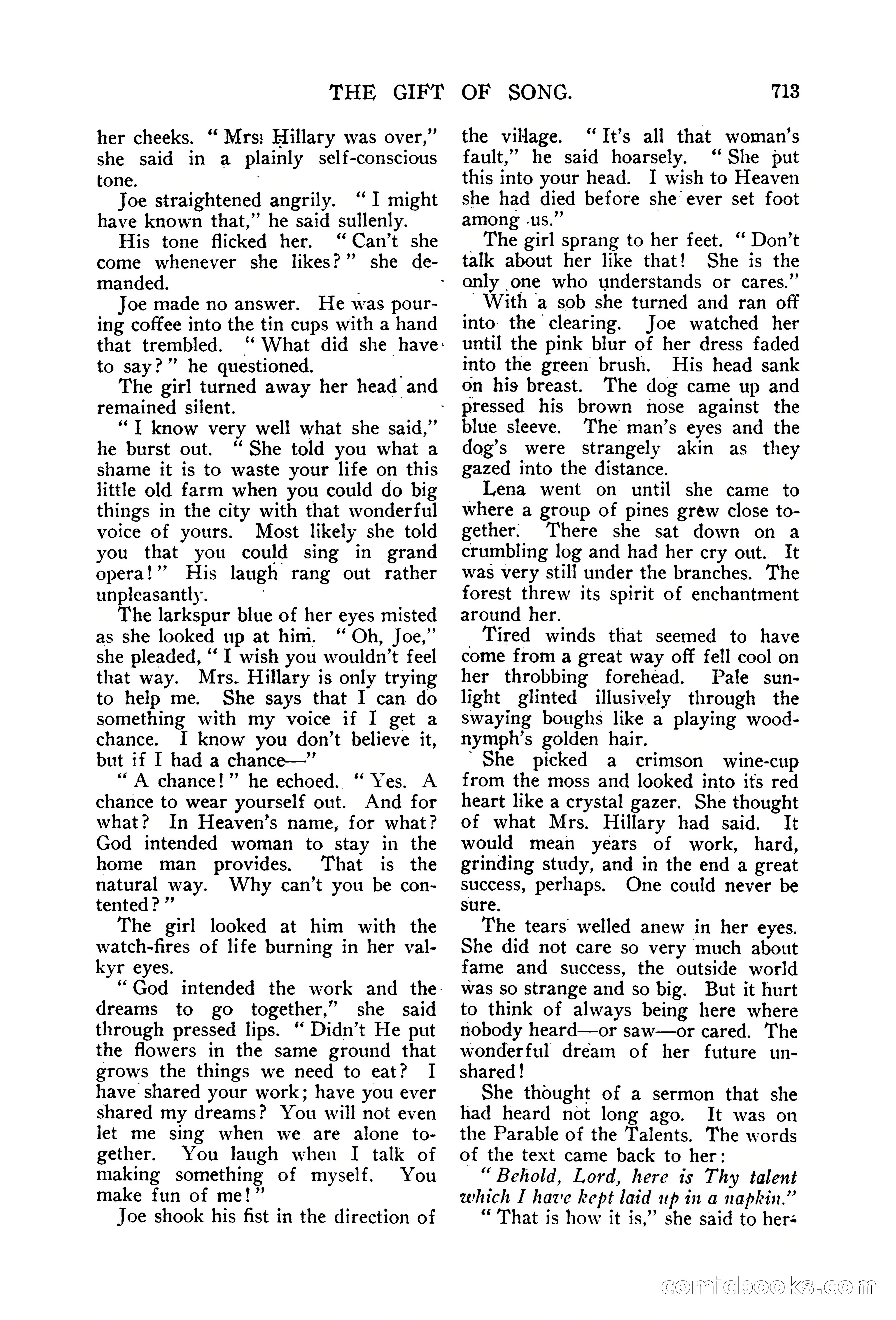
A restored page from Pulp Fiction, 1914. Page through the whole issue in the reader above.
📄 Transcribed text from this page (OCR, searchable)
Machine-transcribed from the original scan — historical spelling and the odd misread are preserved.
THE GIFT her cheeks. “ Mrs: Hillary was over,” she said in a plainly self-conscious tone. | Joe straightened angrily. ‘ I might have known that,” he said sullenly. His tone flicked her. “‘ Can’t she come whenever she likes?” she de- manded. Joe made no answer. He was pour- ing coffee into the tin cups with a hand that trembled. “What did she have: to say?” he questioned. The girl turned away her head and remained silent. ““T know very well what she said,” he burst out. “ She told you what a shame it is to waste your life on this little old farm when you could do big things in the city with that wonderful voice of yours. Most likely she told you that you could sing in grand opera!” His laugh rang out rather unpleasantly. : The larkspur blue of her eyes misted as she looked up at him. ‘“ Oh, Joe,” she pleaded, “I wish you wouldn’t feel that way. Mrs. Hillary is only trying to help me. She says that I can do something with my voice if I get a chance. I know you don’t believe it, but 1f I had a chance—” “A chance!” he echoed. “ Yes. A chance to wear yourself out. And for what? In Heaven’s name, for what? God intended woman to stay in the home man provides. That is the natural way. Why can’t you be con- tented?” The girl looked at him with the watch-fires of life burning in her val- kyr eyes. “God intended the work and the: dreams to go together,” she said through pressed lips. “ Didn’t He put the flowers in the same ground that grows the things we need to eat? I have shared your work; have you ever shared my dreams? You will not even let me sing when we are alone to- gether. You laugh when I talk of making something of myself. You make fun of me!” Joe shook his fist in the direction of OF SONG. 713 the village. “It’s all that woman’s fault,” he said hoarsely. ‘‘ She put this into your head. I wish to Heaven she had died before she ever set foot among -us.”’ The girl sprang to her feet. ‘“ Don’t talk about her like that! She is the anly one who understands or cares.” With a sob she turned and ran off into the clearing. Joe watched her until the pink blur of her dress faded into the green brush. His head sank on his breast. The dog came up and pressed his brown nose against the blue sleeve. The man’s eyes and the dog’s were strangely akin as they gazed into the distance. Lena went on until she came to where a group of pines grew close to- gether. There she sat down on a crumbling log and had her cry out. It was very still under the branches. The forest threw its spirit of enchantment around her. Tired winds that seemed to have come from a great way off fell cool on her throbbing forehead. Pale sun- light glinted illusively through the swaying boughs like a playing wood- nymph’s golden hair. ~She picked a crimson wine-cup from the moss and looked into its red heart like a crystal gazer. She thought of what Mrs. Hillary had said. It would mean years of work, hard, grinding study, and in the end a great success, perhaps. One could never be sure. The tears welled anew in her eyes. She did not care so very much about fame and success, the outside world was so strange and so big. But it hurt to think of always being here where nobody heard—or saw—or cared. The wonderful dream of her future un- shared ! She thought of a sermon that she had heard not long ago. It was on the Parable of the Talents. The words of the text came back to her: “ Behold, Lord, here ts Thy talent which I have kept laid up in a napkin.” “That is how it is,” she said to hers COMicdoo S CO@