
Pulp Fiction, 1914 · page 93 of 266
The Argosy, Vol. 76, No. 3 — page 93: what you’re looking at
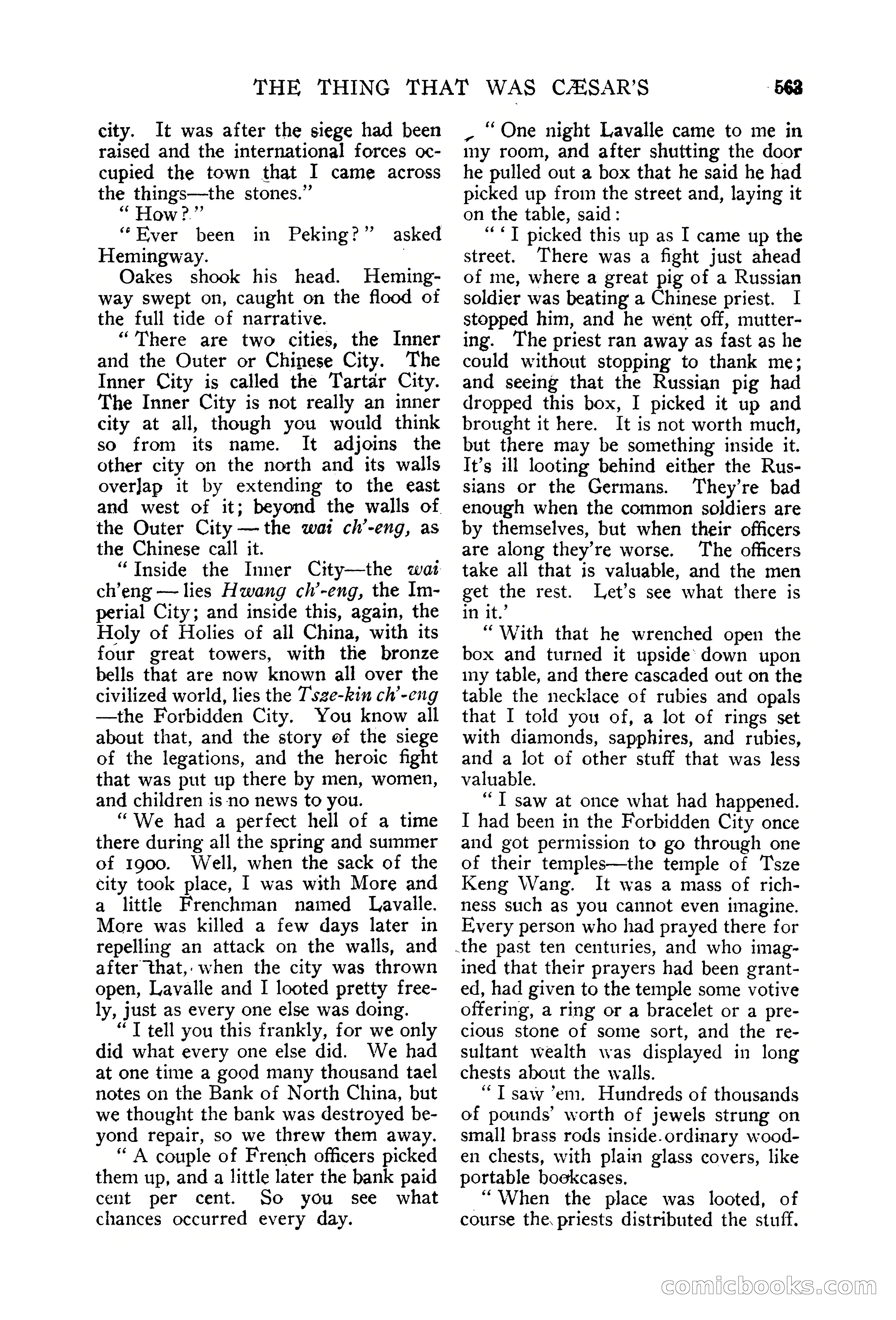
A restored page from Pulp Fiction, 1914. Page through the whole issue in the reader above.
📄 Transcribed text from this page (OCR, searchable)
Machine-transcribed from the original scan — historical spelling and the odd misread are preserved.
THE THING THAT WAS CZISAR’S city. It was after the siege had been raised and the international forces oc- cupied the town that I came across the things—the stones.” “Ever been in Peking?” asked Hemingway. | Oakes shook his head. Heming- way swept on, caught on the flood of the full tide of narrative. “There are two cities, the Inner and the Outer or Chinese City. The Inner City is called the Tartar City. The Inner City is not really an inner city at all, though you would think so from its name. It adjoins the other city on the north and its walls overJap it by extending to the east and west of it; beyond the walls of. the Outer City —the wat ch’-eng, as the Chinese call it. “Inside the Inner City—the waz ch’eng — lies Hwang ch’-eng, the Im- perial City; and inside this, again, the Holy of Holies of all China, with its four great towers, with the bronze bells that are now known all over the civilized world, lies the Tsze-kin ch’-eng —the Forbidden City. You know all about that, and the story of the siege of the legations, and the heroic fight that was put up there by men, women, and children is no news to you. “We had a perfect hell of a time there during all the spring and summer of 1900. Well, when the sack of the city took place, I was with More and a little Frenchman named Lavalle. More was killed a few days later in repelling an attack on the walls, and after that, when the city was thrown open, Lavalle and I looted pretty free- ly, just as every one else was doing. “T tell you this frankly, for we only did what every one else did. We had at one time a good many thousand tael notes on the Bank of North China, but we thought the bank was destroyed be- yond repair, so we threw them away. “A couple of French officers picked them up, and a little later the bank paid cent per cent. So you see what chances occurred every day. 563 _ One night Lavalle came to me in my room, and after shutting the door he pulled out a box that he said he had picked up from the street and, laying it on the table, said: “*T picked this up as I came up the street. There was a fight just ahead of me, where a great pig of a Russian soldier was beating a Chinese priest. I stopped him, and he went off, mutter- ing. The priest ran away as fast as he could without stopping to thank me; and seeing that the Russian pig had dropped this box, I picked it up and brought it here. It is not worth much, but there may be something inside it. It’s ill looting behind either the Rus- sians or the Germans. They’re bad enough when the common soldiers are by themselves, but when their officers are along they’re worse. The officers take all that is valuable, and the men get the rest. Let’s see what there is in it.’ “With that he wrenched open the box and turned it upside’ down upon iny table, and there cascaded out on the table the necklace of rubies and opals that I told you of, a lot of rings set with diamonds, sapphires, and rubies, and a lot of other stuff that was less valuable. “I saw at once what had happened. I had been in the Forbidden City once and got permission to go through one of their temples—the temple of T'sze Keng Wang. It was a mass of rich- ness such as you cannot even imagine. Every person who had prayed there for .the past ten centuries, and who imag- ined that their prayers had been grant- ed, had given to the temple some votive offering, a ring or a bracelet or a pre- cious stone of some sort, and the re- sultant wealth was displayed in long chests about the walls. “I saw ’em. Hundreds of thousands of pounds’ worth of jewels strung on small brass rods inside.ordinary wood- en chests, with plain glass covers, like portable bookcases. “When the place was looted, of course the priests distributed the stuff. COMicdoo S CO@