
Pulp Fiction, 1917 · page 140 of 192
Argosy, Vol. 85, No. 3 — page 140: what you’re looking at
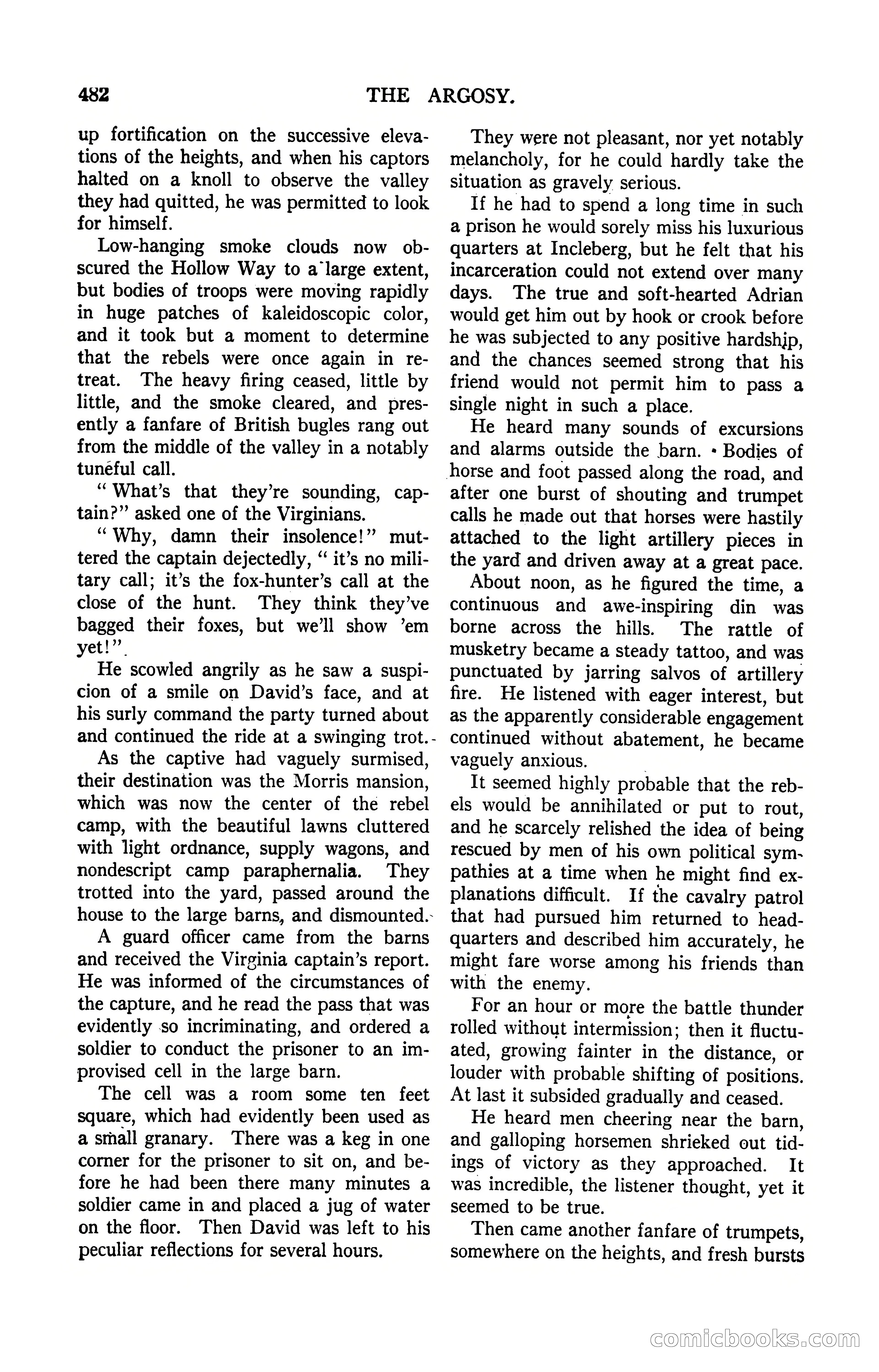
A restored page from Pulp Fiction, 1917. Page through the whole issue in the reader above.
📄 Transcribed text from this page (OCR, searchable)
Machine-transcribed from the original scan — historical spelling and the odd misread are preserved.
482 THE up fortification on the successive eleva- tions of the heights, and when his captors halted on a knoll to observe the valley they had quitted, he was permitted to look for himself. Low-hanging smoke clouds now ob- scured the Hollow Way to a large extent, but bodies of troops were moving rapidly in huge patches of kaleidoscopic color, and it took but a moment to determine that the rebels were once again in re- treat. The heavy firing ceased, little by little, and the smoke cleared, and pres- ently a fanfare of British bugles rang out from the middle of the valley in a notably tuneful call. “What’s that they’re sounding, cap- tain?” asked one of the Virginians. ‘Why, damn their insolence!”’ mut- tered the captain dejectedly, “‘ it’s no mili- tary call; it’s the fox-hunter’s call at the close of the hunt. They think they’ve bagged their foxes, but we’ll show ’em yet!’ He scowled angrily as he saw a suspi- cion of a smile on David’s face, and at his surly command the party turned about and continued the ride at a swinging trot. - As the captive had vaguely surmised, their destination was the Morris mansion, which was now the center of the rebel camp, with the beautiful lawns cluttered with light ordnance, supply wagons, and nondescript camp paraphernalia. They trotted into the yard, passed around the house to the large barns, and dismounted.- A guard officer came from the barns and received the Virginia captain’s report. He was informed of the circumstances of the capture, and he read the pass that was evidently so incriminating, and ordered a soldier to conduct the prisoner to an im- provised cell in the large barn. The cell was a room some ten feet square, which had evidently been used as a small granary. There was a keg in one corner for the prisoner to sit on, and be- fore he had been there many minutes a soldier came in and placed a jug of water on the floor. Then David was left to his peculiar reflections for several hours. ARGOSY. They were not pleasant, nor yet notably melancholy, for he could hardly take the Situation as gravely serious. If he had to spend a long time in such a prison he would sorely miss his luxurious quarters at Incleberg, but he felt that his incarceration could not extend over many days. The true and soft-hearted Adrian would get him out by hook or crook before he was subjected to any positive hardship, and the chances seemed strong that his friend would not permit him to pass a single night in such a place. He heard many sounds of excursions and alarms outside the barn. + Bodies of horse and foot passed along the road, and after one burst of shouting and trumpet calls he made out that horses were hastily attached to the light artillery pieces in the yard and driven away at a great pace. About noon, as he figured the time, a continuous and awe-inspiring din was borne across the hills. The rattle of musketry became a steady tattoo, and was punctuated by jarring salvos of artillery fire. He listened with eager interest, but as the apparently considerable engagement continued without abatement, he became vaguely anxious. . It seemed highly probable that the reb- els would be annihilated or put to rout, and he scarcely relished the idea of being rescued by men of his own political sym- pathies at a time when he might find ex- planations difficult. If the cavalry patrol that had pursued him returned to head- quarters and described him accurately, he might fare worse among his friends than with the enemy. For an hour or more the battle thunder rolled without intermission; then it fluctu- ated, growing fainter in the distance, or louder with probable shifting of positions. At last it subsided gradually and ceased. He heard men cheering near the barn, and galloping horsemen shrieked out tid- ings of victory as they approached. It was incredible, the listener thought, yet it seemed to be true. Then came another fanfare of trumpets, somewhere on the heights, and fresh bursts MICLOOOK C©