
Pulp Fiction, 1917 · page 160 of 192
Argosy, Vol. 85, No. 3 — page 160: what you’re looking at
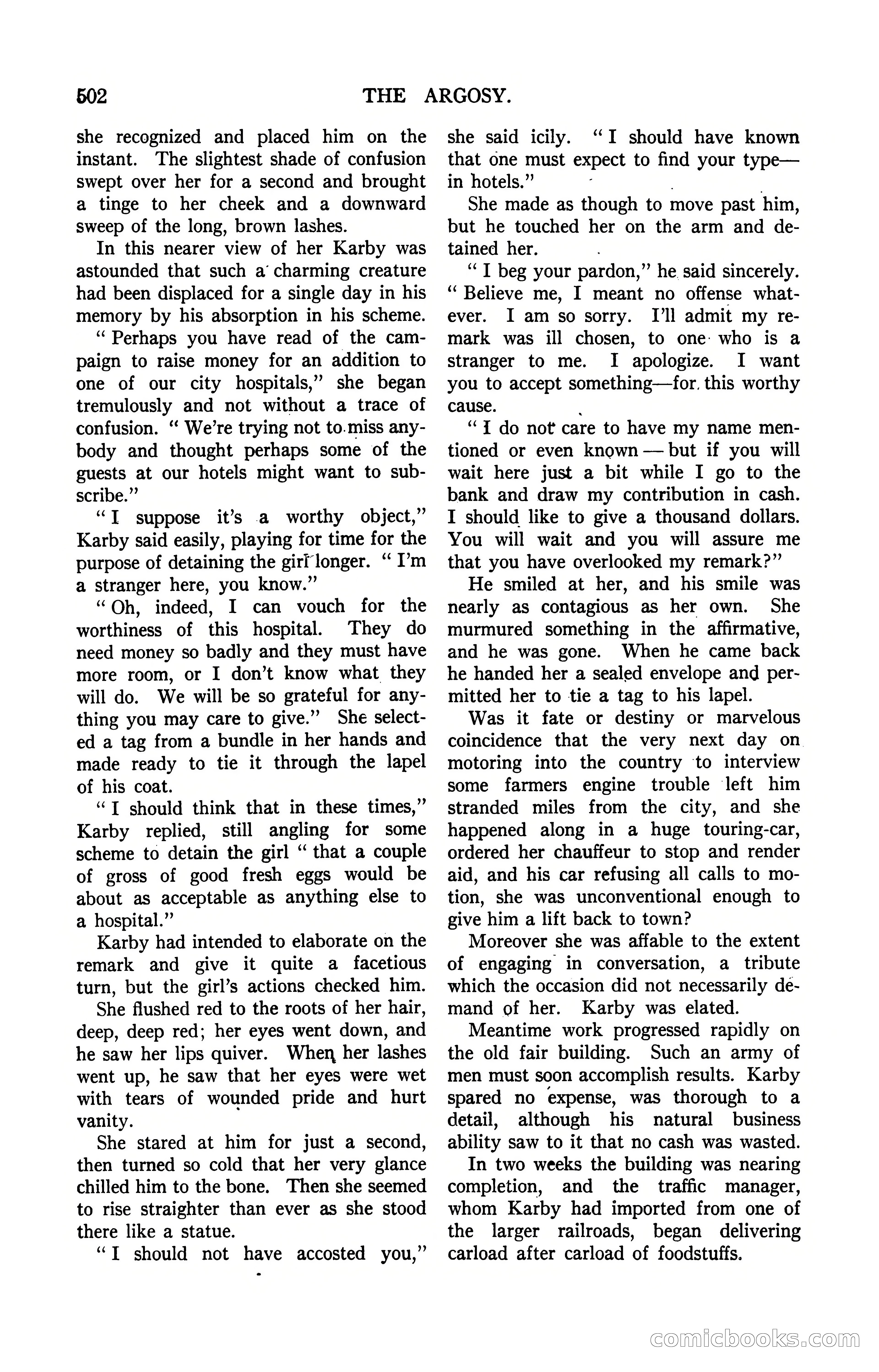
A restored page from Pulp Fiction, 1917. Page through the whole issue in the reader above.
📄 Transcribed text from this page (OCR, searchable)
Machine-transcribed from the original scan — historical spelling and the odd misread are preserved.
502 THE she recognized and placed him on the instant. The slightest shade of confusion swept over her for a second and brought a tinge to her cheek and a downward sweep of the long, brown lashes. In this nearer view of her Karby was astounded that such a charming creature had been displaced for a single day in his memory by his absorption in his scheme. ‘Perhaps you have read of the cam- paign to raise money for an addition to one of our city hospitals,” she began tremulously and not without a trace of confusion. “‘ We’re trying not to.miss any- body and thought perhaps some of the guests at our hotels might want to sub- scribe.” “TI suppose it’s a worthy object,” Karby said easily, playing for time for the purpose of detaining the girl longer. “ I’m a stranger here, you know.” “Oh, indeed, I can vouch for the worthiness of this hospital. They do need money so badly and they must have more room, or I don’t know what they will do. We will be so grateful for any- thing you may care to give.” She select- ed a tag from a bundle in her hands and made ready to tie it through the lapel of his coat. “T should think that in these times,” Karby replied, still angling for some scheme to detain the girl “ that a couple of gross of good fresh eggs would be about as acceptable as anything else to a hospital.” Karby had intended to elaborate on the remark and give it quite a facetious turn, but the girl’s actions checked him. She flushed red to the roots of her hair, deep, deep red; her eyes went down, and he saw her lips quiver. When her lashes went up, he saw that her eyes were wet with tears of wounded pride and hurt vanity. She stared at him for just a second, then turned so cold that her very glance chilled him to the bone. Then she seemed to rise straighter than ever as she stood there like a statue. “T should not have accosted you,” ARGOSY. she said icily. “I should have known that one must expect to find your type— in hotels.” . She made as though to move past him, but he touched her on the arm and de- tained her. ‘““T beg your pardon,” he said sincerely. ‘“‘ Believe me, I meant no offense what- ever. I am so sorry. I’ll admit my re- mark was ill chosen, to one: who is a stranger to me. I apologize. I want you to accept something—for, this worthy cause. ‘“{ do not care to have my name men- tioned or even known — but if you will wait here just a bit while I go to the bank and draw my contribution in cash. I should like to give a thousand dollars. You will wait and you will assure me that you have overlooked my remark?” He smiled at her, and his smile was nearly as contagious as her own. She murmured something in the affirmative, and he was gone. When he came back he handed her a sealed envelope and per- mitted her to tie a tag to his lapel. Was it fate or destiny or marvelous coincidence that the very next day on motoring into the country to interview some farmers engine trouble left him stranded miles from the city, and she happened along in a huge touring-car, ordered her chauffeur to stop and render aid, and his car refusing all calls to mo- tion, she was unconventional enough to give him a lift back to town? Moreover she was affable to the extent of engaging in conversation, a tribute which the occasion did not necessarily de- mand of her. Karby was elated. Meantime work progressed rapidly on the old fair building. Such an army of men must soon accomplish results. Karby spared no expense, was thorough to a detail, although his natural business ability saw to it that no cash was wasted. In two weeks the building was nearing completion, and the traffic manager, whom Karby had imported from one of the larger railroads, began delivering carload after carload of foodstuffs. comicloool C©