
Pulp Fiction, 1917 · page 68 of 192
Argosy, Vol. 85, No. 3 — page 68: what you’re looking at
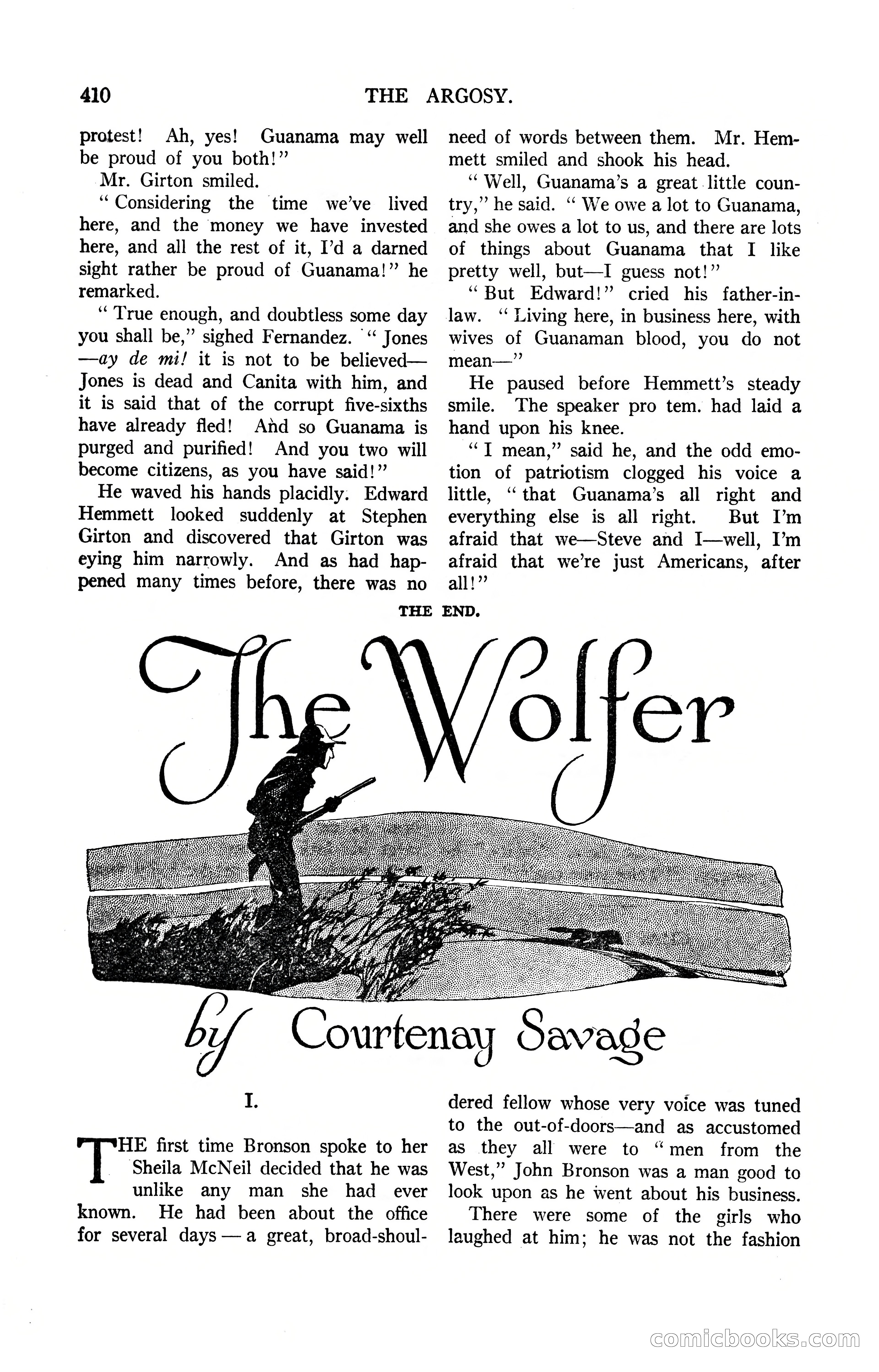
A restored page from Pulp Fiction, 1917. Page through the whole issue in the reader above.
📄 Transcribed text from this page (OCR, searchable)
Machine-transcribed from the original scan — historical spelling and the odd misread are preserved.
410 protest! Ah, yes! Guanama may well be proud of you both!” ‘Mr. Girton smiled. “Considering the time we’ve lived here, and the money we have invested here, and all the rest of it, I’d a darned sight rather be proud of Guanama!” he remarked. ‘“ True enough, and doubtless some day you shall be,” sighed Fernandez. ‘“ Jones —ay de mi! it is not to be believed— Jones is dead and Canita with him, and it is said that of the corrupt five-sixths have already fled! And so Guanama is purged and purified! And you two will become citizens, as you have said!” He waved his hands placidly. Edward Hemmett looked suddenly at Stephen Girton and discovered that Girton was eying him narrowly. And as had hap- pened many times before, there was no law. THE ARGOSY. need of words between them. Mr. Hem- mett smiled and shook his head. ‘Well, Guanama’s a great little coun- try,” he said. “ We owe a lot to Guanama, and she owes a lot to us, and there are lots of things about Guanama that I like pretty well, but—I guess not!” “But Edward!” cried his father-in- ‘Living here, in business here, with wives of Guanaman blood, you do not mean—”’ He paused before Hemmett’s steady smile. The speaker pro tem. had laid a hand upon his knee. “T mean,” said he, and the odd emo- tion of patriotism clogged his voice a little, “that Guanama’s all right and everything else is all right. But I’m afraid that we—Steve and I—well, I’m afraid that we’re just Americans, after all!” THE END. I. HE first time Bronson spoke to her _ Sheila McNeil decided that he was unlike any man she had _ ever known. He had been about the office for several days —a great, broad-shoul- Courtenay Savage dered fellow whose very voice was tuned to the out-of-doors—and as accustomed as they all were to “men from the West,” John Bronson was a man good to look upon as he went about his business. There were some of the girls who laughed at him; he was not the fashion CO DOO C©