
Pulp Fiction, 1917 · page 101 of 200
The Argosy, Vol. 90 No. 1 — page 101: what you’re looking at
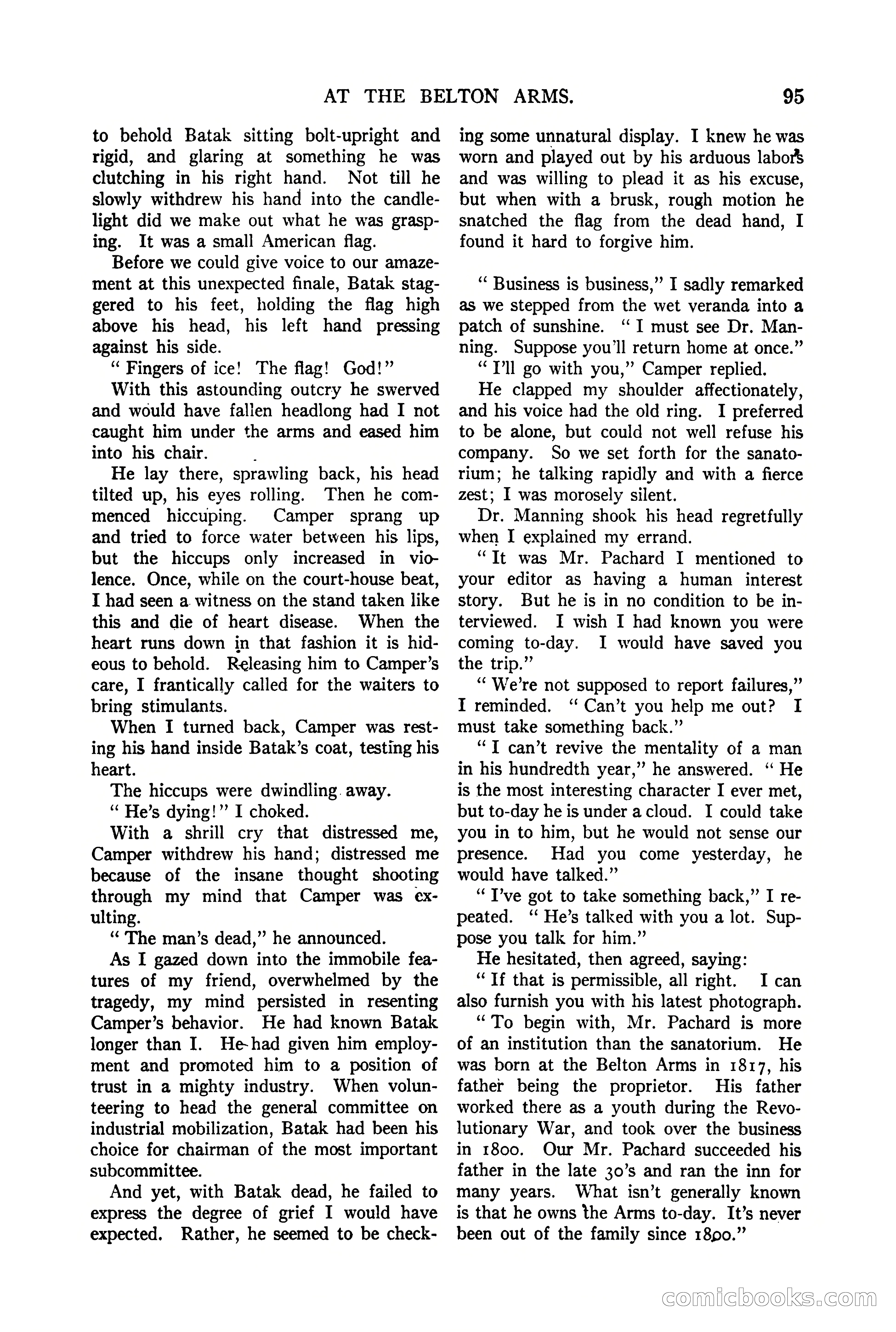
A restored page from Pulp Fiction, 1917. Page through the whole issue in the reader above.
📄 Transcribed text from this page (OCR, searchable)
Machine-transcribed from the original scan — historical spelling and the odd misread are preserved.
AT THE BELTON ARMS. to behold Batak sitting bolt-upright and rigid, and glaring at something he was clutching in his right hand. Not till he slowly withdrew his hand into the candle- light did we make out what he was grasp- ing. It was a small American flag. Before we could give voice to our amaze- ment at this unexpected finale, Batak stag- gered to his feet, holding the flag high above his head, his left hand pressing against his side. “Fingers of ice! The flag! God!” With this astounding outcry he swerved and would have fallen headlong had I not caught him under the arms and eased him into his chair. He lay there, sprawling back, his head tilted up, his eyes rolling. Then he com- menced hiccuping. Camper sprang up and tried to force water between his lips, but the hiccups only increased in vio- lence. Once, while on the court-house beat, I had seen a witness on the stand taken like this and die of heart disease. When the heart runs down in that fashion it is hid- eous to behold. Releasing him to Camper’s care, I frantically called for the waiters to bring stimulants. When I turned back, Camper was rest- ing his hand inside Batak’s coat, testing his heart. The hiccups were dwindling. away. ‘“ He’s dying!” I choked. With a shrill cry that distressed me, Camper withdrew his hand; distressed me because of the insane thought shooting through my mind that Camper was ex- ulting. “The man’s dead,” he announced. As I gazed down into the immobile fea- tures of my friend, overwhelmed by the tragedy, my mind persisted in resenting Camper’s behavior. He had known Batak longer than I. He-had given him employ- ment and promoted him to a position of trust in a mighty industry. When volun- teering to head the general committee on industrial mobilization, Batak had been his choice for chairman of the most important subcommittee. And yet, with Batak dead, he failed to express the degree of grief I would have expected. Rather, he seemed to be check- 95 ing some unnatural display. I knew he was worn and played out by his arduous labors and was willing to plead it as his excuse, but when with a brusk, rough motion he snatched the flag from the dead hand, I found it hard to forgive him. ‘ Business is business,” I sadly remarked as we stepped from the wet veranda into a patch of sunshine. ‘I must see Dr. Man- ning. Suppose you'll return home at once.” “Pll go with you,” Camper replied. He clapped my shoulder affectionately, and his voice had the old ring. I preferred to be alone, but could not well refuse his company. So we set forth for the sanato- rium; he talking rapidly and with a fierce zest; I was morosely silent. Dr. Manning shook his head regretfully when I explained my errand. “Tt was Mr. Pachard I mentioned to your editor as having a human interest story. But he is in no condition to be in- terviewed. I wish I had known you were coming to-day. I would have saved you the trip.” ‘“‘ We’re not supposed to report failures,” IT reminded. ‘“ Can’t you help me out? I must take something back.” “I can’t revive the mentality of a man in his hundredth year,” he answered. “ He is the most interesting character I ever met, but to-day he is under acloud. I could take you in to him, but he would not sense our presence. Had you come yesterday, he would have talked.” ‘“‘T’ve got to take something back,” I re- peated. ‘‘ He’s talked with you a lot. Sup- pose you talk for him.” He hesitated, then agreed, saying: ‘Tf that is permissible, all right. I can also furnish you with his latest photograph. “To begin with, Mr. Pachard is more of an institution than the sanatorium. He was born at the Belton Arms in 1817, his father being the proprietor. His father worked there as a youth during the Revo- lutionary War, and took over the business in 1800. Our Mr. Pachard succeeded his father in the late 30’s and ran the inn for many years. What isn’t generally known is that he owns the Arms to-day. It’s never been out of the family since 18p0.”’ oO comicbooks CO