
Pulp Fiction, 1917 · page 147 of 200
The Argosy, Vol. 90 No. 1 — page 147: what you’re looking at
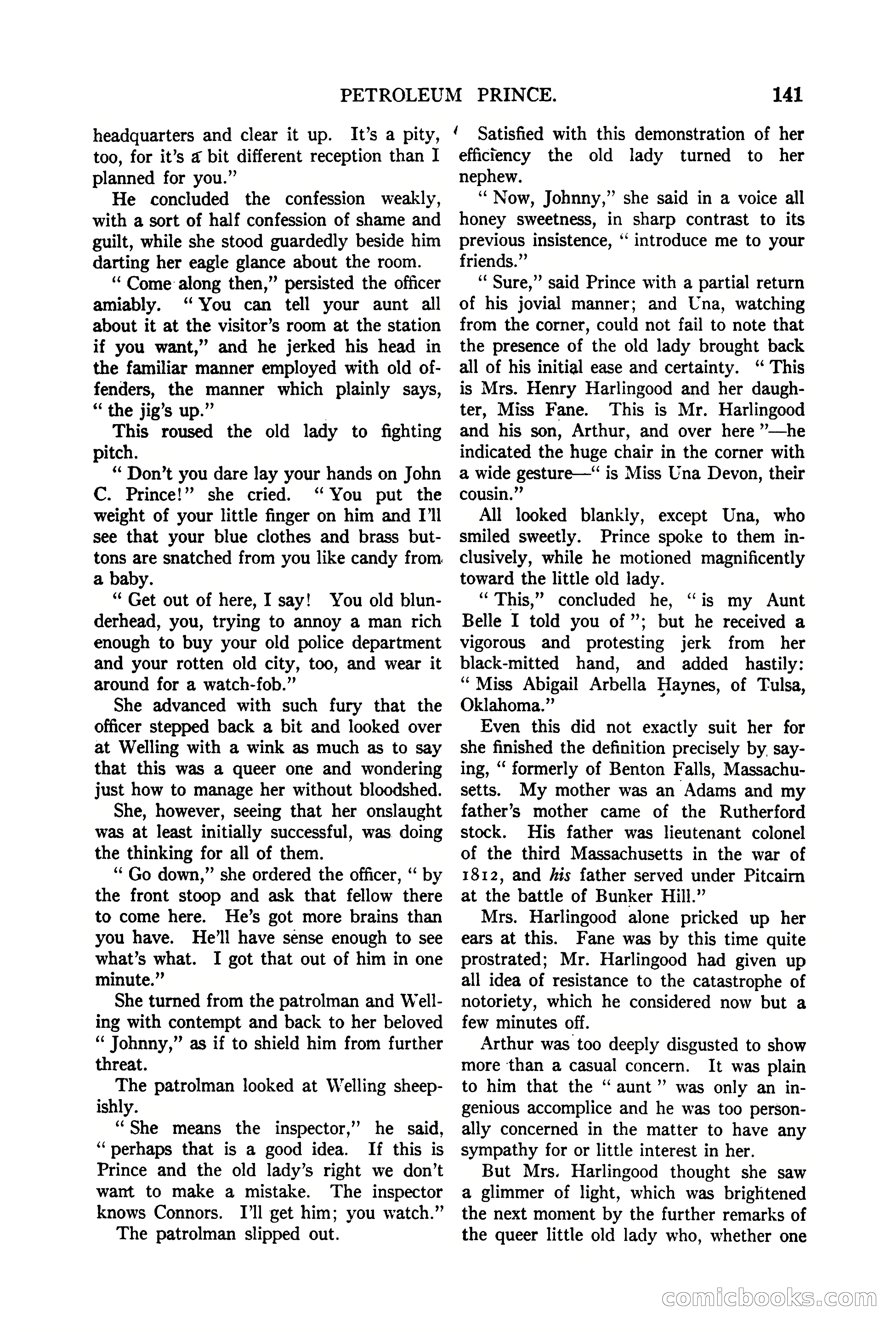
A restored page from Pulp Fiction, 1917. Page through the whole issue in the reader above.
📄 Transcribed text from this page (OCR, searchable)
Machine-transcribed from the original scan — historical spelling and the odd misread are preserved.
PETROLEUM PRINCE. headquarters and clear it up. It’s a pity, ‘ too, for it’s a bit different reception than I planned for you.” He concluded the confession weakly, with a sort of half confession of shame and guilt, while she stood guardedly beside him darting her eagle glance about the room. ‘Come along then,’ persisted the officer amiably. “You can tell your aunt all about it at the visitor’s room at the station if you want,” and he jerked his head in the familiar manner employed with old of- fenders, the manner which plainly says, “‘ the jig’s up.” | This roused the old lady to fighting pitch. “Don’t you dare lay your hands on John C. Prince!” she cried. ‘ You put the weight of your little finger on him and Ill see that your blue clothes and brass but- tons are snatched from you like candy from. a baby. “* Get out of here, I say! You old blun- derhead, you, trying to annoy a man rich enough to buy your old police department and your rotten old city, too, and wear it around for a watch-fob.” She advanced with such fury that the officer stepped back a bit and looked over at Welling with a wink as much as to say that this was a queer one and wondering just how to manage her without bloodshed. She, however, seeing that her onslaught was at least initially successful, was doing the thinking for all of them. “Go down,” she ordered the officer, ‘‘ by the front stoop and ask that fellow there to come here. He’s got more brains than you have. He’ll have sense enough to see what’s what. I got that out of him in one minute.”’ She turned from the patrolman and Well- ing with contempt and back to her beloved ‘‘ Johnny,” as if to shield him from further threat. The patrolman looked at Welling sheep- ishly. ‘“‘She means the inspector,’ he said, “perhaps that is a good idea. If this is Prince and the old lady’s right we don’t want to make a mistake. The inspector knows Connors. I'll get him; you watch.” The patrolman slipped out. 141 Satisfied with this demonstration of her efficiency the old lady turned to her nephew. ‘““ Now, Johnny,” she said in a voice all honey sweetness, in sharp contrast to its previous insistence, ‘‘ introduce me to your friends.” ‘ Sure,” said Prince with a partial return of his jovial manner; and Una, watching from the corner, could not fail to note that the presence of the old lady brought back all of his initial ease and certainty. ‘“ This is Mrs. Henry Harlingood and her daugh- ter, Miss Fane. This is Mr. Harlingood and his son, Arthur, and over here ”—he indicated the huge chair in the corner with a wide gesture—“ is Miss Una Devon, their cousin.” All looked blankly, except Una, who smiled sweetly. Prince spoke to them in- clusively, while he motioned magnificently toward the little old lady. “This,” concluded he, “is my Aunt Belle I told you of”; but he received a vigorous and protesting jerk from her black-mitted hand, and added hastily: ‘Miss Abigail Arbella Haynes, of Tulsa, Oklahoma.” Even this did not exactly suit her for she finished the definition precisely by. say- ing, “‘ formerly of Benton Falls, Massachu- setts. My mother was an Adams and my father’s mother came of the Rutherford stock. His father was lieutenant colonel of the third Massachusetts in the war of 1812, and his father served under Pitcairn at the battle of Bunker Hill.” Mrs. Harlingood alone pricked up her ears at this. Fane was by this time quite prostrated; Mr. Harlingood had given up all idea of resistance to the catastrophe of notoriety, which he considered now but a few minutes off. Arthur was too deeply disgusted to show more than a casual concern. It was plain to him that the “ aunt” was only an in- genious accomplice and he was too person- ally concerned in the matter to have any sympathy for or little interest in her. But Mrs. Harlingood thought she saw a glimmer of light, which was brightened the next moment by the further remarks of the queer little old lady who, whether one oO MIG OO CO S CO