
Pulp Fiction, 1917 · page 159 of 200
The Argosy, Vol. 90 No. 1 — page 159: what you’re looking at
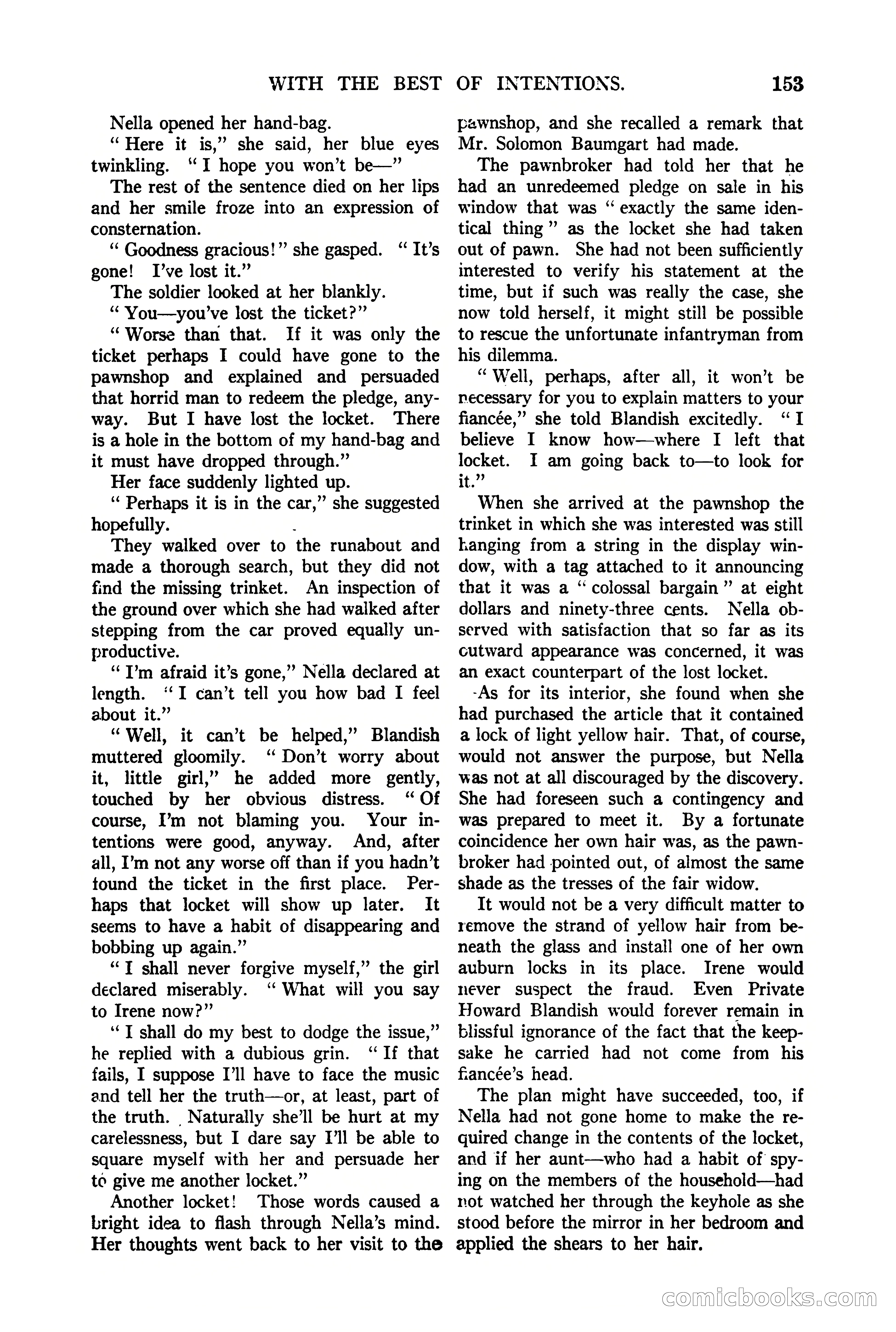
A restored page from Pulp Fiction, 1917. Page through the whole issue in the reader above.
📄 Transcribed text from this page (OCR, searchable)
Machine-transcribed from the original scan — historical spelling and the odd misread are preserved.
WITH THE BEST Nella opened her hand-bag. “Here it is,” she said, her blue eyes twinkling. ‘I hope you won’t be—”’ The rest of the sentence died on her lips and her smile froze into an expression of consternation. ‘“‘ Goodness gracious!” she gasped. “ It’s gone! I’ve lost it.” The soldier looked at her blankly. ‘“* You—you’ve lost the ticket?” “Worse than that. If it was only the ticket perhaps I could have gone to the pawnshop and explained and persuaded that horrid man to redeem the pledge, any- way. But I have lost the locket. There is a hole in the bottom of my hand-bag and it must have dropped through.”’ Her face suddenly lighted up. ‘‘ Perhaps it is in the car,” she suggested hopefully. ; They walked over to the runabout and made a thorough search, but they did not find the missing trinket. An inspection of the ground over which she had walked after stepping from the car proved equally un- productive. ‘I’m afraid it’s gone,” Nella declared at length. ‘‘I can’t tell you how bad I feel about it.” “Well, it can’t be helped,” Blandish muttered gloomily. ‘ Don’t worry about it, little girl,” he added more gently, touched by her obvious distress. “Of course, I’m not blaming you. Your in- tentions were good, anyway. And, after all, I’m not any worse off than if you hadn’t found the ticket in the first place. Per- haps that locket will show up later. It seems to have a habit of disappearing and bobbing up again.” “TY shall never forgive myself,” the girl declared miserably. ‘‘ What will you say to Irene now?”’ ‘‘T shall do my best to dodge the issue,” he replied with a dubious grin. “If that fails, I suppose I’ll have to face the music and tell her the truth—or, at least, part of the truth. Naturally she’ll be hurt at my carelessness, but I dare say I’ll be able to square myself with her and persuade her to give me another locket.” Another locket! Those words caused a bright idea to flash through Nella’s mind. Her thoughts went back to her visit to the OF INTENTIONS. 153 pewnshop, and she recalled a remark that Mr. Solomon Baumgart had made. The pawnbroker had told her that he had an unredeemed pledge on sale in his window that was ‘“ exactly the same iden- tical thing” as the locket she had taken out of pawn. She had not been sufficiently interested to verify his statement at the time, but if such was really the case, she now told herself, it might still be possible to rescue the unfortunate infantryman from his dilemma. “Well, perhaps, after all, it won’t be necessary for you to explain matters to your fiancée,” she told Blandish excitedly. “TI believe I know how—where I left that locket. I am going back to—to look for it.” When she arrived at the pawnshop the trinket in which she was interested was still hanging from a string in the display win- dow, with a tag attached to it announcing that it was a “ colossal bargain” at eight dollars and ninety-three cents. Nella ob- served with satisfaction that so far as its cutward appearance was concerned, it was an exact counterpart of the lost locket. -As for its interior, she found when she had purchased the article that it contained a lock of light yellow hair. That, of course, would not answer the purpose, but Nella was not at all discouraged by the discovery. She had foreseen such a contingency and was prepared to meet it. By a fortunate coincidence her own hair was, as the pawn- broker had pointed out, of almost the same shade as the tresses of the fair widow. It would not be a very difficult matter to remove the strand of yellow hair from be- neath the glass and install one of her own auburn locks in its place. Irene would never suspect the fraud. Even Private Howard Blandish would forever remain in blissful ignorance of the fact that the keep- sake he carried had not come from his fancée’s head. The plan might have succeeded, too, if Nella had not gone home to make the re- quired change in the contents of the locket, and if her aunt—who had a habit of spy- ing on the members of the household—had not watched her through the keyhole as she stood before the mirror in her bedroom and applied the shears to her hair. oO MIGdoOok CO CO