
Pulp Fiction, 1917 · page 31 of 200
The Argosy, Vol. 90 No. 1 — page 31: what you’re looking at
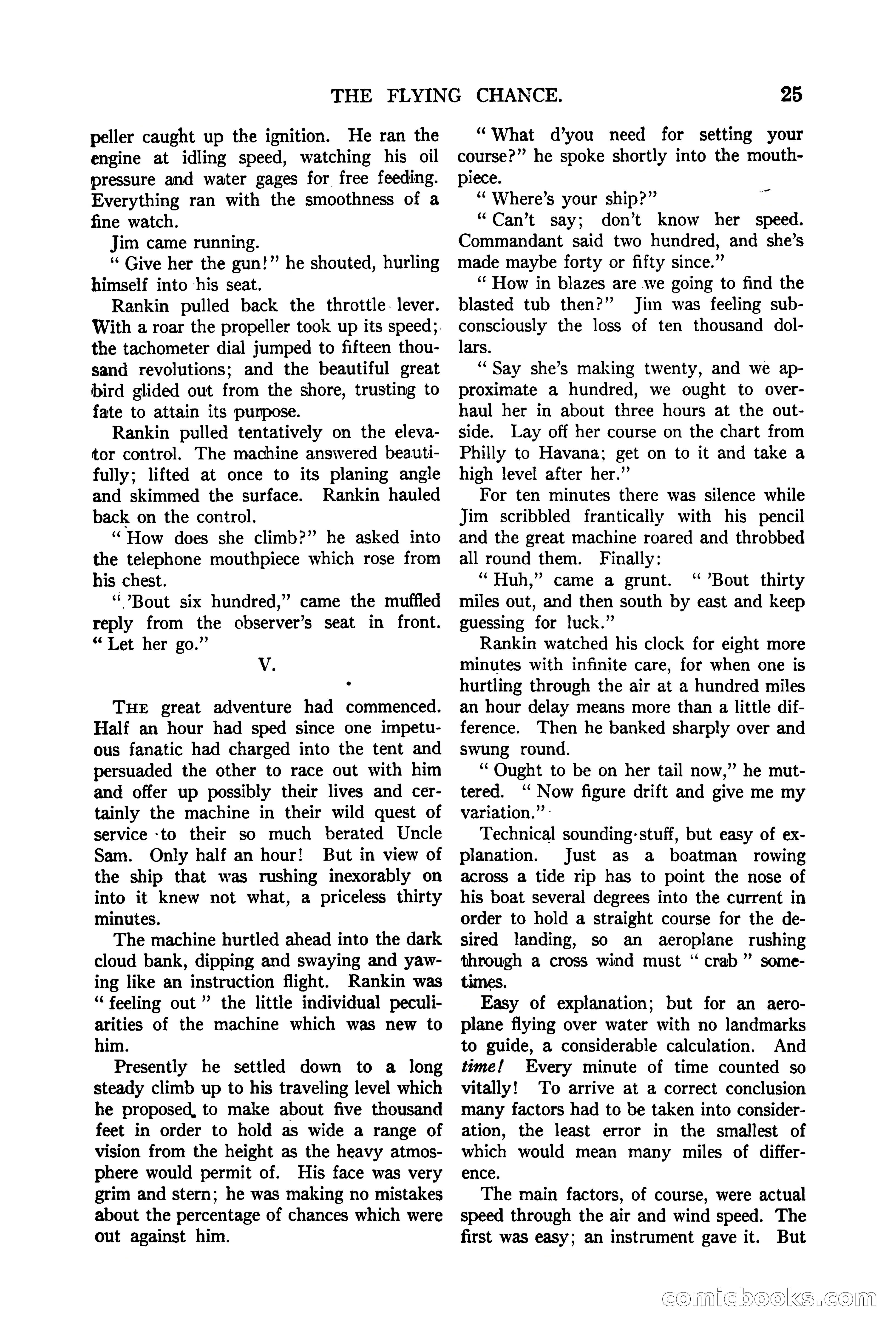
A restored page from Pulp Fiction, 1917. Page through the whole issue in the reader above.
📄 Transcribed text from this page (OCR, searchable)
Machine-transcribed from the original scan — historical spelling and the odd misread are preserved.
THE FLYING CHANCE. peller caught up the ignition. He ran the engine at idling speed, watching his oil pressure and water gages for free feeding. Everything ran with the smoothness of a fine watch. Jim came running. ‘Give her the gun!” he shouted, hurling himself into ‘his seat. Rankin pulled back the throttle. lever. With a roar the propeller took up its speed;. the tachometer dial jumped to fifteen thou- sand revolutions; and the beautiful great bird glided out from the shore, trusting to fate to attain its punpose. Rankin pulled tentatively on the eleva- tor control. The machine answered beauti- fully; lifted at once to its planing angle and skimmed the surface. Rankin hauled back on the control. ““ How does she climb?” he asked into the telephone mouthpiece which rose from his chest. “Bout six hundred,” came the muffled reply from the observer’s seat in front. “Let her go.” V. THE great adventure had commenced. Half an hour had sped since one impetu- ous fanatic had charged into the tent and persuaded the other to race out with him and offer up possibly their lives and cer- tainly the machine in their wild quest of service -to their so much berated Uncle Sam. Only half an hour! But in view of the ship that was rushing inexorably on into it knew not what, a priceless thirty minutes. The machine hurtled ahead into the dark cloud bank, dipping and swaying and yaw- ing like an instruction flight. Rankin was “ feeling out” the little individual peculli- arities of the machine which was new to him. Presently he settled down to a long steady climb up to his traveling level which he proposed, to make about five thousand feet in order to hold as wide a range of vision from the height as the heavy atmos- phere would permit of. His face was very grim and stern; he was making no mistakes about the percentage of chances which were out against him. 25 “What d’you need for setting your course?” he spoke shortly into the mouth- piece. “‘Where’s your ship?” “Can’t say; don’t know her speed. Commandant said two hundred, and she’s made maybe forty or fifty since.” ‘‘ How in blazes are we going to find the blasted tub then?” Jim was feeling sub- consciously the loss of ten thousand dol- lars. ‘“‘ Say she’s making twenty, and we ap- proximate a hundred, we ought to over- haul her in about three hours at the out- side. Lay off her course on the chart from Philly to Havana; get on to it and take a high level after her.” For ten minutes there was silence while Jim scribbled frantically with his pencil and the great machine roared and throbbed all round them. Finally: “Huh,” came a grunt. “ Bout thirty miles out, and then south by east and keep guessing for luck.” Rankin watched his clock for eight more minutes with infinite care, for when one is hurtling through the air at a hundred miles an hour delay means more than a little dif- ference. Then he banked sharply over and swung round. “Ought to be on her tail now,” he mut- tered. ‘‘ Now figure drift and give me my variation.” - Technical sounding: stuff, but easy of ex- planation. Just as a boatman rowing across a tide rip has to point the nose of his boat several degrees into the current in order to hold a straight course for the de- sired landing, so an aeroplane rushing through a cross wind must “ crab” some- Easy of explanation; but for an aero- plane flying over water with no landmarks to guide, a considerable calculation. And time! Every minute of time counted so vitally! To arrive at a correct conclusion many factors had to be taken into consider- ation, the least error in the smallest of which would mean many miles of differ- ence. The main factors, of course, were actual speed through the air and wind speed. The first was easy; an instrument gave it. But —_ oO Comicbooe S CO