
Pulp Fiction, 1917 · page 62 of 200
The Argosy, Vol. 90 No. 1 — page 62: what you’re looking at
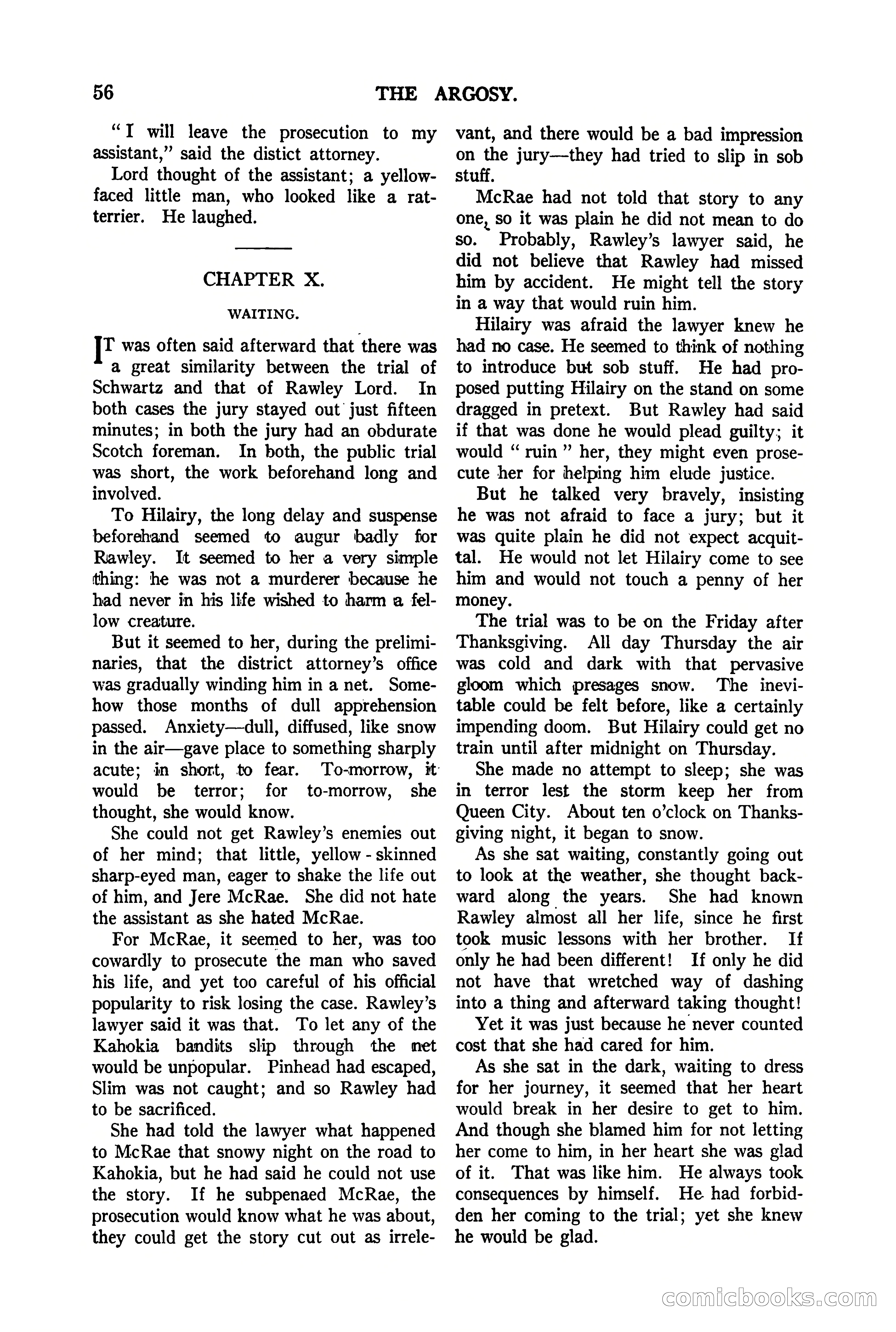
A restored page from Pulp Fiction, 1917. Page through the whole issue in the reader above.
📄 Transcribed text from this page (OCR, searchable)
Machine-transcribed from the original scan — historical spelling and the odd misread are preserved.
56 “T will leave the prosecution to my assistant,” said the distict attorney. Lord thought of the assistant; a yellow- faced little man, who looked like a rat- terrier. He laughed. CHAPTER X. WAITING. T was often said afterward that there was a great similarity between the trial of Schwartz and that of Rawley Lord. In both cases the jury stayed out just fifteen minutes; in both the jury had an obdurate Scotch foreman. In both, the public trial was short, the work beforehand long and involved. To Hilairy, the long delay and suspense beforehand seemed to augur badly for Rawley. It seemed to her a very simple thing: he was not a murderer because he had never in his life wished to harm a fel- low creature. But it seemed to her, during the prelimi- naries, that the district attorney’s office was gradually winding him in a net. Some- how those months of dull apprehension passed. Anxiety—dull, diffused, like snow in the air—gave place to something sharply acute; in short, to fear. would be terror; for thought, she would know. She could not get Rawley’s enemies out of her mind; that little, yellow - skinned sharp-eyed man, eager to shake the life out of him, and Jere McRae. She did not hate the assistant as she hated McRae. For McRae, it seemed to her, was too cowardly to prosecute the man who saved his life, and yet too careful of his official popularity to risk losing the case. Rawley’s lawyer said it was that. To let any of the Kahokia bandits slip through the met would be unpopular. Pinhead had escaped, Slim was not caught; and so Rawley had to be sacrificed. She had told the lawyer what happened to McRae that snowy night on the road to Kahokia, but he had said he could not use the story. If he subpenaed McRae, the prosecution would know what he was about, they could get the story cut out as irrele- to-morrow, she To-morrow, it: THE ARGOSY. vant, and there would be a bad impression on the jury—they had tried to slip in sob stuff. McRae had not told that story to any one, so it was plain he did not mean to do so. Probably, Rawley’s lawyer said, he did not believe that Rawley had missed him by accident. He might tell the story in a way that would ruin him. Hilairy was afraid the lawyer knew he had no case. He seemed to think of nothing to introduce but sob stuff. He had pro- posed putting Hilairy on the stand on some dragged in pretext. But Rawley had said if that was done he would plead guilty; it would “ruin” her, they might even prose- cute her for helping him elude justice. But he talked very bravely, insisting he was not afraid to face a jury; but it was quite plain he did not expect acquit- tal. He would not let Hilairy come to see him and would not touch a penny of her money. The trial was to be on the Friday after Thanksgiving. All day Thursday the air was cold and dark with that pervasive gloom which presages snow. The inevi- table could be felt before, like a certainly impending doom. But Hilairy could get no train until after midnight on Thursday. She made no attempt to sleep; she was in terror lest the storm keep her from Queen City. About ten o’clock on Thanks- giving night, it began to snow. As she sat waiting, constantly going out to look at the weather, she thought back- ward along the years. She had known Rawley almost all her life, since he first took music lessons with her brother. If only he had been different! If only he did not have that wretched way of dashing into a thing and afterward taking thought! Yet it was just because he never counted cost that she had cared for him. As she sat in the dark, waiting to dress for her journey, it seemed that her heart would break in her desire to get to him. And though she blamed him for not letting her come to him, in her heart she was glad of it. That was like him. He always took consequences by himself. He had forbid- den her coming to the trial; yet she knew he would be glad. comicbool< CO