
Pulp Fiction, 1917 · page 66 of 200
The Argosy, Vol. 90 No. 1 — page 66: what you’re looking at
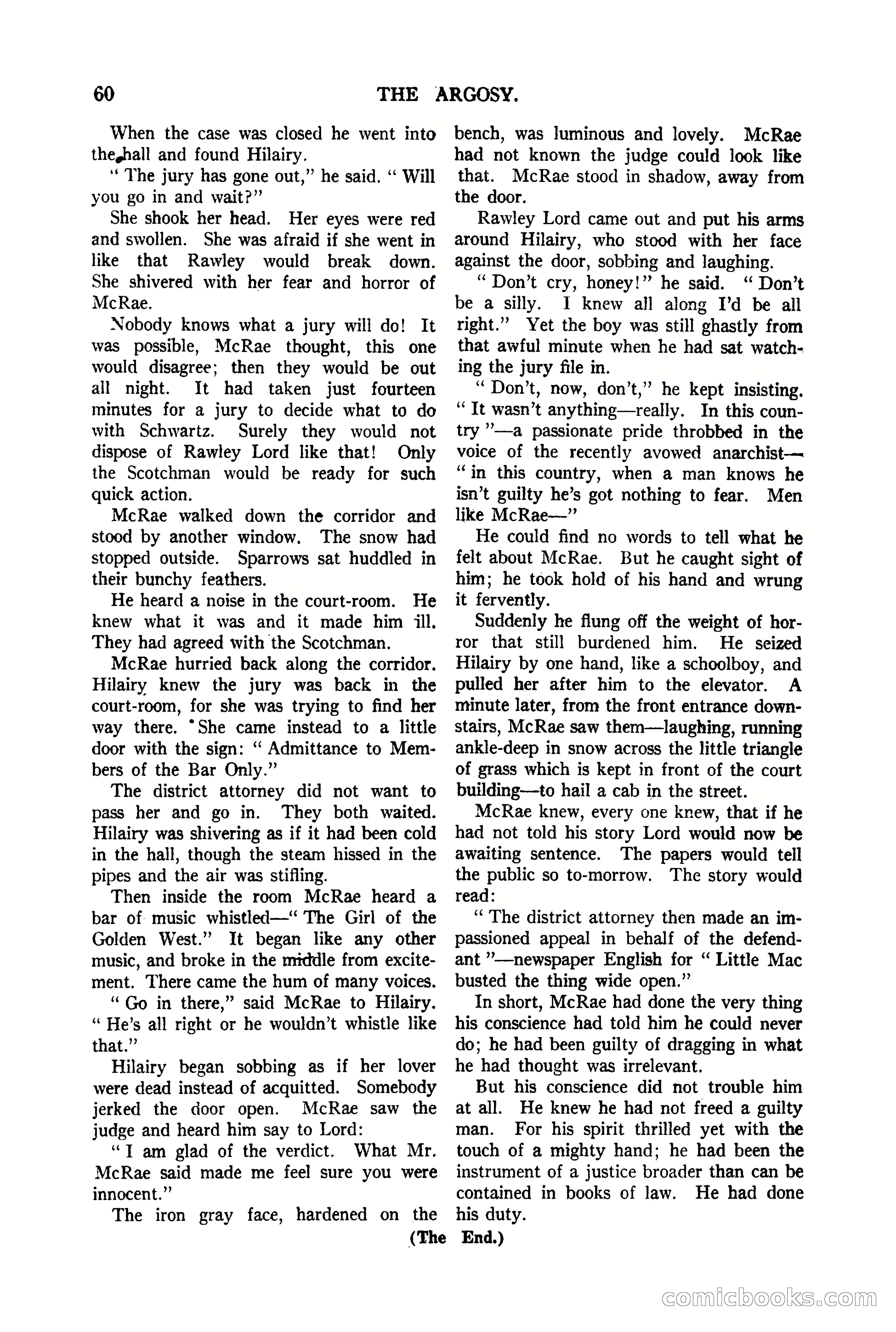
A restored page from Pulp Fiction, 1917. Page through the whole issue in the reader above.
📄 Transcribed text from this page (OCR, searchable)
Machine-transcribed from the original scan — historical spelling and the odd misread are preserved.
60 When the case was closed he went into theghall and found Hilairy. ‘The jury has gone out,” he said. “ Will you go in and wait?” She shook her head. Her eyes were red and swollen. She was afraid if she went in like that Rawley would break down. She shivered with her fear and horror of McRae. Nobody knows what a jury will do! It was possible, McRae thought, this one would disagree; then they would be out all night. It had taken just fourteen minutes for a jury to decide what to do with Schwartz. Surely they would not dispose of Rawley Lord like that! Only the Scotchman would be ready for such quick action. McRae walked down the corridor and stood by another window. The snow had stopped outside. Sparrows sat huddled in their bunchy feathers. He heard a noise in the court-room. He knew what it was and it made him ill. They had agreed with the Scotchman. McRae hurried back along the corridor. Hilairy knew the jury was back in the court-room, for she was trying to find her way there. “She came instead to a little door with the sign: “‘ Admittance to Mem- bers of the Bar Only.” The district attorney did not want to pass her and go in. They both waited. Hilairy was shivering as if it had been cold in the hall, though the steam hissed in the pipes and the air was stifling. Then inside the room McRae heard a bar of music whistled—“ The Girl of the Golden West.” It began like any other music, and broke in the middle from excite- ment. There came the hum of many voices. ‘(Go in there,” said McRae to Hilairy. ‘“ He’s all right or he wouldn’t whistle like that.” Hilairy began sobbing as if her lover were dead instead of acquitted. Somebody jerked the door open. McRae saw the judge and heard him say to Lord: “T am glad of the verdict. What Mr. McRae said made me feel sure you were innocent.” The iron gray face, hardened on the THE ARGOSY. bench, was luminous and lovely. McRae had not known the judge could look like that. McRae stood in shadow, away from the door. Rawley Lord came out and put his arms around Hilairy, who stood with her face against the door, sobbing and laughing. “Don’t cry, honey!” he said. ‘“ Don’t be a silly. I knew all along I’d be all right.” Yet the boy was still ghastly from that awful minute when he had sat watch- ing the jury file in. ‘Don’t, now, don’t,” he kept insisting. ‘It wasn’t anything—really. In this coun- try ’—a passionate pride throbbed in the voice of the recently avowed anarchist— ‘in this country, when a man knows he isn’t guilty he’s got nothing to fear. Men like McRae—”’ He could find no words to tell what he felt about McRae. But he caught sight of him; he took hold of his hand and wrung it fervently. Suddenly he flung off the weight of hor- ror that still burdened him. He seized Hilairy by one hand, like a schoolboy, and pulled her after him to the elevator. A minute later, from the front entrance down- stairs, McRae saw them—laughing, running ankle-deep in snow across the little triangle of grass which is kept in front of the court building—to hail a cab in the street. McRae knew, every one knew, that if he had not told his story Lord would now be awaiting sentence. The papers would tell the public so to-morrow. The story would read: ‘“‘ The district attorney then made an im- passioned appeal in behalf of the defend- ant ”—newspaper English for “ Little Mac busted the thing wide open.” In short, McRae had done the very thing his conscience had told him he could never do; he had been guilty of dragging in what he had thought was irrelevant. But his conscience did not trouble him at all. He knew he had not freed a guilty man. For his spirit thrilled yet with the touch of a mighty hand; he had been the instrument of a justice broader than can be contained in books of law. He had done his duty. (The End.) comicbool< CO