
Pulp Fiction, 1920 · page 104 of 180
Argosy, Vol. 118, No. 4 — page 104: what you’re looking at
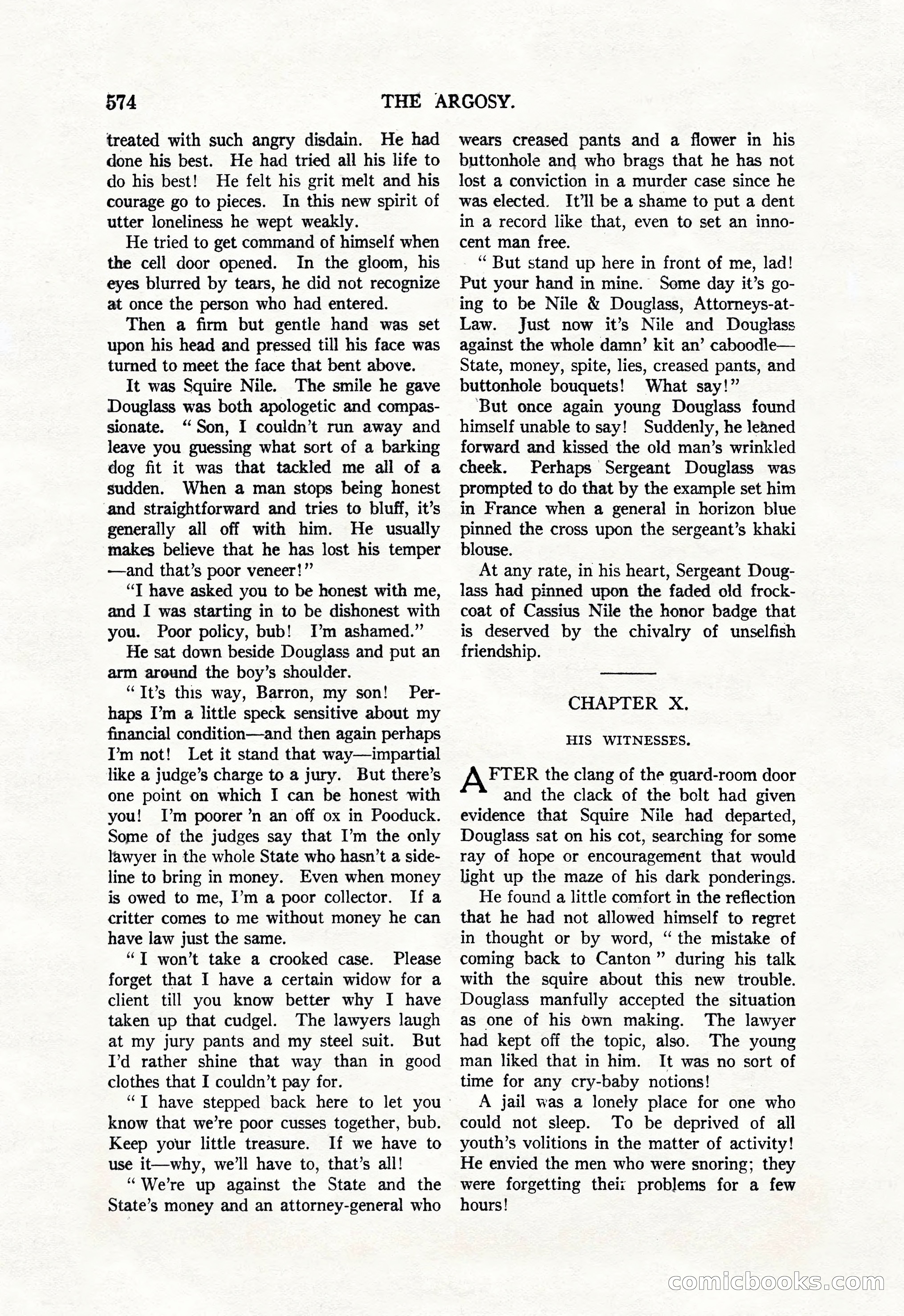
A restored page from Pulp Fiction, 1920. Page through the whole issue in the reader above.
📄 Transcribed text from this page (OCR, searchable)
Machine-transcribed from the original scan — historical spelling and the odd misread are preserved.
574 treated with such angry disdain. He had done his best. He had tried all his life to do his best! He felt his grit melt and his courage go to pieces. In this new spirit of utter loneliness he wept weakly. He tried to get command of himself when the cell door opened. In the gloom, his eyes blurred by tears, he did not recognize at once the person who had entered. Then a firm but gentle hand was set upon his head and pressed till his face was turned to meet the face that bent above. It was Squire Nile. The smile he gave Douglass was both apologetic and compas- sionate. “Son, I couldn’t run away and leave you guessing what sort of a barking dog fit it was that tackled me all of a sudden. When a man stops being honest and straightforward and tries to bluff, it’s generally all off with him. He usually makes believe that he has lost his temper —and that’s poor veneer!”’ “T have asked you to be honest with me, and I was starting in to be dishonest with you. Poor policy, bub! I’m ashamed.” He sat down beside Douglass and put an arm around the boy’s shoulder. “It’s this way, Barron, my son! Per- haps I’m a little speck sensitive about my financial condition—and then again perhaps I’m not! Let it stand that way—impartial like a judge’s charge to a jury. But there’s one point on which I can be honest with you! I’m poorer ’n an off ox in Pooduck. Some of the judges say that I’m the only lawyer in the whole State who hasn’t a side- line to bring in money. Even when money is owed to me, I’m a poor collector. If a critter comes to me without money he can have law just the same. “T won’t take a crooked case. Please forget that I have a certain widow for a client till you know better why I have taken up that cudgel. The lawyers laugh at my jury pants and my steel suit. But I’d rather shine that way than in good clothes that I couldn’t pay for. ‘“T have stepped back here to let you - know that we’re poor cusses together, bub. Keep your little treasure. If we have to use it—why, we'll have to, that’s all! “We're up against the State and the State’s money and an attorney-general who THE ARGOSY. wears creased pants and a flower in his buttonhole and who brags that he has not lost a conviction in a murder case since he was elected. It'll be a shame to put a dent in a record like that, even to set an inno- cent man free. “But stand up here in front of me, lad! Put your hand in mine. Some day it’s go- ing to be Nile & Douglass, Attorneys-at- Law. Just now it’s Nile and Douglass against the whole damn’ kit an’ caboodle— State, money, spite, lies, creased pants, and buttonhole bouquets! What say!” But once again young Douglass found himself unable to say! Suddenly, he leaned forward and kissed the old man’s wrinkled cheek. Perhaps Sergeant Douglass was prompted to do that by the example set him in France when a general in horizon blue pinned the cross upon the sergeant’s khaki blouse. At any rate, in his heart, Sergeant Doug- lass had pinned upon the faded old frock- coat of Cassius Nile the honor badge that is deserved by the chivalry of unselfish friendship. CHAPTER X., HIS WITNESSES. AFTER the clang of the guard-room door and the clack of the bolt had given evidence that Squire Nile had departed, Douglass sat on his cot, searching for some ray of hope or encouragement that would light up the maze of his dark ponderings. He found a little comfort in the reflection that he had not allowed himself to regret in thought or by word, “ the mistake of coming back to Canton” during his talk with the squire about this new trouble. Douglass manfully accepted the situation as one of his Own making. The lawyer had kept off the topic, also. The young man liked that in him. It was no sort of time for any cry-baby notions! A jail was a lonely place for one who could not sleep. To be deprived of all youth’s volitions in the matter of activity! He envied the men who were snoring; they were forgetting theii problems for a few hours! JOO (C(O) S (C(C)