
Pulp Fiction, 1920 · page 106 of 180
Argosy, Vol. 118, No. 4 — page 106: what you’re looking at
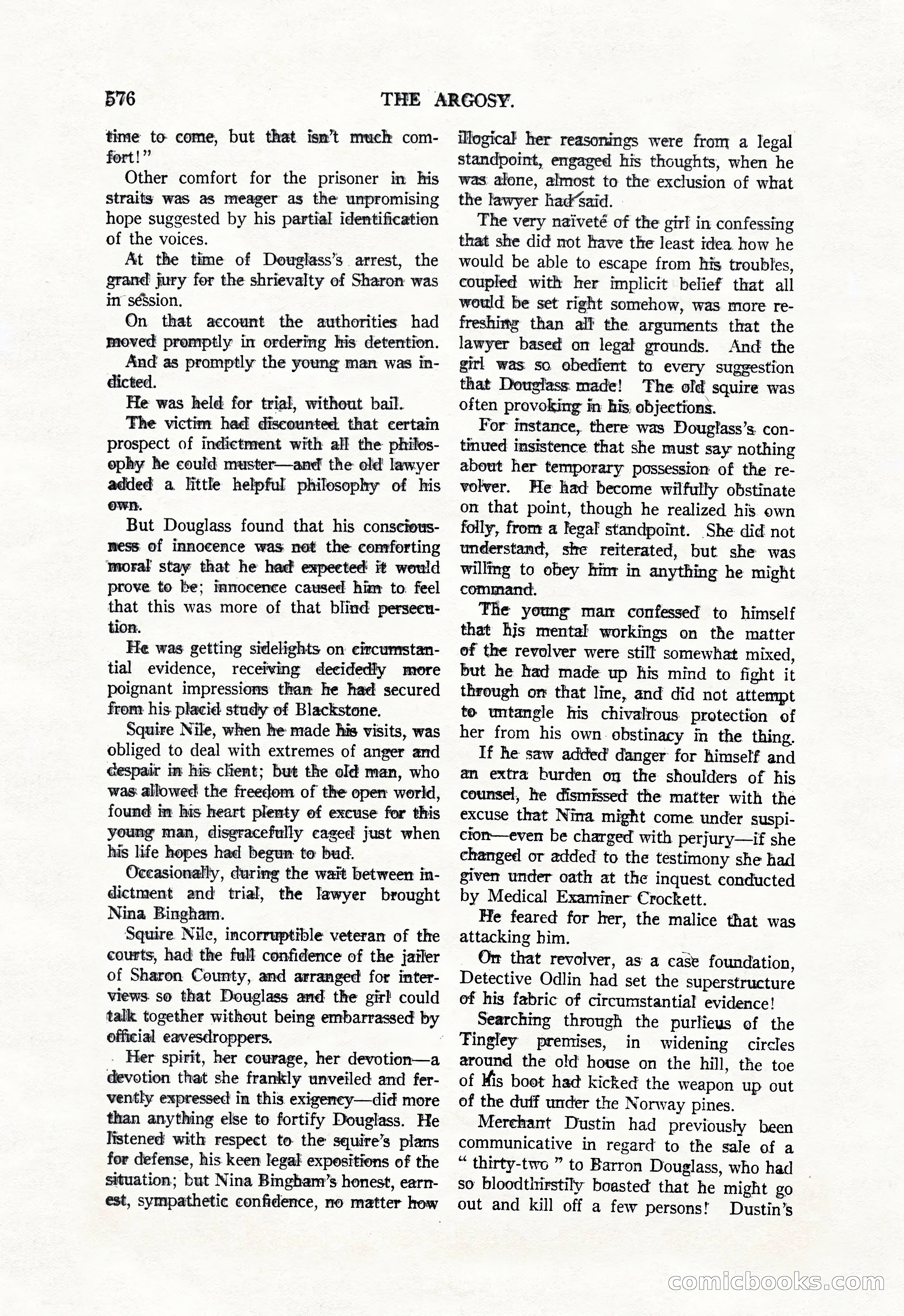
A restored page from Pulp Fiction, 1920. Page through the whole issue in the reader above.
📄 Transcribed text from this page (OCR, searchable)
Machine-transcribed from the original scan — historical spelling and the odd misread are preserved.
576 time to come, but that ism’t much com- fort!” Other comfort for the prisoner in his straits was as meager as the unpromising hope suggested by his partial identification of the voices. At the time of Dowglass’s arrest, the grand jury for the shrievalty of Sharon was in séSsion. On that account the authorities had moved promptly in ordering his detention. And as promptly the young man was in- dicted. Fe was held for trial, without bail. The victim had discounted. that certain prospect of indictment with all the philes- ophy he could muster—and the eld lawyer added a little helpful philosophy of his own. But Douglass found that his consecteus- ness of innocence was net the conrforting moral stay that he had expected it would prove to be; innocence caused him to: feel that this was more of that blind persecu- tion. He was getting sidelights on circumstan- tial evidence, receiving decidedly more poignant impressions tham he had secured from: his placid study of Blackstone. Squire Nile, when he made his visits, was obliged to deal with extremes of anger and cespair in his client; but the old man, who was allowed the freedom of the open world, found im his heart plenty ef excuse for this young man, disgracefully caged just when his life hopes had begun: to bud. Occasionally, during the wait between in- dictment and trial, the lawyer brought Nina Bingham. Squire. Nile, incorruptible veteran of the courts, had the full confidence of the jailer of Sharon County, and arranged for inter- views so that Douglass and the girl could talk together without being embarrassed by official eavesdroppers. . Her spirit, her courage, her devotion—a devotion that she frankly unveiled and fer- vently expressed in this exigency—did more than anything else to fortify Douglass. He listened with respect to the squire’s plans for defense, his keen legal expositions of the situation; but Nina Bingham’s honest, earn- est, sympathetic confidence, no matter how THE ARGOSY. iogical her reasonings were from a legal standpoint, engaged his thoughts, when he was alone, almost to the exclusion of what the lawyer had“said. — The very naiveté of the girl in confessing that she did not have the least idea how he would be able to escape from his troubles, coupled with her implicit belief that all would be set right somehow, was more re- freshimg than all the arguments that the lawyer based on legal grounds. And the girl was so obedient to every suggestion that Douglass made! The old squire was often provoking in his, abjections. For instance, there was Douglass’s. con- tmued insistence that she must say nothing about her temporary possession of the re- volver. He had become wilfully obstinate on that point, though he realized his own folly, from a legal standpoint. She did not understand, sire reiterated, but she was willing to obey hint in anything he might command. The young mam confessed to himself that hjs mental workings on the matter of the revolver were still somewhat mixed, but he had made up his mind to fight it through or: that line, and did not attempt to untangle his chivalrous protection of her from his own obstinacy in the thing. If he saw added danger for himself and an extra burden on the shoulders of his counsel, he dismissed the matter with the excuse that Nina might come under suspi- cton—even be charged with perjury—if she changed or added to the testimony she had given under oath at the inquest. conducted by Medical Examiner Crockett. He feared for ler, the malice that was attacking him. Om that revolver, as a case foundation, Detective Odlin had set the superstructure of his fabric of circumstantial evidence! Searching through the purliews of the Fingley premises, in widening circles around the old house on the hill, the toe of Wis boot had kicked the weapon up out of the duff under the Norway pines. Merchant Dustin had previously been communicative in regard to the sale of a “ thirty-two ” to Barron Douglass, who had so bloodthirstily boasted that he might go out and kill off a few persons! Dustin’s CO DOO SS (CO)