
Pulp Fiction, 1920 · page 113 of 180
Argosy, Vol. 118, No. 4 — page 113: what you’re looking at
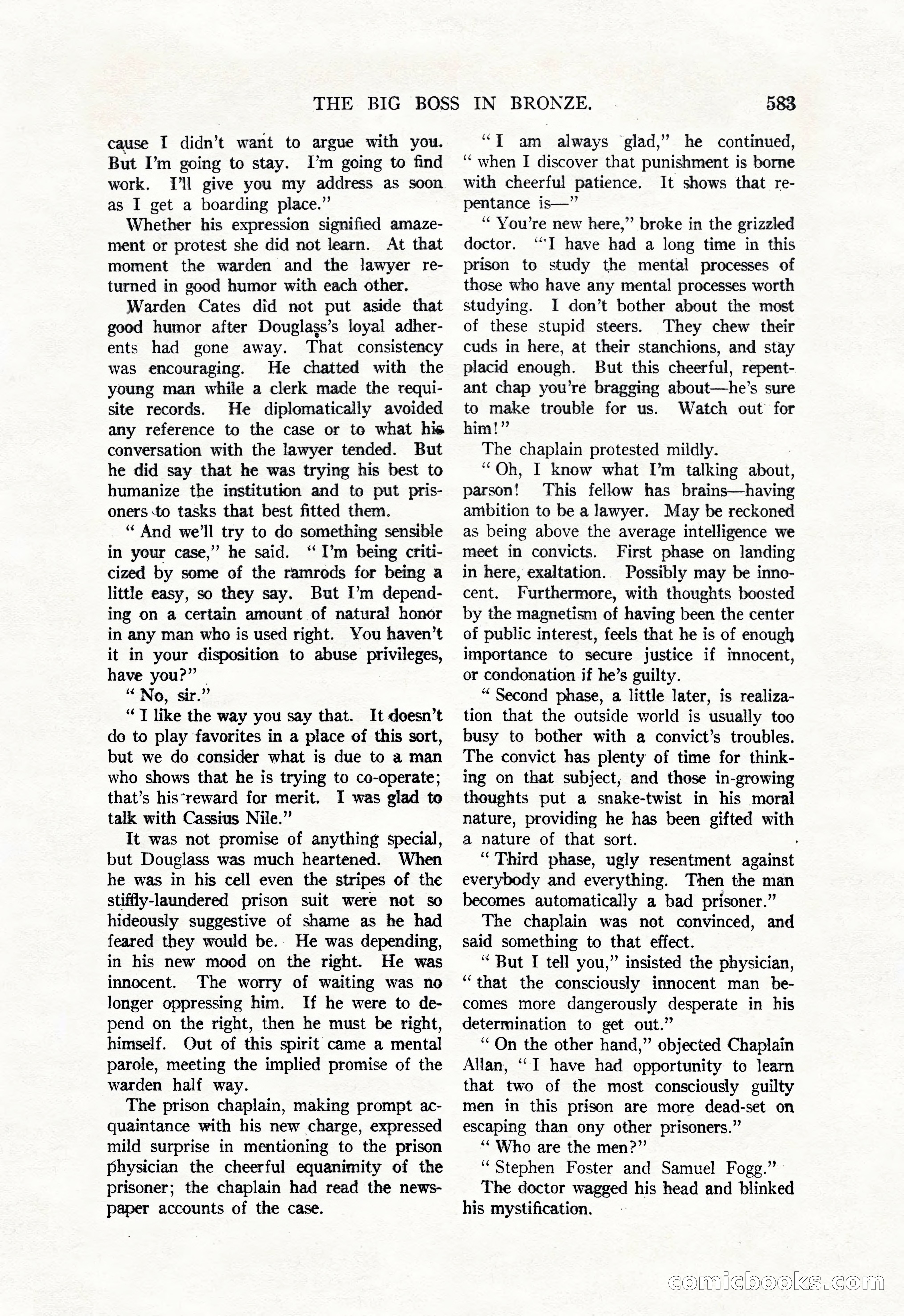
A restored page from Pulp Fiction, 1920. Page through the whole issue in the reader above.
📄 Transcribed text from this page (OCR, searchable)
Machine-transcribed from the original scan — historical spelling and the odd misread are preserved.
THE BIG BOSS IN BRONZE. cause I didn’t want to argue with you. But I’m going to stay. I’m going to find work, I'll give you my address as soon as I get a boarding place.” Whether his expression signified amaze- ment or protest she did not learn. At that moment the warden and the lawyer re- turned in good humor with each other. Warden Cates did not put aside that good humor after Douglass’s loyal adher- ents had gone away. That consistency was encouraging. He chatted with the young man while a clerk made the requi- site records. He diplomatically avoided any reference to the case or to what his conversation with the lawyer tended. But he did say that he was trying his best to humanize the institution and to put pris- oners to tasks that best fitted them. _ “ And we'll try to do something sensible in your case,” he said. “I’m being criti- cized by some of the ramrods for being a little easy, so they say. But I’m depend- ing on a certain amount of natural honor in any man who is used right. You haven’t it in your disposition to abuse privileges, have you?” — 4 No, sir.” “T like the way you say that. It doesn’t do to play favorites in a piace of this sort, but we do consider what is due to a man who shows that he is trying to co-operate; that’s his‘reward for merit. I was glad to talk with Cassius Nile.”’ It was not promise of anything special, but Douglass was much heartened. When he was in his cell even the stripes of the stiffly-laundered prison suit were not so hideously suggestive of shame as he had feared they would be. He was depending, in his new mood on the right. He was innocent. The worry of waiting was no longer oppressing him. If he were to de- pend on the right, then he must be right, himself. Out of this spirit came a mental parole, meeting the implied promise of the warden half way. 3 The prison chaplain, making prompt ac- quaintance with his new charge, expressed mild surprise in mentioning to the prison physician the cheerful equanimity of the prisoner; the chaplain had read the news- paper accounts of the case. 583 “Tam always glad,” he continued, ‘when I discover that punishment is borne with cheerful patience. It shows that re- _pentance is—” ‘ You’re new here,” broke in the grizzled doctor. “I have had a long time in this prison to study the mental processes of those who have any mental processes worth studying. I don’t bother about the most of these stupid steers. They chew their cuds in here, at their stanchions, and stay placid enough. But this cheerful, repent- ant chap you’re bragging about—he’s sure to make trouble for us. Watch out for him!” The chaplain protested mildly. ‘Oh, I know what I’m talking about, parson! This fellow has brains—having ambition to be a lawyer. May be reckoned as being above the average intelligence we meet in convicts. First phase on landing in here, exaltation. Possibly may be inno- cent. Furthermore, with thoughts boosted by the magnetism of having been the center of public interest, feels that he is of enough importance to secure justice if innocent, or condonation if he’s guilty. “ Second phase, a little later, is realiza- tion that the outside world is usually too busy to bother with a convict’s troubles. The convict has plenty of time for think- ing on that subject, and those in-growing thoughts put a snake-twist in his moral nature, providing he has been gifted with a nature of that sort. “Third phase, ugly resentment against everybody and everything. Then the man becomes automatically a bad prisoner.” The chaplain was not convinced, and said something to that effect. ‘But I tell you,” insisted the physician, “that the consciously innocent man be- comes more dangerously desperate in his determination to get out.” “On the other hand,” objected Chaplain Allan, “I have had opportunity to learn that two of the most consciously guilty men in this prison are more dead-set on escaping than ony other prisoners.” ‘““'Who are the men?”’ ‘Stephen Foster and Samuel Fogg.” The doctor wagged his head and blinked his mystification. OO (C(O) S (C(O)