
Pulp Fiction, 1920 · page 12 of 180
Argosy, Vol. 118, No. 4 — page 12: what you’re looking at
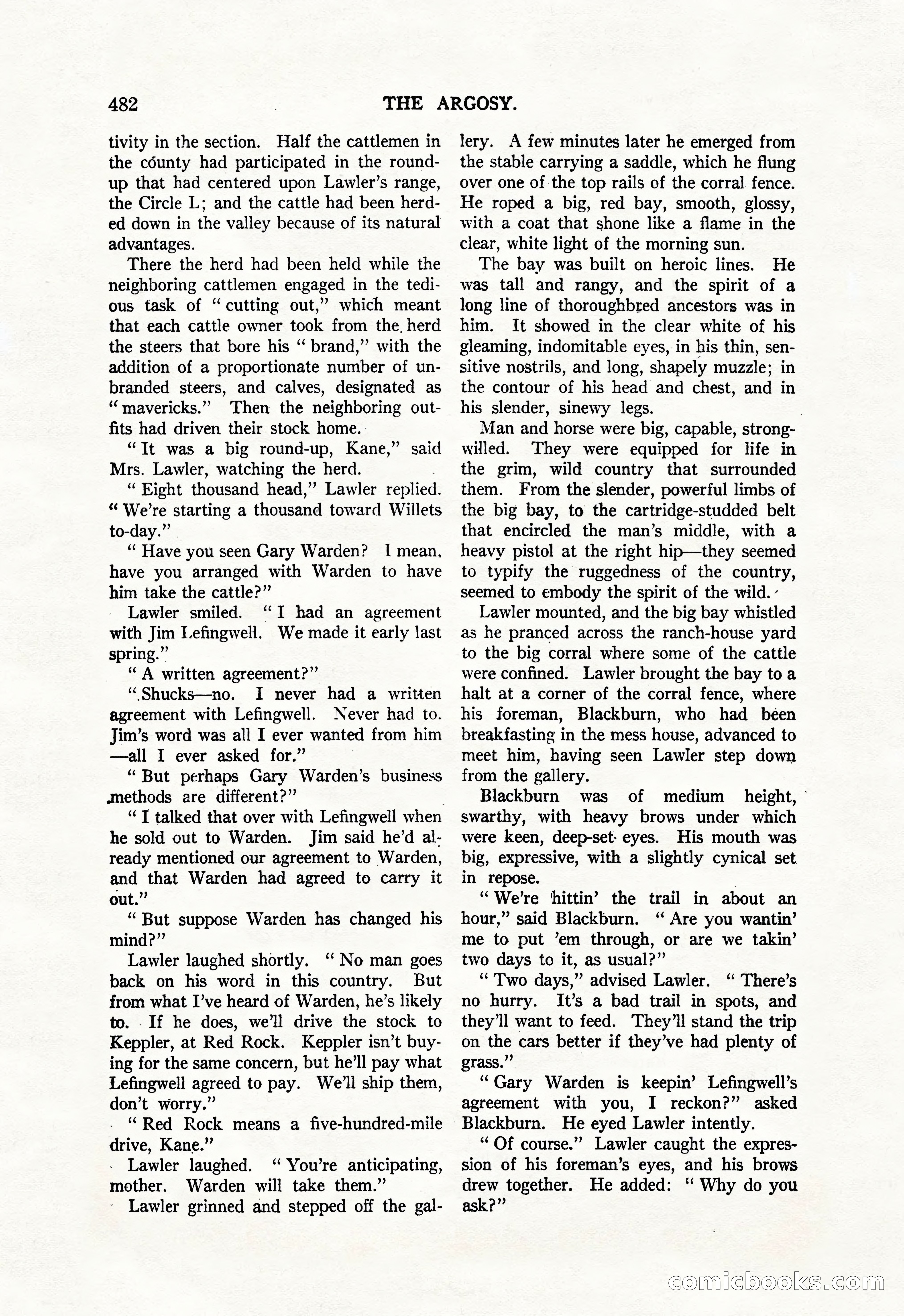
A restored page from Pulp Fiction, 1920. Page through the whole issue in the reader above.
📄 Transcribed text from this page (OCR, searchable)
Machine-transcribed from the original scan — historical spelling and the odd misread are preserved.
482 tivity in the section. Half the cattlemen in the céunty had participated in the round- up that had centered upon Lawler’s range, the Circle L; and the cattle had been herd- ed down in the valley because of its natural advantages. There the herd had been held while the neighboring cattlemen engaged in the tedi- ous task of “ cutting out,” which meant that each cattle owner took from the, herd the steers that bore his ‘‘ brand,’’ with the addition of a proportionate number of un- branded steers, and calves, designated as “mavericks.” Then the neighboring out- fits had driven their stock home.. “It was a big round-up, Kane,” said Mrs. Lawler, watching the herd. “ Hight thousand head,” Lawler replied. “We're starting a thousand toward Willets to-day.”’ ‘“‘ Have you seen Gary Warden? I mean, have you arranged with Warden to have him take the cattle?” Lawler smiled. “I had an agreement with Jim Lefingwell. We made it early last spring.”’ “A written agreement?” “ Shucks—no. I never had a written agreement with Lefingwell. Never had to. Jim’s word was all I ever wanted from him —all I ever asked for.” “ But perhaps Gary Warden’s business methods are different?” “T talked that over with Lefingwell when he sold out to Warden. Jim said he’d al- ready mentioned our agreement to Warden, and that Warden had agreed to carry it out.”’ “ But suppose Warden has changed his mind?” Lawler laughed shortly. ‘‘ No man goes back on his word in this country. But from what I’ve heard of Warden, he’s likely to. .If he does, we'll drive the stock to Keppler, at Red Rock. Keppler isn’t buy- ing for the same concern, but he’ll pay what Lefingwell agreed to pay. We'll ship them, don’t worry.” “Red Rock means a five-hundred-mile drive, Kane.” Lawler laughed. ‘“ You’re anticipating, mother. Warden will take them.” Lawler grinned and stepped off the gal- THE ARGOSY. lery. A few minutes later he emerged from the stable carrying a saddle, which he flung over one of the top rails of the corral. fence. He roped a big, red bay, smooth, glossy, with a coat that shone like a flame in the clear, white light of the morning sun. The bay was built on heroic lines. He was tall and rangy, and the spirit of a long line of thoroughbred ancestors was in him. It showed in the clear white of his gleaming, indomitable eyes, in his thin, sen- sitive nostrils, and long, shapely muzzle; in the contour of his head and chest, and in his slender, sinewy legs. Man and horse were big, capable, strong- . willed. They were equipped for life in the grim, wild country that surrounded them. From the slender, powerful limbs of the big bay, to the cartridge-studded belt that encircled the man’s middle, with a heavy pistol at the right hip—they seemed to typify the ruggedness of the country, seemed to embody the spirit of the wild. - Lawler mounted, and the big bay whistled as he pranced across the ranch-house yard to the big corral where some of the cattle were confined. Lawler brought the bay to a halt at a corner of the corral fence, where his foreman, Blackburn, who had béen breakfasting in the mess house, advanced to meet him, having seen Lawler step down from the gallery. Blackburn was of medium height swarthy, with heavy brows under which were keen, deep-set: eyes. His mouth was big, expressive, with a slightly cynical set in repose. “We're hittin’ the trail in about an hour,” said Blackburn. “ Are you wantin’ me to put ’em through, or are we takin’ two days to it, as usual?” ‘Two days,” advised Lawler. “ There’s no hurry. It’s a bad trail in spots, and they'll want to feed. They’ll stand the trip on the cars better if they’ve had plenty of grass.” . ‘“‘Gary Warden is keepin’ Lefingwell’s agreement with you, I reckon?” asked ~Blackburn. He eyed Lawler intently. “‘ Of course.” Lawler caught the expres- sion of his foreman’s eyes, and his brows drew together. He added: ‘‘ Why do you ask?” DOOLK