
Pulp Fiction, 1920 · page 122 of 180
Argosy, Vol. 118, No. 4 — page 122: what you’re looking at
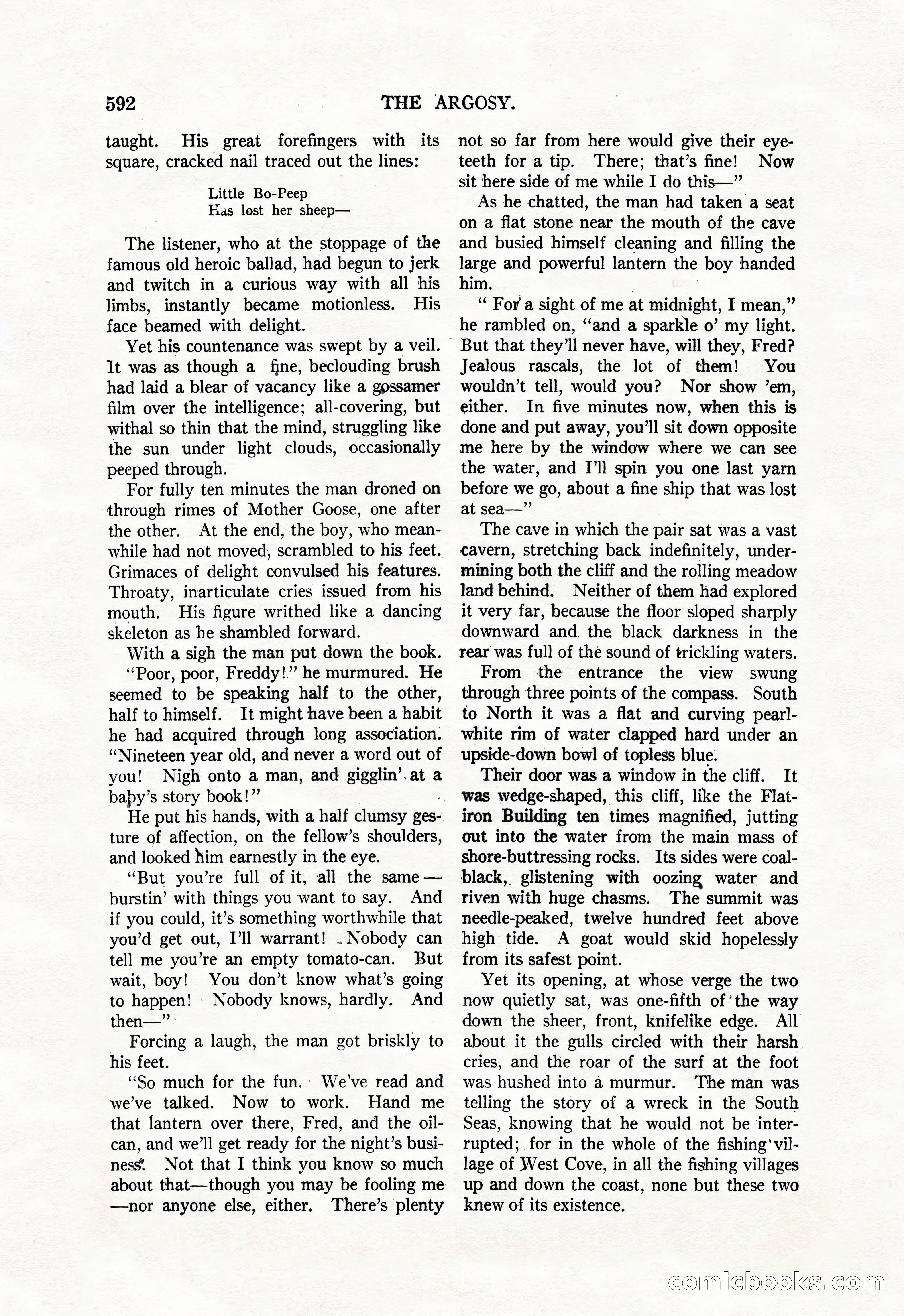
A restored page from Pulp Fiction, 1920. Page through the whole issue in the reader above.
📄 Transcribed text from this page (OCR, searchable)
Machine-transcribed from the original scan — historical spelling and the odd misread are preserved.
592 taught. His great forefingers with its square, cracked nail traced out the lines: Little Bo-Peep Has lost her sheep— The listener, who at the stoppage of the famous old heroic ballad, had begun to jerk and twitch in a curious way with all his limbs, instantly became motionless. His face beamed with delight. Yet his countenance was swept by a veil. It was as though a fine, beclouding brush had laid a blear of vacancy like a gossamer film over the intelligence; all-covering, but withal so thin that the mind, struggling like the sun under light clouds, occasionally peeped through. For fully ten minutes the man droned on through rimes of Mother Goose, one after the other. At the end, the boy, who mean- while had not moved, scrambled to his feet. Grimaces of delight convulsed his features. Throaty, inarticulate cries issued from his mouth. His figure writhed like a dancing skeleton as he shambled forward. _ With a sigh the man put down the book. ‘Poor, poor, Freddy!” he murmured. He seemed to be speaking half to the other, half to himself. It might have been a habit he had acquired through long association. ‘Nineteen year old, and never a word out of you! Nigh onto a man, and gigglin’.at a bapy’s story book!” He put his hands, with a half clumsy ges ture of affection, on the fellow’s shoulders, and looked him earnestly in the eye. “But you’re full of it, all the same — burstin’ with things you want to say. And if you could, it’s something worthwhile that you’d get out, I'll warrant! . Nobody can tell me you’re an empty tomato-can. But wait, boy! You don’t know what’s going to happen! - Nobody knows, hardly. And then—’’ Forcing a laugh, the man got briskly to his feet. “So much for the fun.: We've read and we’ve talked. Now to work. Hand me that lantern over there, Fred, and the oil- can, and we'll get ready for the night’s busi- ness, Not that I think you know so much about that—though you may be fooling me —nor anyone else, either. There’s plenty THE ARGOSY. not so far from here would give their eye- teeth for a tip. There; that’s fine! Now sit here side of me while I do this—”’ As he chatted, the man had taken a seat on a flat stone near the mouth of the cave and busied himself cleaning and filling the large and powerful lantern the boy handed him. “ For a sight of me at midnight, I mean,” he rambled on, ‘and a sparkle o’ my light. - But that they’ll never have, will they, Fred? Jealous rascals, the lot of them! wouldn’t tell, would you? Nor show ’em, either. In five minutes now, when this is done and put away, you’ll sit down opposite me here by the window where we can see the water, and Ill spin you one last yarn before we go, about a fine ship that was lost at sea—”’ The cave in which the pair sat was a vast cavern, stretching back indefinitely, under- mining both the cliff and the rolling meadow land behind. Neither of them had explored it very far, because the floor sloped sharply downward and. the black darkness in the rear was full of the sound of trickling waters. From the entrance the view swung through three points of the compass. South to North it was a flat and curving pearl- white rim of water clapped hard under an upside-down bow! of topless blue. Their door was a window in the cliff. It was wedge-shaped, this cliff, like the Flat- iron Building ten times magnified, jutting out into the water from the main mass of shore-buttressing rocks. Its sides were coal- black, glistening with oozing water and riven with huge chasms. The summit was needle-peaked, twelve hundred feet above high tide. A goat would skid hopelessly from its safest point. Yet its opening, at whose verge the two now quietly sat, was one-fifth of‘the way down the sheer, front, knifelike edge. You All about it the gulls circled with their harsh. cries, and the roar of the surf at the foot was hushed into a murmur. The man was telling the story of a wreck in the South Seas, knowing that he would not be inter- rupted; for in the whole of the fishing‘ vil- lage of West Cove, in all the fishing villages up and down the coast, none but these two knew of its existence. JOO (C(O) im S (C(O)