
Pulp Fiction, 1920 · page 153 of 180
Argosy, Vol. 118, No. 4 — page 153: what you’re looking at
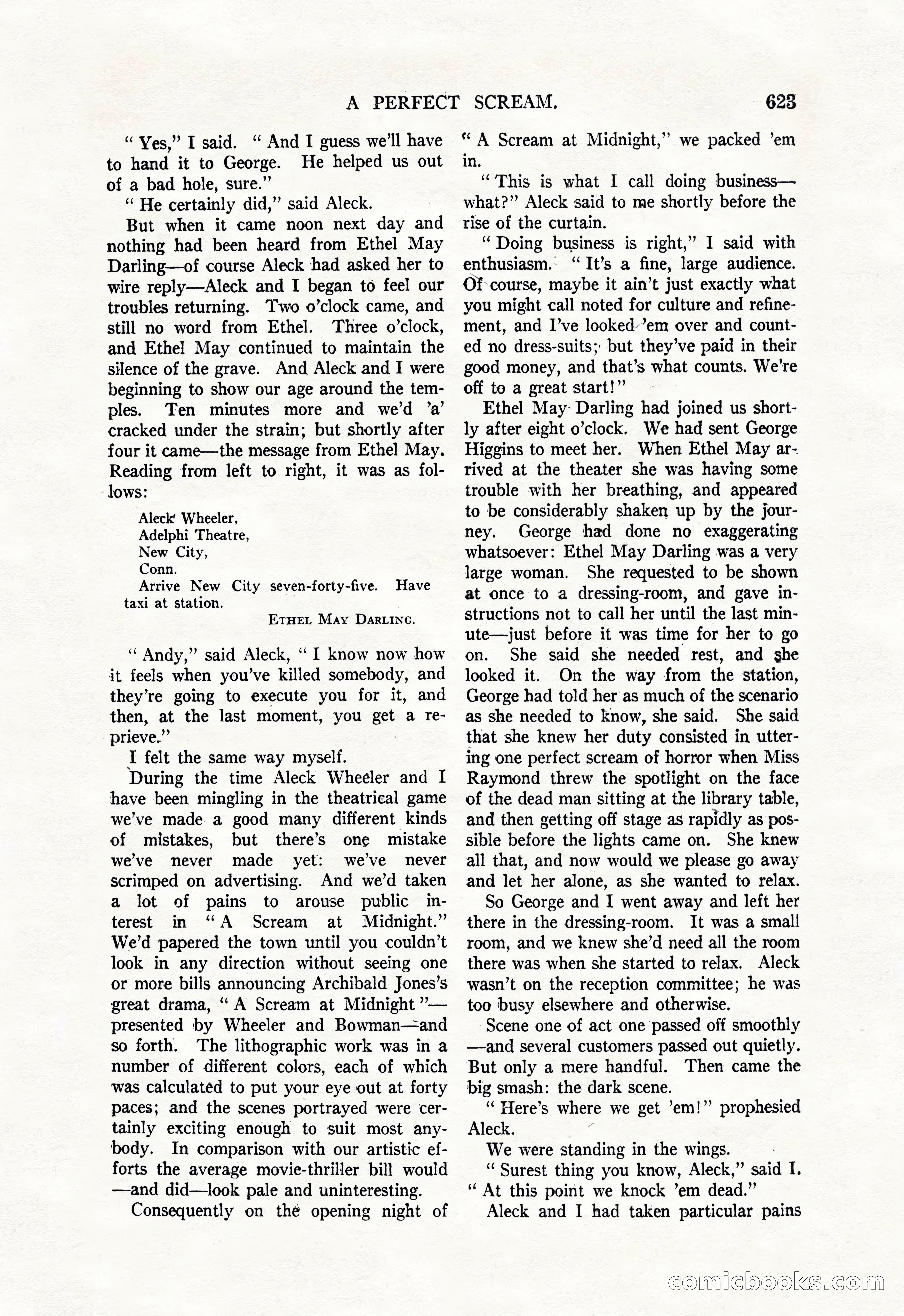
A restored page from Pulp Fiction, 1920. Page through the whole issue in the reader above.
📄 Transcribed text from this page (OCR, searchable)
Machine-transcribed from the original scan — historical spelling and the odd misread are preserved.
A PERFECT SCREAM. “Ves.” I said. “ And I guess we'll have to hand it to George. He helped us out of a bad hole, sure.”’ ‘“ He certainly did,” said Aleck. But when it came noon next day and nothing had been heard from Ethel May Darling—of course Aleck had asked her to wire reply—Aleck and I began to feel our troubles returning. Two o’clock came, and still no word from Ethel. Three o’clock, and Ethel May continued to maintain the silence of the grave. And Aleck and I were beginning to show our age around the tem- ples. Ten minutes more and we'd ’a’ cracked under the strain; but shortly after four it came—the message from Ethel May. Reading from left to right, it was as fol- -lows: Aleck Wheeler, Adelphi Theatre, New City, Conn. Arrive New City seven-forty-five. taxi at station. Have ETHEL May DARLING. ‘“ Andy,” said Aleck, “ I know now how it feels when you’ve killed somebody, and they’re going to execute you for it, and then, at the last moment, you get a re- prieve..”’ . I felt the same way myself. During the time Aleck Wheeler and I have been mingling in the theatrical game we've made. a good many different kinds of mistakes, but there’s one mistake we've never made yet: we've never scrimped on advertising. And we’d taken a lot of pains to arouse public in- terest in ‘“‘A Scream at Midnight.” We'd papered the town until you couldn’t look in any direction without seeing one or more bills announcing Archibald Jones’s great drama, ‘‘ A Scream at Midnight ’”— presented by Wheeler and Bowman—and so forth. The lithographic work was in a number of different colors, each of which was calculated to put your eye out at forty paces; and the scenes portrayed were cer- tainly exciting enough to suit most any- body. In comparison with our artistic ef- forts the average movie-thriller bill would —and did—look pale and uninteresting. Consequently on the opening night of 623 * A Scream at Midnight,” we packed ’em in. “This is what I call doing business— what?” Aleck said to me shortly before the rise of the curtain. “Doing business is right,” I said with enthusiasm. ‘It’s a fine, large audience. Of course, maybe it ain’t just exactly what you might call noted for culture and refine- ment, and I’ve looked’’em over and count- ed no dress-suits;: but they’ve paid in their good money, and that’s what counts. We’re off to a great start!” Ethel May- Darling had joined us short- ly after eight o’clock. We had sent George Higgins to meet her. When Ethel May ar- rived at the theater she was having some trouble with her breathing, and appeared to be considerably shaken up by the jour- ney. George had done no exaggerating whatsoever: Ethel May Darling was a very large woman. She requested to be shown at once to a dressing-room, and gave in- structions not to call her until the last min- ute—just before it was time for her to go on. She said she needed rest, and ghe looked it. On the way from the station, George had told her as much of the scenario as she needed to know, she said. She said that she knew her duty consisted in utter- ing one perfect scream of horror when Miss Raymond threw the spotlight on the face of the dead man sitting at the library table, and then getting off stage as rapidly as pos- sible before the lights came on. She knew all that, and now would we please go away and let her alone, as she wanted to relax. So George and I went away and left her there in the dressing-room. It was a small room, and we knew she’d need all the room there was when she started to relax. Aleck wasn’t on the reception committee; he was too busy elsewhere and otherwise. Scene one of act one passed off smoothly —and several customers passed out quietly. But only a mere handful. Then came the big smash: the dark scene. ‘Here’s where we get ’em!” prophesied Aleck. ‘ We were standing in the wings. ‘“ Surest thing you know, Aleck,” said I. ‘“ At this point we knock ’em dead.” Aleck and I had taken particular pains conmnicoool.