
Pulp Fiction, 1920 · page 157 of 180
Argosy, Vol. 118, No. 4 — page 157: what you’re looking at
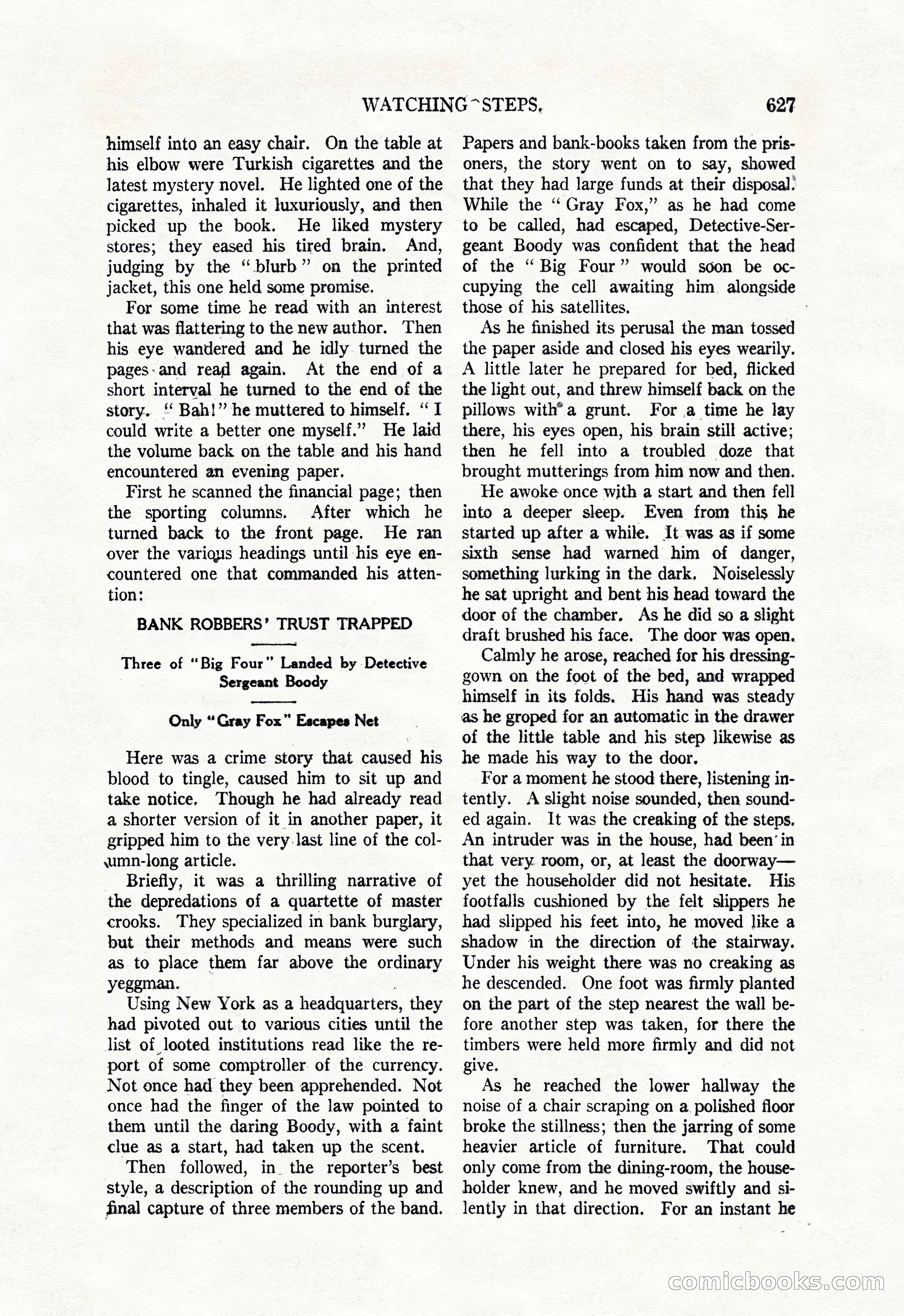
A restored page from Pulp Fiction, 1920. Page through the whole issue in the reader above.
📄 Transcribed text from this page (OCR, searchable)
Machine-transcribed from the original scan — historical spelling and the odd misread are preserved.
WATCHING “STEPS. himself into an easy chair. On the table at his elbow were Turkish cigarettes and the latest mystery novel. He lighted one of the cigarettes, inhaled it luxuriously, and then picked up the book. He liked mystery stores; they eased his tired brain. And, judging by the “blurb” on the printed jacket, this one held some promise. For some time he read with an interest that was flattering to the new author. Then his eye wandered and he idly turned the pages-and read again. At the end of a short interval he turned to the end of the story. ‘‘ Bah!” he muttered to himself. “I could write a better one myself.” He laid the volume back on the table and his hand encountered an evening paper. First he scanned the financial page; then the sporting columns. After which he turned back to the front page. He ran over the various headings until his eye en- countered one that commanded his atten- tion: BANK ROBBERS’ TRUST TRAPPED Omen a ee Three of “Big Four” Landed by Detective : : Sergeant Boody Only “Gray Fox" Escapes Net Here was a crime story that caused his blood to tingle, caused him to sit up and take notice, Though he had already read a shorter version of it in another paper, it gripped him to the very. last line of the col- sumn-long article. _ Briefly, it was a thrillmg narrative of the depredations of a quartette of master crooks. They specialized in bank burglary, but their methods and means were such as to place them far above the ordinary yeggman. | Using New York as a headquarters, they had pivoted out to various cities until the list of looted institutions read like the re- port of some comptroller of the currency. Not once had they been apprehended. Not once had the finger of the law pointed to them until the daring Boody, with a faint clue as a start, had taken up the scent. Then followed, in. the reporter’s best style, a description of the rounding up and final capture of three members of the band. 627 Papers and bank-books taken from the pris- oners, the story went on to say, showed that they had large funds at their disposal. While the ‘“ Gray Fox,” as he had come to be called, had escaped, Detective-Ser- geant Boody was confident that the head of the “ Big Four” would sdon be oc- cupying the cell awaiting him alongside those of his satellites. As he finished its perusal the man tossed the paper aside and closed his eyes wearily. A little later he prepared for bed, flicked the light out, and threw himself back on the pillows with* a grunt. For a time he lay there, his eyes open, his brain still active; then he fell into a troubled doze that brought mutterings from him now and then. He awoke once with a start and then fell into a deeper sleep. Even from this he started up after a while. It was as if some sixth sense had warned him of danger, something lurking in the dark. Noiselessly he sat upright and bent his head toward the door of the chamber. As he did so a slight draft brushed his face. The door was open. Calmly he arose, reached for his dressing- gown on the foot of the bed, and wrapped himself in its folds. His hand was steady as he groped for an automatic in the drawer of the little table and his step likewise as he made his way to the door. For a moment he stood there, listening in- tently. A slight noise sounded, then sound- ed again. It was the creaking of the steps. An intruder was in the house, had been’ in that very room, or, at least the doorway— yet the householder did not hesitate. His footfalls cushioned by the felt slippers he had slipped his feet into, he moved like a shadow in the direction of the stairway. Under his weight there was no creaking as he descended. One foot was firmly planted on the part of the step nearest the wall be- fore another step was taken, for there the timbers were held more firmly and did not give. As he reached the lower hallway the noise of a chair scraping on a polished floor broke the stillness; then the jarring of some heavier article of furniture. That could only come from the dining-room, the house- holder knew, and he moved swiftly and si- lently in that direction. For an instant he EO OO S (C(C)