
Pulp Fiction, 1920 · page 162 of 180
Argosy, Vol. 118, No. 4 — page 162: what you’re looking at
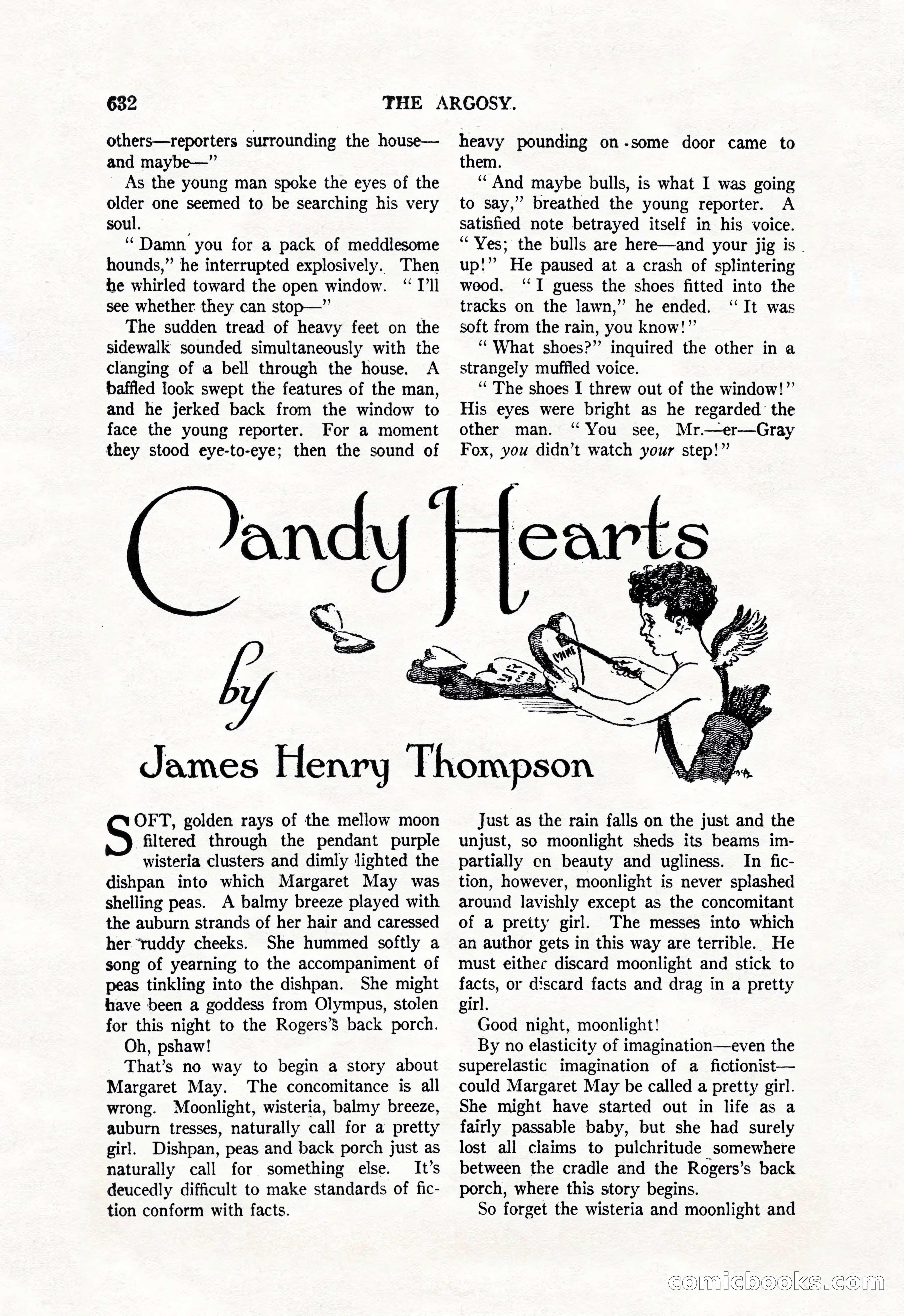
A restored page from Pulp Fiction, 1920. Page through the whole issue in the reader above.
📄 Transcribed text from this page (OCR, searchable)
Machine-transcribed from the original scan — historical spelling and the odd misread are preserved.
632 others—reporters surrounding the house— and maybe—” As the young man spoke the eyes of the older one seemed to be searching his very soul. “Damn you for a pack of meddlesome hounds,” he interrupted explosively. Then he whirled toward the open window. “ I'll see whether they can stop—” The sudden tread of heavy feet on the sidewalk sounded simultaneously with the clanging of a bell through the house. A baffled look swept the features of the man, and he jerked back from the window to face the young reporter. For a moment they stood eye-to-eye; then the sound of THE ARGOSY. heavy pounding on-some door came to them. ‘And maybe bulls, is what I was going to say,” breathed the young reporter. A satisfied note betrayed itself in his voice. ‘Yes; the bulls are here—and your jig is | up!” He paused at a crash of splintering weod. “I guess the shoes fitted into the tracks on the lawn,” he ended. ‘It was soft from the rain, you know!” “What shoes?” inquired the other in a strangely muffled voice. ‘The shoes I threw out of the window!” His eyes were bright as he regarded the other man. ‘“ You see, Mr.—er—Gray Fox, you didn’t watch your step!” James Henry Thompson OFT, golden rays of the mellow moon filtered through the pendant purple wisteria clusters and dimly lighted the dishpan into which Margaret May was shelling peas. A balmy breeze played with the auburn strands of her hair and caressed her ‘ruddy cheeks. She hummed softly a song of yearning to the accompaniment of peas tinkling into the dishpan. She might have been a goddess from Olympus, stolen for this night to the Rogers’$§ back porch. Oh, pshaw! That’s no way to begin a story about Margaret May. The concomitance is all wrong. Moonlight, wisteria, balmy breeze, auburn tresses, naturally call for a pretty girl. Dishpan, peas and back porch just as naturally call for something else. It’s deucedly difficult to make standards of fic- tion conform with facts. Just as the rain falls on the just and the unjust, so moonlight sheds its beams im- partially cn beauty and ugliness. In fic- tion, however, moonlight is never splashed around lavishly except as the concomitant of a pretty girl. The messes into which an author gets in this way are terrible. He must either discard moonlight and stick to facts, or discard facts and drag in a pretty girl. Good night, moonlight! By no elasticity of imagination—even the superelastic imagination of a fictionist— could Margaret May be called a pretty girl. She might have started out in life as a fairly passable baby, but she had surely lost all claims to pulchritude somewhere between the cradle and the Rogers’s back porch, where this story begins. So forget the wisteria and moonlight and AMICLOOO@ (Cl Q) S (C(O)