
Pulp Fiction, 1920 · page 168 of 180
Argosy, Vol. 118, No. 4 — page 168: what you’re looking at
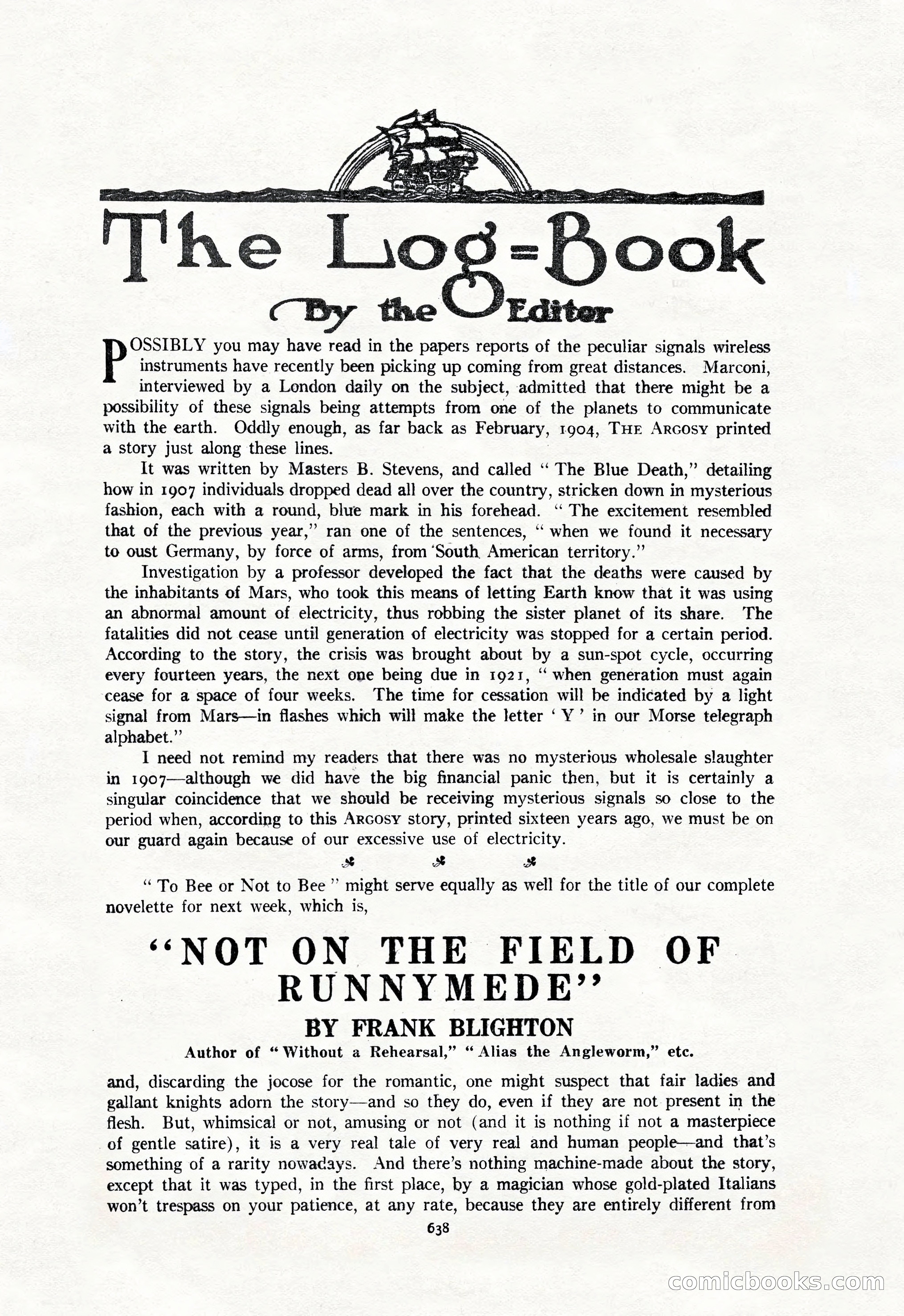
A restored page from Pulp Fiction, 1920. Page through the whole issue in the reader above.
📄 Transcribed text from this page (OCR, searchable)
Machine-transcribed from the original scan — historical spelling and the odd misread are preserved.
OSSIBLY you may have read in the papers reports of the peculiar signals wireless instruments have recently been picking up coming from great distances. Marconi, interviewed by a London daily on the subject, admitted that there might be a possibility of these signals being attempts from one of the planets to communicate with the earth. Oddly enough, as far back as February, 1904, THE ARGOsy printed a story just along these lines. It was written by Masters B. Stevens, and called ‘‘ The Blue Death,” detailing how in 1907 individuals dropped dead all over the country, stricken down in mysterious fashion, each with a round, blue mark in his forehead. ‘“‘ The excitement resembled that of the previous year,” ran one of the sentences, ‘‘ when we found it necessary to oust Germany, by force of arms, from ‘South American territory.” Investigation by a professor developed the fact that the deaths were caused by the inhabitants of Mars, who took this means of letting Earth know that it was using an abnormal amount of electricity, thus robbing the sister planet of its share. The fatalities did not cease until generation of electricity was stopped for a certain period. According to the story, the crisis was brought about by a sun-spot cycle, occurring every fourteen years, the next one being due in 1921, ‘‘ when generation must again cease for a space of four weeks. The time for cessation will be indicated by a light signal from Mars—in flashes which will make the letter ‘ Y’ in our Morse telegraph alphabet.” I need not remind my readers that there was no mysterious wholesale slaughter in 1907—although we did have the big financial panic then, but it is certainly a singular coincidence that we should be receiving mysterious signals so close to the period when, according to this Arcosy story, printed sixteen years ago, we must be on our guard again because of our excessive use of electricity. sg st a “To Bee or Not to Bee’ might serve equally as well for the title of our complete novelette for next week, which is, ‘NOT ON THE FIELD OF RUNNYMEDE”? BY FRANK BLIGHTON Author of “ Without a Rehearsal,” “ Alias the Angleworm,” etc. and, discarding the jocose for the romantic, one might suspect that fair ladies and gallant knights adorn the story—and so they do, even if they are not present in the flesh. But, whimsical or not, amusing or not (and it is nothing if not a masterpiece of gentle satire), it is a very real tale of very real and human people—and that’s something of a rarity nowadays. And there’s nothing machine-made about the story, except that it was typed, in the first place, by a magician whose gold-plated Italians won’t trespass on your patience, at any rate, because they are entirely different from 638 (C(O) > a NOOO SS (C(C)