
Pulp Fiction, 1920 · page 38 of 180
Argosy, Vol. 118, No. 4 — page 38: what you’re looking at
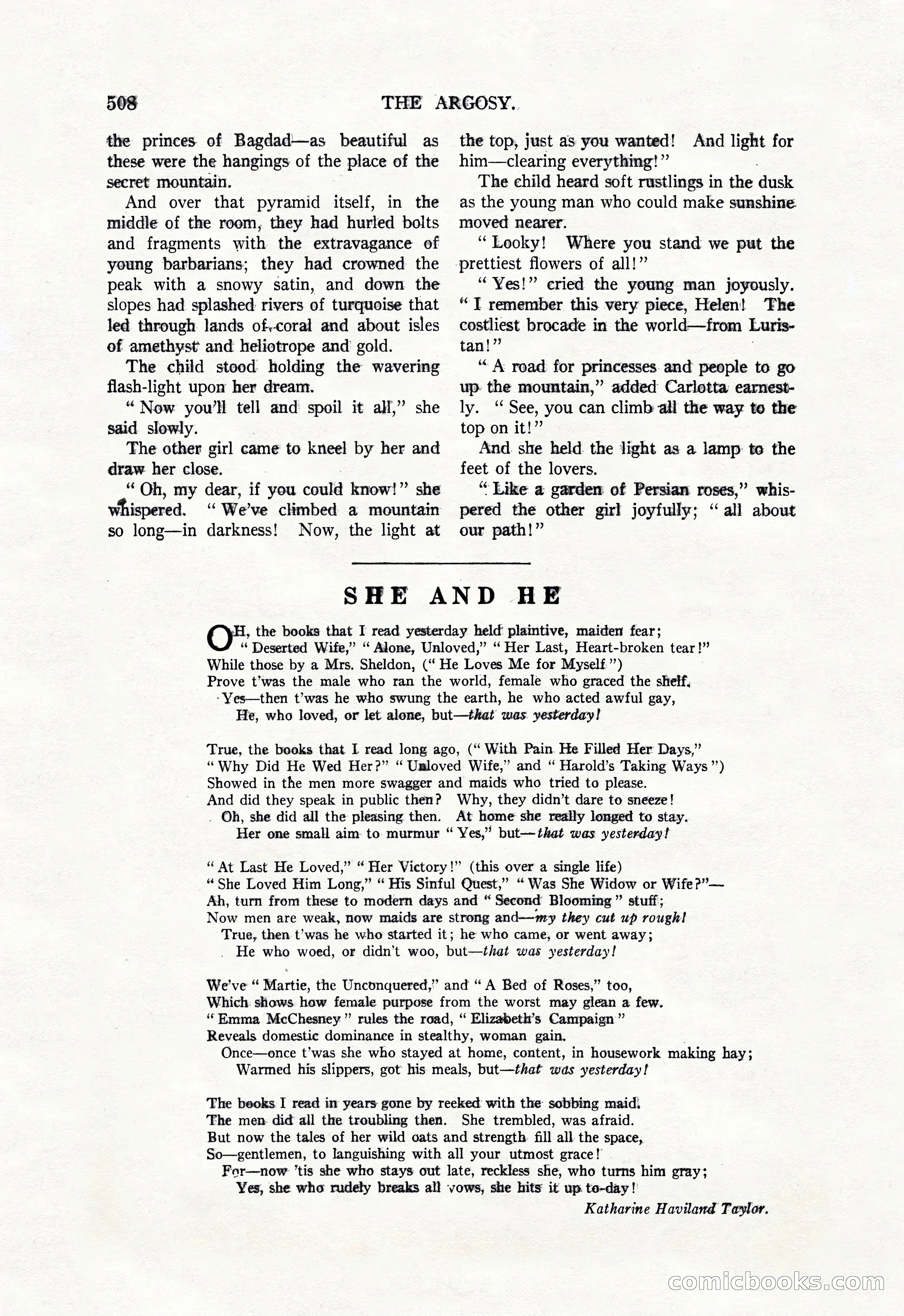
A restored page from Pulp Fiction, 1920. Page through the whole issue in the reader above.
📄 Transcribed text from this page (OCR, searchable)
Machine-transcribed from the original scan — historical spelling and the odd misread are preserved.
508 the princes of Bagdad—as beautiful as these were the hangings of the place of the secret mountain. And over that pyramid itself, in the middle of the room, they had hurled bolts and fragments with the extravagance of young barbarians; they had crowned the peak with a snowy satin, and down the slopes had splashed rivers of turquoise that led through lands of,coral and about isles of amethyst and heliotrope and gold. The child stood holding the wavering flash-light upon her dream. “Now you’ll tell and spoil it all,” she said slowly. , The other girl came to kneel by her and draw her close. “Oh, my dear, if you could know!” she whispered. so long—in darkness! Now, the light at 2 We’ ve climbed a mountam the top, just as you wanted! him—clearing everything!” The child heard soft rustlings in the dusk as the young man who could make sunshine moved nearer. ‘“Looky! Where you stand we put the And light for prettiest flowers of all!” “Yes!” cried the young man joyously. “TI remember this very piece, Helen! The costliest brocade in the world—from Luris- tan!” ““A road for princesses. and people to go up: the mountain,” added Carlotta earnest- ly. ‘‘ See, you can climb ail the way to the top on it!” And. she held. the light as a lamp te the feet of the lovers. “ Like a garden of Persian roses,” whis- pered the other girl joyfully; “all about our path!” SHE AND HE , the books that I read yesterday held plaintive, maiden fear; “ Deserted Wife,” ‘“ Alone, Unloved,” ‘“ Her Last, Heart-broken tear!” While those by a Mrs. Sheldon, (“ He Tacs Me for Myself.’’) Prove t’was the male who ran the world, female who graced the shelf, -Yes—then t’was he who swung the earth, he who acted awful gay, He, who loved, or let alone, but—that was. yesterday! True, the books that I read long ago, (“ With Pain He Filled Her Days,” “Why Did He Wed Her?” “ Unloved Wife,” and ‘“ Harold’s Taking Ways ’”’) Showed in the men more swagger and maids who tried to please. And did they speak in public then? Why, they didn’t dare to sneeze! . Oh, she did all the pleasing then. At home she really longed to stay. Her one small aim- to murmur “ Yes,” but—thkat was yesterday! “ At Last He Loved,” “ Her Victory!” (this over a single life) “ She Loved Him Long,” “ His Sinful Quest,” “ Was She Widow or Wife ?”—~ Ah, turn from these to modern days and “ Second Blooming ” stuff; Now men are weak, now maids are strong and—wmy they cut up rough! True, then t’was he who started it; he who came, or went away; . He who woed, or didn’t woo, but—that was yesterday! We've “ Martie, the Unconquered,” and “ A Bed of Roses,” too, Which. shows how female purpose from the worst may glean a few. ‘“Emma McChesney ” rules the road, “ Elizabeth’s Campaign . Reveals domestic dominance in stealthy, woman gain. Once—once t’was she who stayed at home, content, in housework making hay ; Warmed his slippers, got his meals, but—that was yesterday! The beoks I read in years gone by reeked with the sobbing maid) The men did all the troubling then. She trembled, was afraid. But now the tales of her wild oats and strength fill all the space, So—gentlemen, to languishing with all your utmost grace! For—now ’tis she who stays out late, reckless she, who turns him gray; Yes, she who rudely breaks all vows, she hits it up to-day !' Katharine Haviland Taylor. OO (C(O) SS (C(O)