
Pulp Fiction, 1920 · page 50 of 180
Argosy, Vol. 118, No. 4 — page 50: what you’re looking at
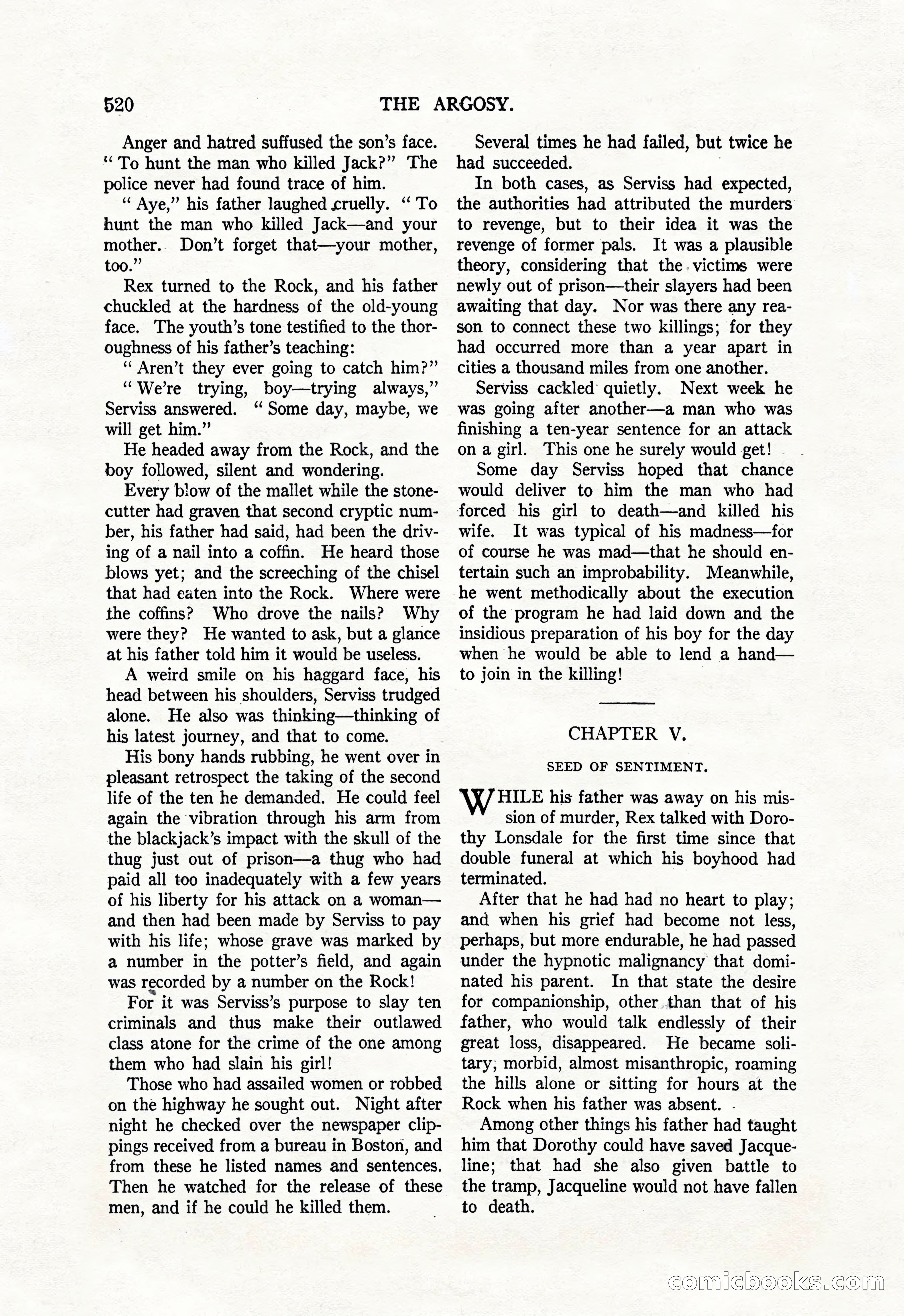
A restored page from Pulp Fiction, 1920. Page through the whole issue in the reader above.
📄 Transcribed text from this page (OCR, searchable)
Machine-transcribed from the original scan — historical spelling and the odd misread are preserved.
520 Anger and hatred suffused the son’s face. “To hunt the man who killed Jack?” The police never had found trace of him. ‘* Aye,” his father laughed cruelly. “ To hunt the man who killed Jack—and your mother.. Don’t forget that—your mother, too.”’ Rex turned to the Rock, and his father chuckled at the hardness of the old-young face. The youth’s tone testified to the thor- oughness of his father’s teaching: ‘“‘ Aren’t they ever going to catch him?” “We're trying, boy—trying always,”’ Serviss answered. ‘“‘ Some day, maybe, we will get him.” He headed away from the Rock, and the boy followed, silent and wondering. Every blow of the mallet while the stone- cutter had graven that second cryptic num- ber, his father had said, had been the driv- ing of a nail into a coffin. He heard those blows yet; and the screeching of the chisel that had eaten into the Rock. Where were the coffins? Who drove the nails? Why were they? He wanted to ask, but a glance at his father told him it would be useless. A weird smile on his haggard face, his head between his shoulders, Serviss trudged alone. He also was thinking—thinking of his latest journey, and that to come. His bony hands rubbing, he went over in pleasant retrospect the taking of the second life of the ten he demanded. He could feel again the vibration through his arm from the blackjack’s impact with the skull of the thug just out of prison—a thug who had paid all too inadequately with a few years of his liberty for his attack on a woman— and then had been made by Serviss to pay with his life; whose grave was marked by a number in the potter’s field, and again was recorded by a number on the Rock! For it was Serviss’s purpose to slay ten criminals and thus make their outlawed class atone for the crime of the one among them who had slain his girl! Those who had assailed women or robbed on the highway he sought out. Night after night he checked over the newspaper clip- pings received from a bureau in Boston, and from these he listed names and sentences. Then he watched for the release of these men, and if he could he killed them. THE ARGOSY. Several times he had failed, but twice he had succeeded. : In both cases, as Serviss had expected, the authorities had attributed the murders to revenge, but to their idea it was the revenge of former pals. It was a plausible theory, considering that the.victims were newly out of prison—their slayers had been awaiting that day. Nor was there any rea- son to connect these two killings; for they had occurred more than a year apart in cities a thousand miles from one another. Serviss cackled quietly. Next week he was going after another—a man who was finishing a ten-year sentence for an attack on a girl. This one he surely would get! Some day Serviss hoped that chance would deliver to him the man who had forced his girl to death—and killed his wife. It was typical of his madness—for of course he was mad—that he should en- tertain such an improbability. Meanwhile, -he went methodically about the execution of the program he had laid down and the insidious preparation of his boy for the day when he would be able to lend a hand— to join in the killing! | CHAPTER V. SEED OF SENTIMENT, W HILE his father was away on his mis- sion of murder, Rex talked with Doro- thy Lonsdale for the first time since that double funeral at which his boyhood had terminated. After that he had had no heart to play; and when his grief had become not less, perhaps, but more endurable, he had passed under the hypnotic malignancy that domi- nated his parent. In that state the desire for companionship, other.than that of his father, who would talk endlessly of their great loss, disappeared. He became soli- tary; morbid, almost misanthropic, roaming the hills alone or sitting for hours at the Rock when his father was absent. - Among other things his father had taught him that Dorothy could have saved Jacque- line; that had she also given battle to the tramp, Jacqueline would not have fallen to death. JOO (S| QO) im S (C(O)