
Pulp Fiction, 1920 · page 57 of 180
Argosy, Vol. 118, No. 4 — page 57: what you’re looking at
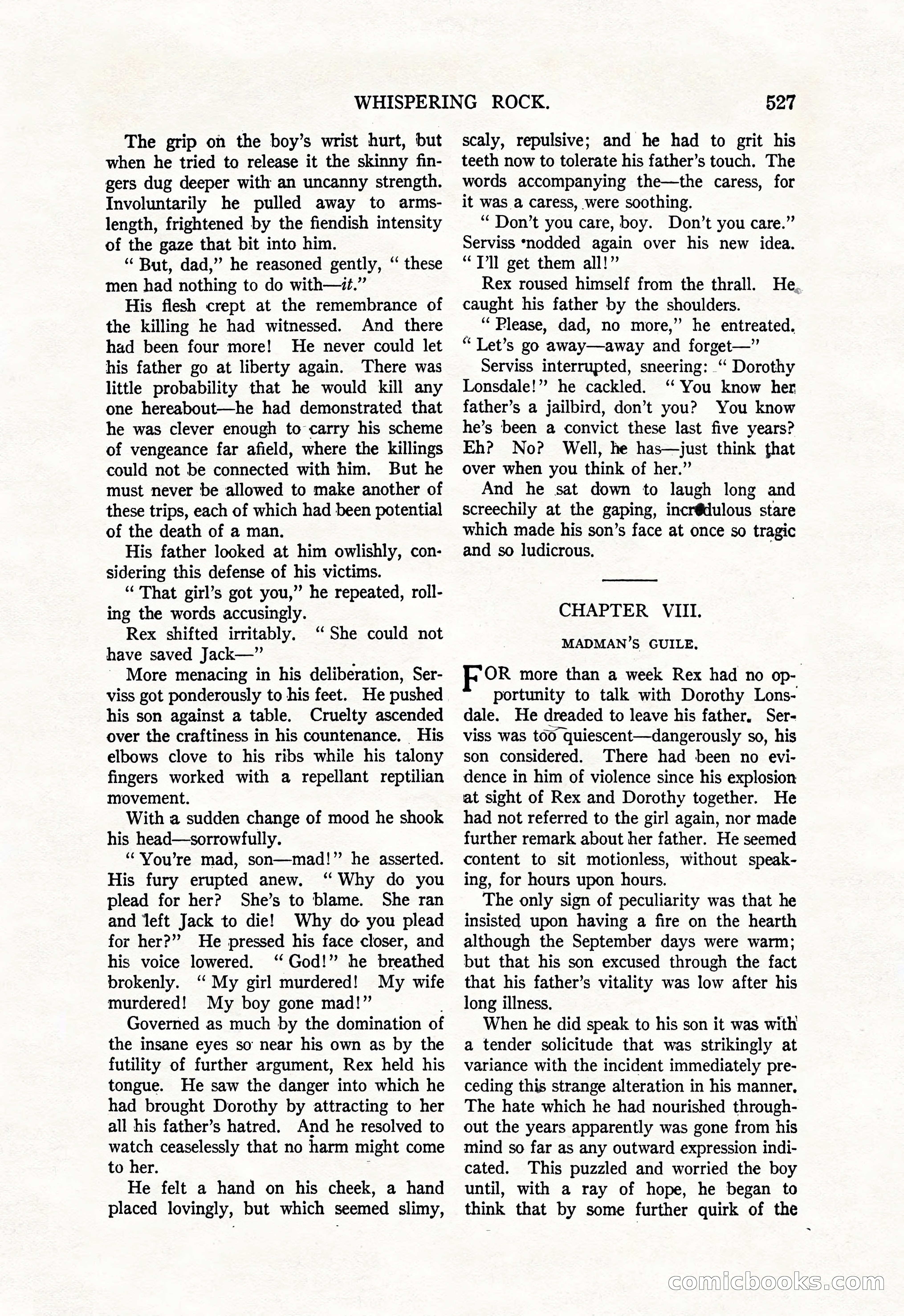
A restored page from Pulp Fiction, 1920. Page through the whole issue in the reader above.
📄 Transcribed text from this page (OCR, searchable)
Machine-transcribed from the original scan — historical spelling and the odd misread are preserved.
WHISPERING ROCK. The grip on the boy’s wrist hurt, but when he tried to release it the skinny fin- gers dug deeper with an uncanny strength. Involuntarily he pulled away to arms- length, frightened by the fiendish intensity of the gaze that bit into him. ‘“ But, dad,” he reasoned gently, “ these men had nothing to do with—z?.” His flesh crept at the remembrance of the killing he had witnessed. And there had been four more! He never could let his father go at liberty again. There was little probability that he would kill any one hereabout—he had demonstrated that he was clever enough to carry his scheme of vengeance far afield, where the killings could not be connected with him. But he must never be allowed to make another of these trips, each of which had been potential of the death of a man. His father looked at him owlishly, con- sidering this defense of his victims. “ That girl’s got you,” he repeated, roll- ing the words accusingly. Rex shifted irritably. have saved Jack—” ~ More menacing in his deliberation, Ser- viss got ponderously to his feet. He pushed his son against a table. Cruelty ascended over the craftiness in his countenance. His elbows clove to his ribs while his talony fingers worked with a repellant reptilian movement. With a sudden change of mood he shook his head—sorrowfully. “You're mad, son—mad!” he asserted. His fury erupted anew. ‘‘ Why do you plead for her? She’s to blame. She ran and left Jack to die! Why do you plead for her?” He pressed his face closer, and his voice lowered. ‘ God!” he breathed brokenly. ‘‘ My girl murdered! My wife murdered! My boy gone mad!” Governed as much by the domination of the insane eyes so near his own as by the futility of further argument, Rex held his tongue. He saw the danger into which he had brought Dorothy by attracting to her all his father’s hatred. And he resolved to watch ceaselessly that no harm might come to her. ; He felt a hand on his cheek, a hand placed lovingly, but which seemed slimy, “She could not 527 scaly, repulsive; and he had to grit his teeth now to tolerate his father’s touch. The words accompanying the—the caress, for it was a Caress, were soothing. “Don’t you care, boy. Don’t you care.” Serviss "nodded again over his new idea. “Tl get them all!” Rex roused himself from the thrall. caught his father by the shoulders. “Please, dad, no more,” he entreated. “Let’s go away—away and forget—” Serviss interrupted, sneering: ‘ Dorothy Lonsdale!” he cackled. ‘ You know her father’s a jailbird, don’t you? You know he’s been a convict these last five years? Eh? No? Well, he has—just think that over when you think of her.” And he sat down to laugh long and screechily at the gaping, incr@dulous stare which made his son’s face at once so tragic and so ludicrous. | CHAPTER VIII. MADMAN’S GUILE, He. OR more than a week Rex had no op- portunity to talk with Dorothy Lons- dale. He dreaded to leave his father. Ser- viss was too quiescent—dangerously so, his son considered. There had been no evi- dence in him of violence since his explosion at sight of Rex and Dorothy together. He had not referred to the girl again, nor made further remark about her father. He seemed content to sit motionless, without speak- ing, for hours upon hours. The only sign of peculiarity was that he insisted upon having a fire on the hearth although the September days were warm; but that his son excused through the fact that his father’s vitality was low after his long illness. When he did speak to his son it was with a tender solicitude that was strikingly at variance with the incident immediately pre- ceding this strange alteration in his manner, The hate which he had nourished through- out the years apparently was gone from his mind so far as any outward expression indi- cated. This puzzled and worried the boy until, with a ray of hope, he began to think that by some further quirk of the im (Cl QO) NOOK