
Pulp Fiction, 1920 · page 63 of 180
Argosy, Vol. 118, No. 4 — page 63: what you’re looking at
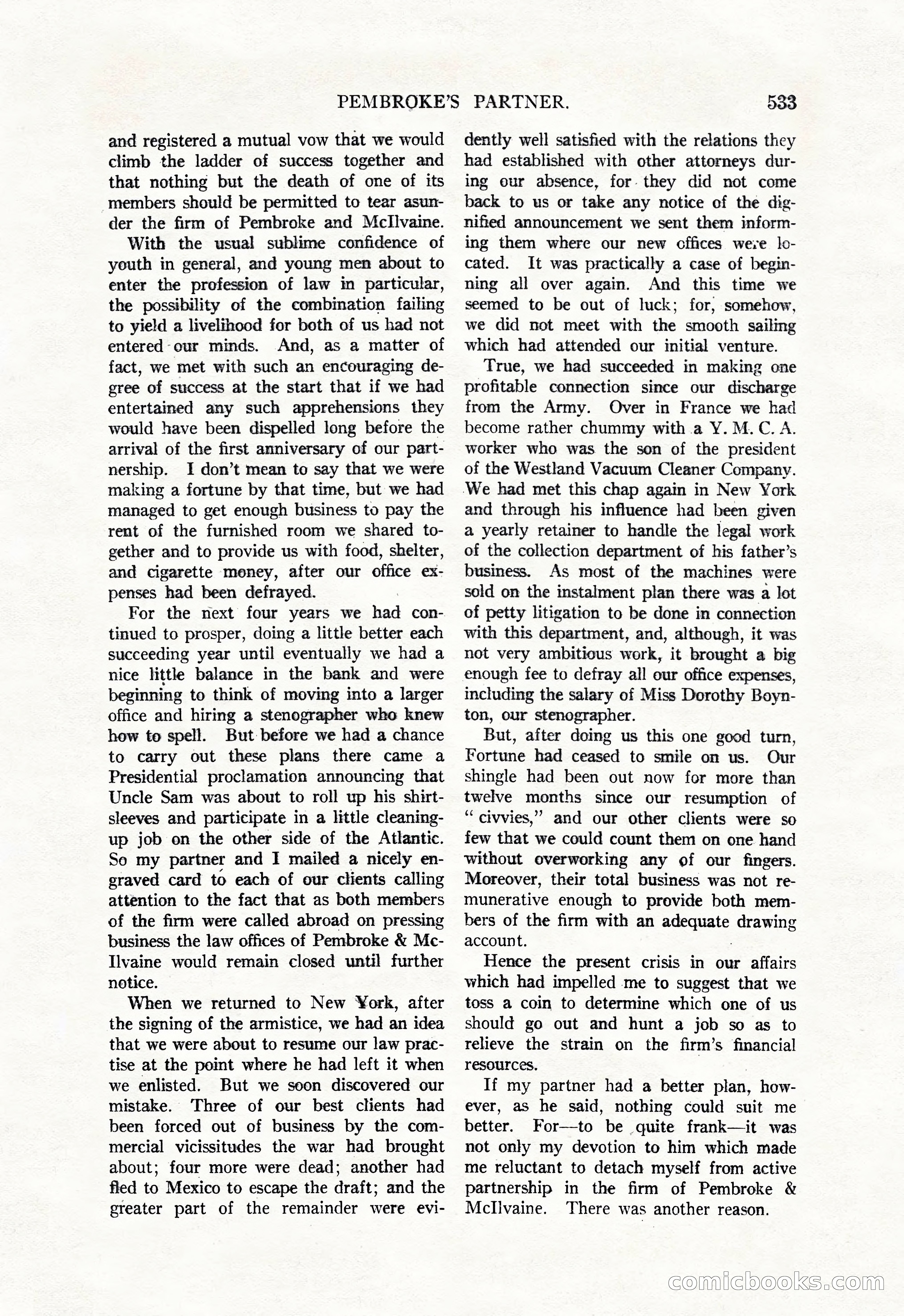
A restored page from Pulp Fiction, 1920. Page through the whole issue in the reader above.
📄 Transcribed text from this page (OCR, searchable)
Machine-transcribed from the original scan — historical spelling and the odd misread are preserved.
PEMBROKE’S and registered a mutual vow that we would climb the ladder of success together and that nothing but the death of one of its members should be permitted to tear asun- der the firm of Pembroke and Mcllvaine. With the usual sublime confidence of youth in general, and young men about to enter the profession of law in particular, the possibility of the combmation failing to yield a livelihood for both of us had not entered our minds. And, as a matter of fact, we met with such an encouraging de- gree of success at the start that if we had entertained any such apprehensions they would have been dispelled long before the arrival of the first anniversary of our part- nership. I don’t mean to say that we were making a fortune by that time, but we had managed to get enough business to pay the rent of the furnished room we shared to- gether and to provide us with food, shelter, and cigarette money, after our office ex- penses had been defrayed. For the next four years we had con- tinued to prosper, doing a little better each succeeding year until eventually we had a nice little balance in the bank and were beginning to think of moving into a larger office and hiring a stenographer who knew how to spell. But before we had a chance to carry out these plans there came a Presidential proclamation announcing that Uncle Sam was about to roll up his shit- sleeves and participate in a little cleaning- up job on the other side of the Atlantic. So my partner and I mailed a nicely en- egraved card to each of our clients calling attention to the fact that as both members of the firm were called abroad on pressing business the law offices of Pembroke & Mc- Ilvaine would remain closed until further notice. When we returned to New York, after the signing of the armistice, we had an idea that we were about to resume our law prac- tise at the pot where he had left it when we enlisted. But we soon discovered our mistake. Three of our best clients had been forced out of business by the com- mercial vicissitudes the war had brought about; four more were dead; another had fled to Mexico to escape the draft; and the greater part of the remainder were evi- PARTNER. 533 dently well satisfied with the relations they had established with other attorneys dur- ing our absence, for. they did not come back to us or take any notice of the dig- nified announcement we sent them inform- ing them where our new offices were lo- cated. It was practically a case of begin- ning all over again. And this time we seemed to be out of luck; for, somehow, we did not meet with the smooth sailing which had attended our initial venture. True, we had succeeded in making one profitable connection since our discharge from the Army. Over in France we had become rather chummy with a Y. M.C. A. worker who was the son of the president of the Westland Vacuum Cleaner Company. ‘We had met this chap again in New York and through his influence had been given a yearly retainer to handle the legal work of the collection department of his father’s business. As most of the machines were sold on the instalment plan there was a lot of petty litigation to be done in connection with this department, and, although, it was not very ambitious work, it brought a big enough fee to defray all our office expenses, including the salary of Miss Dorothy Boyn- ton, our stenographer. But, after doing us this one good turn, Fortune had ceased to smile on us. Our shingle had been out now for more than twelve months since our resumption of ‘ civvies,” and our other clients were so few that we could count them on one hand without overworking any of our fingers. Moreover, their total business was not re- munerative enough to provide both mem- bers of the firm with an ete drawing account. Hence the present crisis in our affairs which had impelled me to suggest that we toss a coin to determine which one of us should go out and hunt a job so as to relieve the strain on the firm’s financial resources. If my partner had a better plan, how- ever, as he said, nothing could suit me better. For—to be quite frank—it was not only my devotion to him which made me reluctant to detach myself from active partnership in the firm of Pembroke & MclIivaine. There was another reason. CGO DOO SS (C(O)