
Pulp Fiction, 1920 · page 116 of 164
Argosy, Vol. 122, No. 1 — page 116: what you’re looking at
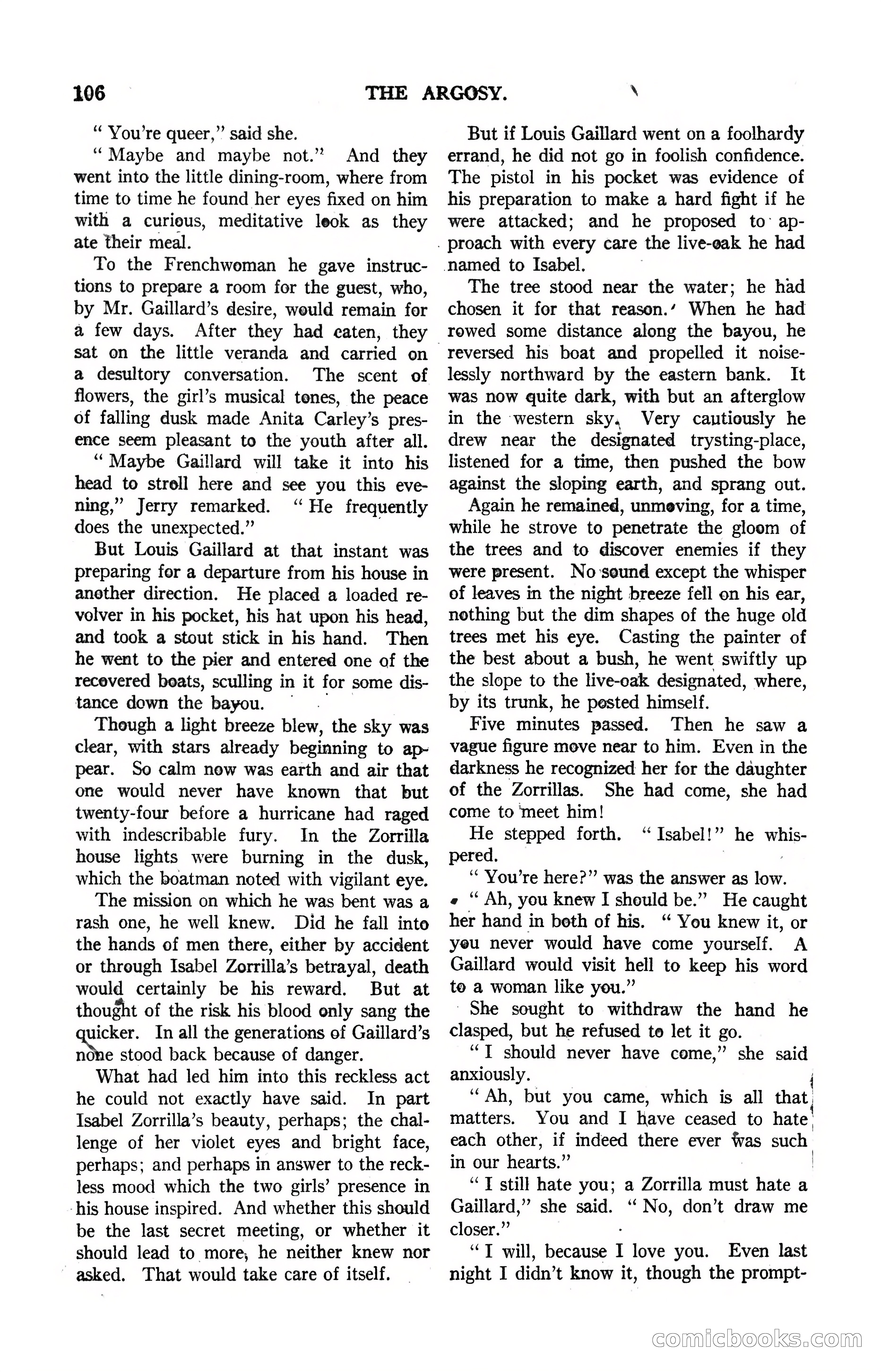
A restored page from Pulp Fiction, 1920. Page through the whole issue in the reader above.
📄 Transcribed text from this page (OCR, searchable)
Machine-transcribed from the original scan — historical spelling and the odd misread are preserved.
106 THE ARGOSY. \ ‘You're queer,”’ said she. “Maybe and maybe not.” And they went into the little dining-room, where from time to time he found her eyes fixed on him with a curieus, meditative leok as they ate their meal. To the Frenchwoman he gave instruc- tions to prepare a room for the guest, who, by Mr. Gaillard’s desire, would remain for a few days. After they had eaten, they sat on the little veranda and carried on — a desultory conversation. The scent of flowers, the girl’s musical tenes, the peace of falling dusk made Anita Carley’s pres- ence seem pleasant to the youth after all. ““Maybe Gaillard will take it into his head to strell here and see you this eve- ning,’ Jerry remarked. “He frequently does the unexpected.” . But Louis Gaillard at that instant was preparing for a departure from his house in another direction. He placed a loaded re- volver in his pocket, his hat upon his head, and took a stout stick in his hand. Then he went to the pier and entered one of the recovered boats, sculling in it for some dis- tance down the bayou. = ==-——™ Though a light breeze blew, the sky was clear, with stars already beginning to ap- pear. So calm now was earth and air that one would never have known that but twenty-four before a hurricane had raged with indescribable fury. In the Zorrilla house lights were burning in the dusk, which the boatman noted with vigilant eye. The mission on which he was bent was a rash one, he well knew. Did he fall into the hands of men there, either by accident or through Isabel Zorrilla’s betrayal, death would certainly be his reward. But at thought of the risk his blood only sang the Cena In all the generations of Gaillard’s noe stood back because of danger. What had led him into this reckless act he could not exactly have said. In part Isabel Zorrilla’s beauty, perhaps; the chal- lenge of her violet eyes and bright face, perhaps; and perhaps in answer to the reck- less mood which the two girls’ presence in -his house inspired. And whether this should be the last secret meeting, or whether it should lead to more, he neither knew nor asked. That would take care of itself. But if Louis Gaillard went on a foolhardy errand, he did not go in foolish confidence. The pistol in his pocket was evidence of his preparation to make a hard fight if he were attacked; and he proposed to: ap- . proach with every care the live-eak he had named to Isabel. The tree stood near the water; he had chosen it for that reason.’ When he had rowed some distance along the bayou, he reversed his boat and propelled it noise- lessly northward by the eastern bank. It was now quite dark, with but an afterglow in the western sky. Very cautiously he drew near the designated trysting-place, listened for a time, then pushed the bow against the sloping earth, and sprang out. Again he remained, unmeving, for a time, while he strove to penetrate the gloom of the trees and to discover enemies if they were present. No-sound except the whisper of leaves in the night breeze fell on his ear, nothing but the dim shapes of the huge old trees met his eye. Casting the painter of the best about a bush, he went swiftly up the slope to the live-oak designated, where, by its trunk, he pested himself. Five minutes passed. Then he saw a vague figure move near to him. Even in the darkness he recognized her for the daughter of the Zorrillas. She had come, she had come to ‘meet him! He stepped forth. ‘“ Isabel!” he whis- pered. | ‘‘ You’re here?” was the answer as low. « “ Ah, you knew I should be.” He caught her hand in beth of his. “ You knew it, or yeu never would have come yourself. A Gaillard would visit hell to keep his word te a woman like you.” She sought to withdraw the hand he clasped, but he refused to let it go. ‘““T should never have come,” she said anxiously. ‘‘Ah, but you came, which is all that, matters. You and I have ceased to hate each other, if indeed there ever wes such in our hearts.” | ‘““T still hate you; a Zorrilla must hate a Gaillard,” she said. ‘“ No, don’t draw me closer.” ‘““T will, because I love you. Even last night I didn’t know it, though the prompt- | cComiclbooks.com