
Pulp Fiction, 1920 · page 126 of 164
Argosy, Vol. 122, No. 1 — page 126: what you’re looking at
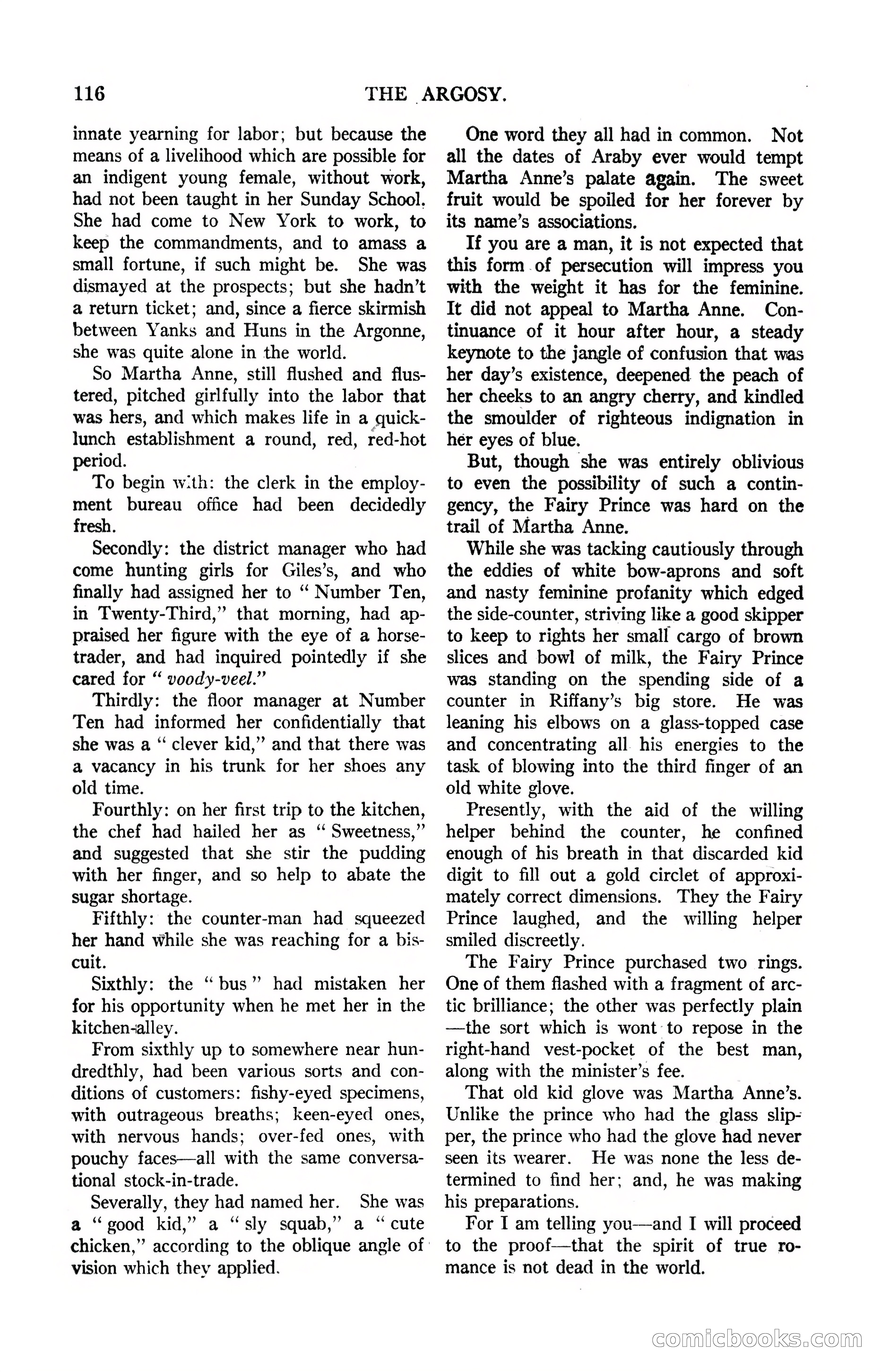
A restored page from Pulp Fiction, 1920. Page through the whole issue in the reader above.
📄 Transcribed text from this page (OCR, searchable)
Machine-transcribed from the original scan — historical spelling and the odd misread are preserved.
116 innate yearning for labor; but because the means of a livelihood which are possible for an indigent young female, without work, had not been taught in her Sunday School. She had come to New York to work, to keep the commandments, and to amass a small fortune, if such might be. She was dismayed at the prospects; but she hadn’t a return ticket; and, since a fierce skirmish between Yanks and Huns in the Argonne, she was quite alone in the world. So Martha Anne, still flushed and flus- tered, pitched girlfully into the labor that was hers, and which makes life in a quick- lunch establishment a round, red, red-hot period. To begin w:th: the clerk in the employ- ment bureau office had been decidedly fresh. Secondly: the district manager who had come hunting girls for Giles’s, and who finally had assigned her to “‘ Number Ten, in Twenty-Third,” that morning, had ap- praised her figure with the eye of a horse- trader, and had inquired pointedly if she cared for “ voody-veel.” Thirdly: the floor manager at Number Ten had informed her confidentially that she was a “ clever kid,” and that there was a vacancy in his trunk for her shoes any old time. Fourthly: on her first trip to the kitchen, the chef had hailed her as ‘ Sweetness,” and suggested that she stir the pudding with her finger, and so help to abate the sugar shortage. Fifthly: the counter-man had squeezed her hand while she was reaching for a bis- cuit. Sixthly: the “bus” had mistaken her for his opportunity when he met her in the kitchen-alley. From sixthly up to somewhere near hun- dredthly, had been various sorts and con- ditions of customers: fishy-eyed specimens, with outrageous breaths; keen-eyed ones, with nervous hands; over-fed ones, with pouchy faces—all with the same conversa- tional stock-in-trade. Severally, they had named her. She was a “good kid,” a “sly squab,” a “cute chicken,” according to the oblique angle of vision which they applied. THE ARGOSY. One word they all had in common. Not all the dates of Araby ever would tempt Martha Anne’s palate again. The sweet fruit would be spoiled for her forever by its name’s associations. If you are a man, it is not expected that this form of persecution will impress you with the weight it has for the feminine. It did not appeal to Martha Anne. Con- tinuance of it hour after hour, a steady keynote to the jangle of confusion that was her day’s existence, deepened the peach of her cheeks to an angry cherry, and kindled the smoulder of righteous indignation in her eyes of blue. But, though she was entirely oblivious to even the possibility of such a contin- gency, the Fairy Prince was hard on the trail of Martha Anne. While she was tacking cautiously through the eddies of white bow-aprons and soft and nasty feminine profanity which edged the side-counter, striving like a good skipper to keep to rights her small cargo of brown slices and bowl of milk, the Fairy Prince was standing on the spending side of a counter in Riffany’s big store. He was leaning his elbows on a glass-topped case and concentrating all his energies to the task of blowing into the third finger of an old white glove. Presently, with the aid of the willing helper behind the counter, he confined enough of his breath in that discarded kid digit to fill out a gold circlet of approxi- mately correct dimensions. They the Fairy Prince laughed, and the willing helper smiled discreetly. The Fairy Prince purchased two rings. One of them flashed with a fragment of arc- tic brilliance; the other was perfectly plain —the sort which is wont to repose in the right-hand vest-pocket of the best man, along with the minister’s fee. That old kid glove was Martha Anne’s. Unlike the prince who had the glass slip- per, the prince who had the glove had never seen its wearer. He was none the less de- termined to find her; and, he was making his preparations. For I am telling you-——and I will proceed to the proof—that the spirit of true ro- mance is not dead in the world. cComiclbooks.com